Boiling eggs at high altitude takes longer, because the water in your pot is cooler than a sea-level recipe assumes. In Denver a rolling boil is only about 95 °C, so a six-minute egg comes out half raw. You did nothing wrong. The recipe was written for another place.
Why water boils cooler up high
Water boils when its vapour can push back against the air above it. Higher up there is less air, so water boils sooner and at a lower temperature: roughly 1 °C lower for every 300 metres, or about 1 °F for every 500 feet. Turning the heat up does not help. The water cannot get hotter than its boiling point; it only boils away faster.
How much longer eggs take, by altitude
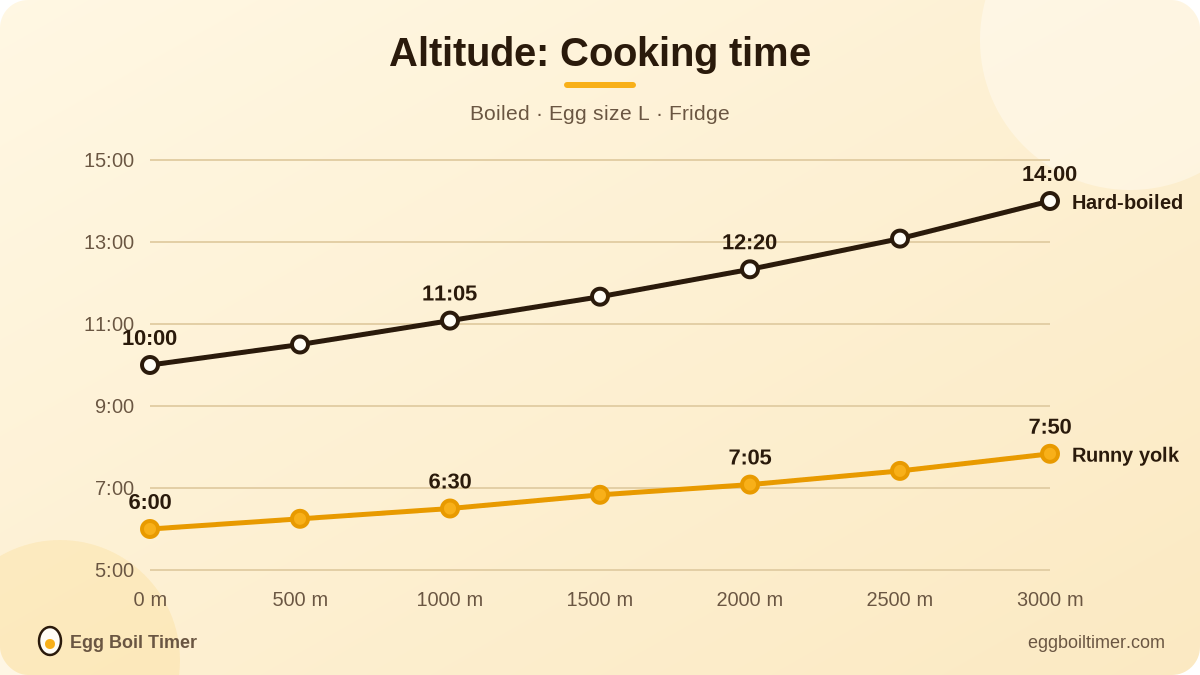
An egg cooks from the outside in, and cooler water pushes heat into it more slowly. The table shows what that does to a large egg taken straight from the fridge and lowered into boiling water. The times come from the same model the timer on this site uses.
| Altitude | Water boils at | Runny yolk | Hard-boiled |
|---|---|---|---|
| 0 m | 100.0 °C | 6:00 | 10:00 |
| 500 m | 98.3 °C | 6:15 | 10:30 |
| 1000 m | 96.7 °C | 6:30 | 11:05 |
| 1500 m | 95.0 °C | 6:50 | 11:40 |
| 2000 m | 93.3 °C | 7:05 | 12:20 |
| 2500 m | 91.7 °C | 7:25 | 13:05 |
| 3000 m | 90.0 °C | 7:50 | 14:00 |

Denver, Mexico City, La Paz: the same egg in nine cities
The effect is small in the foothills and large in the Andes. In La Paz a hard-boiled egg needs about half as long again as at the coast, and a soft egg is difficult, because the white sets slowly too.
| City | Altitude | Water boils at | Runny yolk | Hard-boiled |
|---|---|---|---|---|
| Kathmandu | 1400 m | 95.3 °C | 6:45 | 11:30 |
| Denver | 1609 m | 94.6 °C | 6:55 | 11:50 |
| Johannesburg | 1753 m | 94.2 °C | 7:00 | 12:00 |
| Nairobi | 1795 m | 94.0 °C | 7:00 | 12:05 |
| Mexico City | 2240 m | 92.5 °C | 7:15 | 12:40 |
| Addis Ababa | 2355 m | 92.2 °C | 7:20 | 12:55 |
| Bogotá | 2640 m | 91.2 °C | 7:35 | 13:20 |
| Quito | 2850 m | 90.5 °C | 7:40 | 13:45 |
| La Paz | 3640 m | 87.9 °C | 8:20 | 15:20 |
What to do in a high kitchen
- Do not turn up the heat. Keep a gentle boil and put the lid on between steps so the water stays as hot as it can.
- Add time instead of guessing. Enter the altitude of your town once and the timer adds the extra minutes: Egg Boil Timer.
- Soft eggs need the most care, because seconds matter: Soft Boiled Egg Timer. For a firm yolk for salads and lunch boxes: Hard Boiled Egg Timer.