A traditional spanish omelette, known in Spain as tortilla de patatas, combines sliced potatoes, eggs, olive oil, and sea salt into a thick cake. Slices soften gently in warm olive oil rather than frying crisp. Bound by softly set eggs, the interior stays creamy and tender.
The Architecture of Tortilla Española: Potato, Egg, and Oil Balance
Authentic Spanish tortilla relies on four basic ingredients: potatoes, fresh eggs, olive oil, and salt. Yellow onion remains an enduring regional addition. The ratio dictates slice integrity. A balanced formula uses roughly 600 grams of potatoes, one medium onion (about 150 grams), and six large eggs. Poaching uses 250 milliliters of olive oil. Most of that oil drains away before cooking and can be strained for other meals.
Egg mass provides structural stability. Six large eggs deliver roughly 300 to 330 grams of liquid albumen and yolk solids. This volume fills every gap between potato discs. In Spain, cooks debate whether onion belongs in tortilla at all. Sliced thin and softened alongside the tubers, onion adds natural sweetness and moisture that keeps wedges tender.
Poaching Slices in Olive Oil: Starch Breakdown Without Browning
The decisive cooking phase softens the potatoes without crisping them. French fries rely on high-heat surface browning, but a Spanish tortilla demands pliable potato slices that yield under a fork without developing a leathery crust.
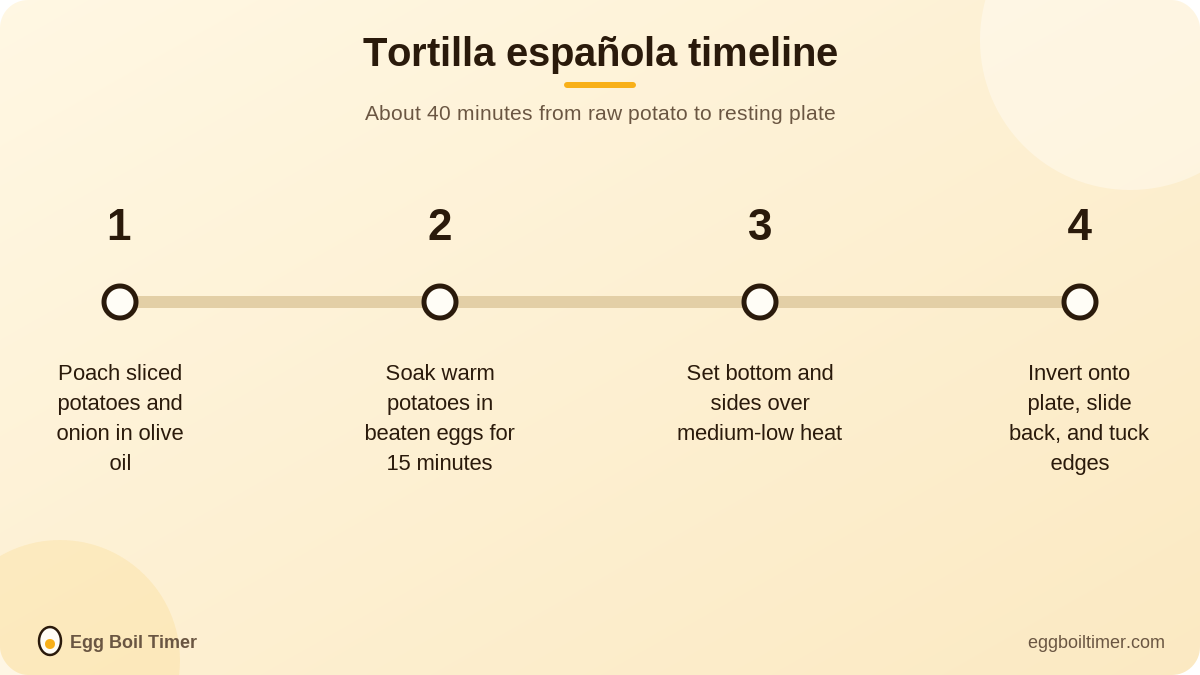
- Peel 600 grams of Yukon Gold or Kennebec potatoes. Cut them in half lengthwise and slice them across into rounds 3 millimeters (1/8 inch) thick. Uniform thickness ensures identical cooking speed.
- Heat 250 milliliters of extra virgin olive oil in a heavy 24-centimeter (9.5-inch) nonstick skillet over medium heat. A test potato slice should sizzle gently without blistering (roughly 140 °C / 285 °F).
- Add the sliced potatoes and thinly sliced onion with one teaspoon of fine sea salt, turning them so every piece gets coated in oil.
- Lower the heat to medium-low. Simmer gently for 20 to 25 minutes, turning occasionally with a flexible spatula. Slices should soften until a fork pierces them effortlessly, showing pale ivory flesh with minimal browning.
- Drain the contents through a heatproof colander set over a bowl. Let the potatoes drain for 5 minutes. Reserve the fragrant cooking oil for other kitchen tasks or homemade Aioli: Traditional Garlic Sauce and Foolproof Method.
The Soaking Stage: Why Warm Starch Must Sit in Beaten Eggs
Pouring hot drained potatoes into raw egg and turning the burner on right away causes premature scrambling. Instead, beat six large eggs in a wide bowl with half a teaspoon of salt until whites and yolks merge. Fold the warm, drained potatoes and onions directly into the beaten eggs while they retain residual heat.
Let this mixture sit undisturbed on the counter for 10 to 15 minutes. This resting window allows the outer starch granules of warm potato slices to absorb raw egg like a sponge. As egg seeps into crevices, starch and proteins form a cohesive slurry. The slices bind into a solid round that holds together during the flip.
Executing the Plate Flip Without Spills or Structural Collapses
The flip is the most intimidating step, but confidence and correct technique eliminate accidents. You need a 24-centimeter nonstick skillet and a flat, rimless plate slightly wider than the rim of the pan.
- Wipe the skillet clean, return it to medium-high heat, and add two teaspoons of reserved olive oil. When the oil shimmers, pour in the soaked egg and potato mixture.
- Shake the pan gently back and forth for 60 seconds. Use a silicone spatula to pull the outer edges inward, letting raw liquid egg run down the sides.
- Lower heat to medium-low. Cook for 3 to 4 minutes until edges firm and the bottom sets pale golden, while the top remains loose.
- Remove the skillet from heat. Place your flat plate face-down over the skillet. Press one hand flat against the center of the plate while gripping the skillet handle firmly.
- In one smooth, decisive motion over your counter, invert the skillet so the tortilla drops cleanly onto the plate.
- Slide the tortilla off the plate back into the skillet, raw side down. Use your spatula to tuck edges under into a rounded cushion shape. Cook for 2 to 3 minutes to set the base.
Internal Heat and Doneness: Creamy Centers versus Firm Wedges
Cooking time determines whether your finished tortilla has a juicy center (jugosa) or a fully set crumb suited for sandwich wedges. For timing other egg textures, our Egg Boil Timer provides exact boiling and poaching benchmarks.
For a runnier center favored across Madrid, cook the second side for barely 90 to 120 seconds over medium heat. The exterior sets while the interior stays custardy. Slide the finished round onto a plate and rest it for 15 minutes to let moisture settle.
When cooking for vulnerable groups under food safety rules, maintain low heat for 3 to 4 minutes on the second side. The center should reach 71 °C (160 °F) on an instant-read thermometer. Resting equalizes heat throughout the potato layers so each wedge cuts cleanly.
Resolving Common Tortilla Defects and Pan Adhesion
A few common variables separate a velvety Spanish omelette from a dry, broken cake. Use this diagnostic table to prevent texture and handling failures.
| Fault | Primary Mechanism | Kitchen Correction |
|---|---|---|
| Omelette sticks during the flip. | Worn nonstick coating or cold oil. | Use a sound nonstick pan and heat oil until shimmering before adding eggs. |
| Egg breaks into dry curds. | Pan heat too high during the initial pour. | Lower heat to medium-low after the first 60 seconds of gentle edge agitation. |
| Potatoes crunchy or hard. | Slices too thick or under-poached. | Keep slices under 3 millimeters and ensure a fork pierces them easily before draining. |
| Greasy or heavy mouthfeel. | Potatoes not drained sufficiently before soaking. | Let cooked potatoes drain in a wire colander for a full 5 minutes before mixing. |
| Liquid spills during flip. | Plate smaller than skillet rim or hesitation during turn. | Use a flat plate wider than the pan diameter and invert in one swift movement. |
Serving Temperatures, Tapas Pairings, and Chilled Storage
Unlike French rolled omelettes served scorching hot, tortilla española tastes best warm or at room temperature after resting for 20 to 30 minutes. Slices reveal a cleaner profile once starches stabilize. In Spanish bars, tortilla is served at any hour: skewered into pinchos with olives, stuffed into baguettes, or plated with garlic mayonnaise.
Store leftover slices wrapped tightly in parchment or an airtight container in the refrigerator for up to 3 days. Avoid reheating tortilla in a microwave, which turns egg rubbery and separates oil. Instead, bring wedges to room temperature for 30 minutes, or warm them gently in a dry skillet over low heat.
Tortilla Española Compared with Italian Frittata and French Omelette
While eggs anchor skillet dishes across the Mediterranean, technique defines distinct styles. Our Egg Recipes: Breakfast, Lunch, and Dinner Ideas guide showcases these traditions side by side.
| Dish | Dominant Cook Method | Stirring and Agitation | Core Texture Profile |
|---|---|---|---|
| Spanish Omelette (Tortilla). | Stovetop poach, soak, then skillet flip. | Minimal agitation; edges tucked into rounded disc. | Dense, custard-like, potato-forward, thick slice. |
| Italian Frittata Recipe: The Italian Skillet Method and Fillings. | Stovetop sear, finished under oven broiler. | Eggs stirred into fillings, then baked uncovered. | Fluffy, browned top, aerated crumb with mixed fillings. |
| French Rolled Omelette. | Rapid stovetop swirling in foaming butter. | Continuous high-speed whisking until just curded. | Silky, unbrowned exterior with soft liquid center. |
To pace stove heat and coagulation times for skillet dishes, use our Omelette Timer: Exact Cooking Times and Fold Guide for precise countdowns.


