To learn how to make Korean baked eggs (Maekbanseok Gyeran), bake room-temperature eggs in a covered Dutch oven at 140 °C (285 °F) for 2.5 hours over a damp towel with 240 ml of water. Trapped humidity and low, prolonged heat induce a Maillard reaction inside the shell, producing springy, amber whites and roasted, nutty yolks. You can compare standard egg cooking times on our Egg Boil Timer">egg boil timer.
Sauna Heat and Elvan Stones: Cultural Origins of Maekbanseok Gyeran
Korean baked eggs originated in public saunas (jjimjilbang), where bathhouse operators laid raw shell eggs on heated elvan stone slabs (maekbanseok). Ambient radiant heat baked the eggs over several hours while guests relaxed. Visitors traditionally cracked the warm, brown-shelled eggs on their heads and ate them alongside sikhye, a chilled sweet rice beverage.
Unlike quick water baths used in standard Egg Recipes: Breakfast, Lunch, and Dinner Ideas">egg recipes bbc, extended heat alters the physical properties of the albumen and yolk. The white transforms from a fragile gel into a dense, chewy structure. The yolk loses its sulfurous aroma and develops a mild, toasted profile similar to roasted nuts.
How to Make Korean Baked Eggs in a Home Dutch Oven
Recreating authentic sauna eggs at home requires humidity. Plain dry baking in an open pan dehydrates shell contents and toughens the exterior. Wrapping the bottom of a heavy pot with a damp towel creates a humid microclimate that shields the shells while the internal temperature rises steadily.
Standard baking sets whites in 30 minutes, as detailed in our guide to Oven Hard-Boiled Eggs: Exact Times at 160 °C">eggs in the oven. Achieving deep amber Korean spa eggs requires a low-and-slow steam-bake routine:
- Warm the shells: Set 6 large eggs on the counter for 2 hours before cooking. Cold eggs placed directly into a warm oven develop hairline shell fractures.
- Line the pot: Preheat the oven to 140 °C (285 °F). Fold a cotton kitchen towel to fit the base of a heavy Dutch oven.
- Add water and salt: Pour 240 ml of tap water and 1 teaspoon of table salt over the towel. Moisture keeps heat transfer uniform, and the cloth stops shells from rattling against metal.
- Arrange the eggs: Place the room-temperature eggs in a single layer on top of the damp towel. Close the pot with a tight-fitting lid.
- Bake for 150 minutes: Position the covered pot on the middle rack. Bake for 2 hours and 30 minutes without lifting the lid, preserving trapped steam.
- Cool in cold water: Transfer the eggs to a bowl of ice water for 10 minutes. Tap each shell against the counter to loosen the membrane, then peel under running water.
Why Egg Whites Brown in the Shell Without Seasoning
The mahogany tint inside a Korean baked egg is not caused by liquid marinades, tea leaves, or food dyes. The color change results entirely from the Maillard reaction inside the intact shell. A single large chicken egg supplies about 6.3 grams of protein alongside trace glucose naturally present in the white.
Sustained thermal energy between 120 °C and 150 °C causes amino acids in the albumen to bond with reducing sugars. This reaction creates aromatic pyrazine and furan compounds identical to those found in coffee roasts and toasted bread crusts. Egg albumen coagulates at 80 °C, so holding the protein network past this mark for several hours tightens the gel matrix, creating its signature elastic bite.
Because heat penetrates slowly, hydrogen sulfide gas escapes gradually through microscopic shell pores rather than collecting around the yolk. This prevents the dark green ring and pungent odor typical of overboiled eggs, replacing it with a clean, nutty scent.
Pressure Cooker, Slow Cooker, and Oven Times Compared
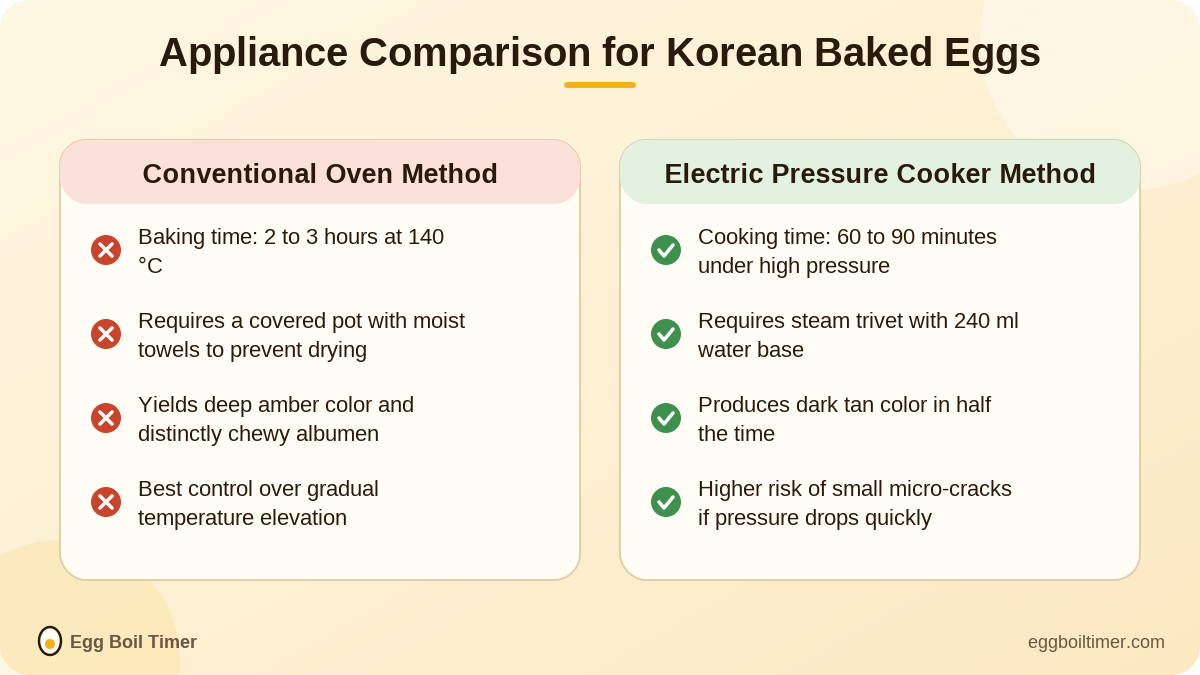
Baking in a conventional oven takes 2.5 hours, but alternative kitchen tools yield comparable textures on different schedules. The table below outlines how heat application affects cooking times, moisture retention, shell failure rates, and browning depth.
| Appliance & Method | Total Cooking Time | Browning Depth | Primary Shell Stress Risk | Humidity Requirement |
|---|---|---|---|---|
| Dutch Oven (140 °C) | 2 hours 30 minutes | Deep amber white | Scorched towel if water evaporates | 240 ml water in folded towel |
| Electric Pressure Cooker | 60 to 90 minutes | Dark tan white | Micro-cracks from rapid venting | 240 ml water under trivet |
| Slow Cooker (Low setting) | 5 to 6 hours | Light tan white | Uneven heat along pot sides | Damp towel base with 180 ml water |
For an Instant Pot or electric pressure cooker, pour 240 ml of water into the inner pot, set 6 eggs on a steam rack, and select High Pressure for 60 to 90 minutes. High steam pressure forces heat rapidly through the shell, darkening the albumen in half the time required by an oven. Always allow a natural pressure release for 15 minutes before opening the valve to prevent shells from bursting.
Slow cookers offer a gentle option for overnight cooking. Line the slow cooker with a damp cloth, add 180 ml of warm water, arrange the room-temperature eggs, and cook on Low for 5 to 6 hours. The white becomes pale tan with a slightly softer chew than the oven method.
Troubleshooting Shell Fractures and Rubbery Albumen
Baking eggs for hours can occasionally produce unintended defects like cracked shells, pale whites, or tough, rubbery textures. Understanding the cause behind each issue helps preserve both appearance and texture.
Cracked shells stem almost exclusively from thermal shock or physical vibration. Placing cold eggs directly into a heated vessel causes air inside the egg's air cell to expand faster than the shell can flex. Rest raw eggs on the counter for 2 hours to match room temperature, and always place a folded cloth beneath them to dampen contact with hot metal.
If your eggs remain pale after 2 hours in the oven, ambient humidity was likely too low or the temperature dropped below 130 °C. Ensure your oven holds a steady 140 °C and keep the Dutch oven lid sealed tight throughout the bake. Conversely, a rubbery white indicates excessive baking temperatures above 160 °C, which desiccate the protein matrix rather than allowing slow browning.
Serving Methods, Dipping Salts, and Safe Storage Limits
Korean spa eggs are traditionally served warm with a dipping mixture of fine sea salt and toasted sesame seeds. Their smooth, non-sticky white makes them a convenient snack for travel, work lunches, or athletic recovery. Sliced baked eggs also add a rich, roasted element when served alongside pan dishes like Shakshuka: Eggs Poached in Spiced Tomato Sauce">shakshuka or arranged on a platter of Classic Deviled Eggs Recipe: Creamy Filling and Easy Peeling">deviled eggs.
Even after extended thermal processing, cooked eggshells remain porous to air and bacteria. Official USDA guidelines mandate that cooked egg dishes be cooled promptly and refrigerated at or below 4 °C (40 °F). Store peeled or unpeeled eggs in an airtight container for up to 3 to 4 days for optimal taste and food safety.


