Anda Poli is an Indian skillet flatbread made by cooking whisked eggs directly onto whole wheat bread in hot ghee. The liquid egg seeps into the porous bread surface as it cooks, binding chilies, onions, and coriander to a crispy crust in under ten minutes. You can use fresh whole wheat dough discs or day-old chapatis. Explore our collection of Egg Recipes: Breakfast, Lunch, and Dinner Ideas">egg recipes for more skillet breakfasts from around the world.
What Is Anda Poli? Western India's Egg Chapati
In Maharashtra and across western India, poli means flatbread cooked on a flat cast-iron griddle (tawa). Layered with spiced whisked eggs, it becomes Anda Poli, known in northern regions as Anda Paratha. Rather than tucking a pre-cooked omelette inside a wrap, this skillet technique cooks liquid egg and wheat flatbread together in a single pan.
The characteristic texture relies on rapid egg protein coagulation. Heat transfers through the pan floor, causing albumen proteins to grip the wheat starches before liquid leaks out. A single large egg supplies roughly 6.3 grams of protein along with essential micronutrients, turning simple flatbread into a sustained meal. Similar to street-style How to Make and Buy Egg Wraps: A Complete Low-Carb Guide">egg wrap variations, Anda Poli serves as a quick breakfast or portable lunchbox dish.
Cast-iron tawas provide steady thermal mass that prevents localized burning. Carbon steel pans work similarly well if seasoned thoroughly. Thin non-stick skillets release eggs effortlessly, but they lack the heavy heat storage needed to blister whole wheat dough quickly while setting thick liquid egg layers underneath.
Egg, Spice, and Flour Ratios for a Stable Egg Layer
Moisture balance determines whether the flatbread turns crisp or turns soggy. Excess liquid from watery vegetables breaks the egg bond during flipping.
- Fresh eggs: 2 large eggs (50 to 55 grams each) per 20 cm flatbread ensure full edge-to-edge coverage without pooling over pan edges.
- Flatbread base: 1 whole wheat dough disc (atta) or 1 precooked chapati. Dry leftover chapatis grab liquid egg faster than wet raw dough.
- Aromatics: 2 tablespoons finely minced red onion and 1 green chili, chopped small so sharp edges do not tear the setting egg sheet.
- Herbs and spices: 1 tablespoon chopped fresh coriander, 1/4 teaspoon red chili powder, 1/4 teaspoon ground turmeric, 1/4 teaspoon roasted cumin powder, and 1/2 teaspoon fine salt.
- Cooking fat: 1 tablespoon ghee or neutral vegetable oil. Ghee crisps the exterior while adding a rich, nutty aroma.
Salting the raw egg mixture right before pouring prevents liquid weeping. If salt sits in beaten eggs for longer than ten minutes, it breaks down delicate protein structures, causing moisture to pool during searing.
Pan Step-by-Step: Fusing Liquid Egg to Wheat Bread
This sequence anchors raw egg to flatbread before proteins set hard in the skillet.
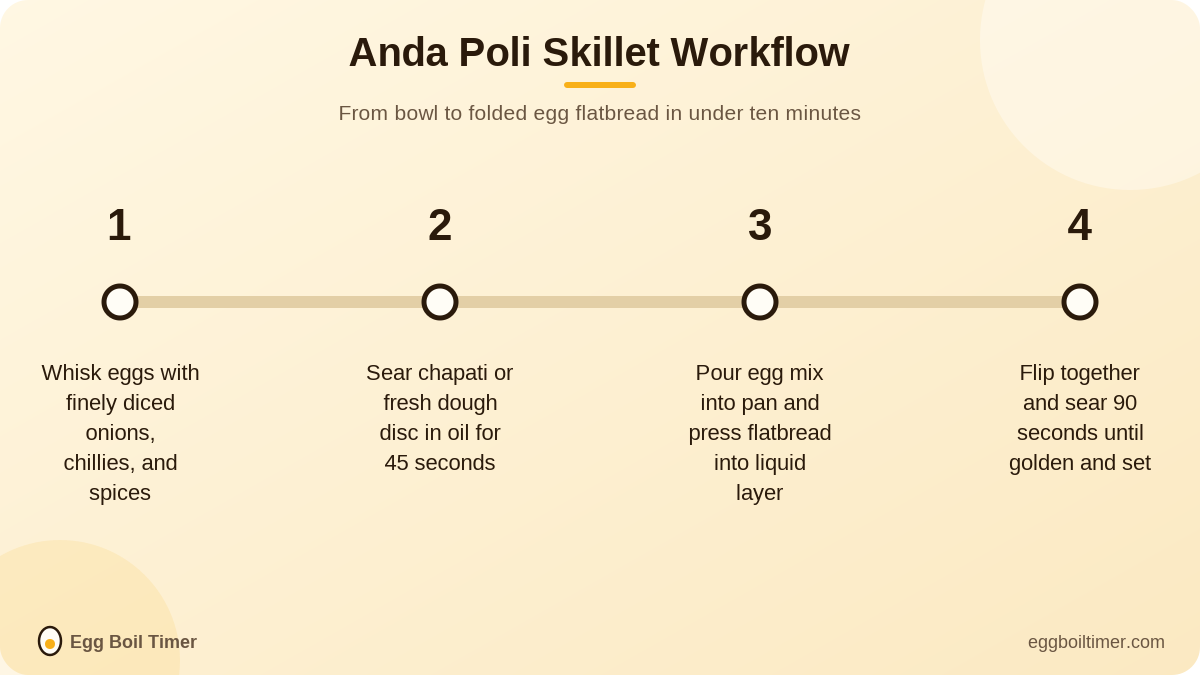
- Whisk the egg base: Crack 2 eggs into a wide bowl. Add minced onion, green chili, coriander, chili powder, turmeric, cumin, and salt. Whisk with a fork for 45 seconds to blend white and yolk completely while trapping micro air bubbles.
- Heat the skillet: Set a cast-iron skillet or tawa over medium heat until it reaches roughly 175 °C. Coat the pan floor with half a tablespoon of ghee.
- Warm the flatbread: Lay the flatbread disc in the skillet. Cook raw dough for 45 seconds per side until light pale bubbles form. For day-old chapatis, warm 20 seconds per side until pliable, then set aside on a plate.
- Combine in the pan: Pour the whisked egg mixture into the center of the skillet. Place the flatbread directly onto the raw liquid pool. Press down firmly with a wide spatula for 10 seconds so egg spreads evenly to the outer bread edges.
- Sear the base: Cook undisturbed for 90 seconds over medium-low heat until the egg underside sets completely. Drizzle remaining ghee along the pan rim.
- Flip and crisp: Slide your spatula fully under the egg layer and flip flatbread and egg together in one fluid motion. Sear the bread side for 60 to 90 seconds until deep golden brown. Transfer to a cutting board, roll tightly, and slice diagonally.
Coagulation and Heat Control on the Tawa
Egg proteins coagulate in distinct temperature bands. Albumen in egg whites begins solidifying between 60 °C and 65 °C, while yolk proteins thicken between 65 °C and 70 °C. Because whisked egg spreads into a thin layer across the skillet, total cooking time requires under three minutes.
High flame scorches ground turmeric and chili powder before raw onion bits soften. Maintaining medium-low burner heat allows flatbread to crisp while the egg layer cooks into a tender matrix. Use our main Egg Boil Timer">egg timer tools to calibrate cooking times across various breakfast preparations. Precise heat control keeps stuffed pan recipes like Indonesian Martabak Telur Recipe: Crispy Indonesian Egg Pancake">martabak, Iranian Kuku Sabzi: Traditional Persian Herb Frittata Recipe">kuku sabzi, and Turkish skillet Menemen Recipe: Turkish Scrambled Eggs with Tomatoes">menemen from scorching on heavy griddles.
Pan Troubleshooting: Soggy Bread, Burnt Spices, Loose Egg
Skillet heat and vegetable moisture explain most issues with egg-bound flatbreads. Use this guide to correct common pan errors.
| Symptom | Root Cause | Corrective Action |
|---|---|---|
| Egg separates from bread | Bread was cold or greasy when placed over liquid egg | Press warm flatbread into raw egg liquid within 5 seconds of pouring. |
| Flatbread turns rubbery or soggy | Onions released water; skillet heat was too low | Salt onions right before cooking; keep skillet at steady 175 °C heat. |
| Spices taste bitter or burnt | Pan surface exceeded 200 °C before pouring eggs | Lower flame and melt ghee to buffer ground spices against heat. |
| Egg remains raw under bread center | Egg mixture pooled thick in middle of pan floor | Tilt skillet gently to spread raw egg into a thin, uniform disc. |
| Flatbread tears during flip | Egg layer was partially raw when flipped | Wait until egg edges lift cleanly from pan sides before sliding spatula. |
Cheese, Extra Greens, and Street-Style Variations
Anda Poli accepts additional fillings as long as ingredient moisture stays balanced. Vegetable heavy additions require pre-sautéing to prevent steam pockets from loosening the egg seal.
| Variation | Key Modification | Best Accompaniment |
|---|---|---|
| Cheesy Anda Poli | Grate 30g processed cheese over setting egg before folding | Garlic chutney or spiced tomato dip |
| High-Veggie Paratha | Add finely shredded carrots and spinach to egg wash | Mint-coriander yogurt raita |
| Street-Style Roll | Top egg side with sliced raw onions, chaat masala, and lemon juice | Tamarind chutney and hot masala chai |
| Egg White Poli | Swap 2 whole eggs for 3 egg whites and coarse black pepper | Cucumber raita or green salsa |
Much like an oven-baked Frittata Recipe: The Italian Skillet Method and Fillings">frittata or a baked Shakshuka: Eggs Poached in Spiced Tomato Sauce">shakshuka base, Anda Poli adapts to leftover roasted vegetables or sharp cheeses without losing structural integrity.
Refrigeration Limits and Skillet Crisping for Leftovers
Cool leftover Anda Poli at room temperature for no longer than 30 minutes to stop steam from softening the crust inside storage containers. Refrigerate cooked egg flatbreads at or below 4 °C within two hours to inhibit bacterial growth.
Store cooled wraps wrapped tightly in parchment paper inside airtight containers for up to 48 hours. Avoid microwave reheating, which turns whole wheat crusts rubbery and tough. Instead, re-crisp leftovers in a skillet over medium heat with half a teaspoon of ghee for 60 seconds per side until internal temperatures reach 74 °C (165 °F). This restores outer crunch while heating the inner egg layer safely. This is general information, not medical advice.


