Most people boil eggs because that is how they were taught. But you do not need a full pot of bubbling water to cook an egg in its shell. Steam does the same job with a fraction of the water, it is gentler on the shells, and many cooks find that steamed eggs peel more cleanly than boiled ones.
Why steam works
Steam from boiling water is close to 100 °C, the same as the water itself, so the egg heats at nearly the same speed. The difference is what happens when the eggs go in. A pot of water drops in temperature as soon as cold eggs are added and needs time to come back to the boil. A small amount of water under a lid recovers almost at once, so the timing stays more predictable, and the eggs never knock against each other in rolling water.
How to steam eggs
- Bring 2 to 3 cm (about an inch) of water to a boil in a pan with a lid. A steamer basket helps, but the eggs can also sit directly in the shallow water.
- Add the eggs straight from the fridge, in one layer, and put the lid on at once.
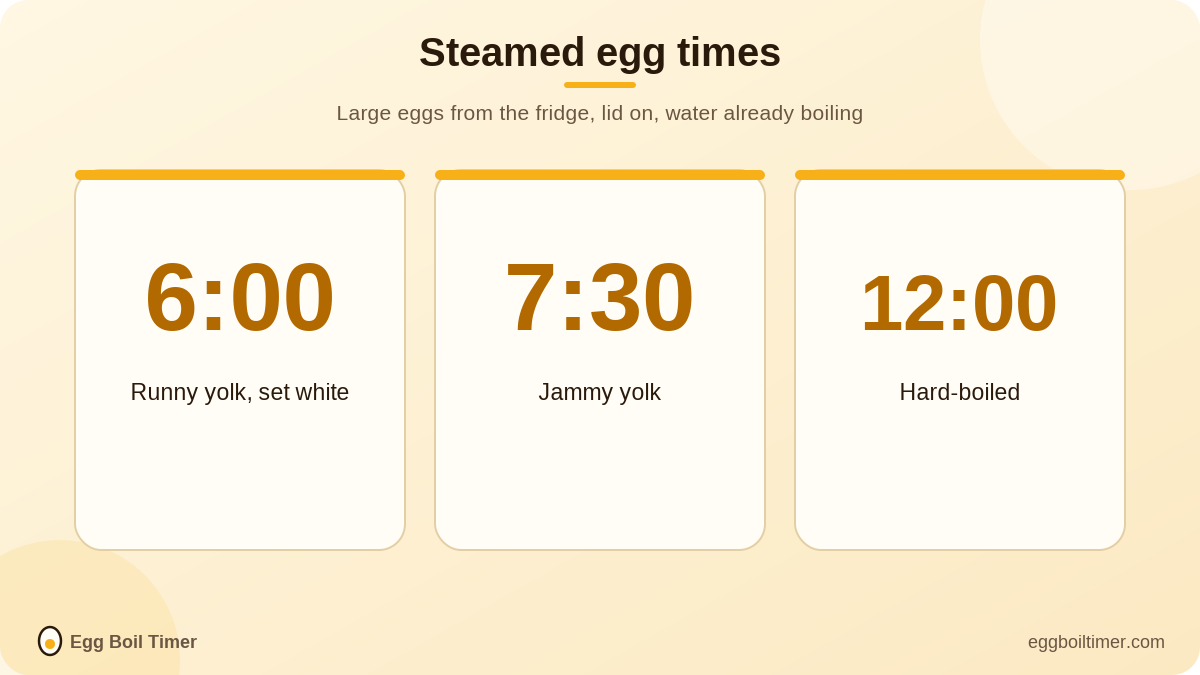
- Start the timer now. About 6 minutes gives a runny yolk with a set white, 7 to 8 minutes a jammy yolk, and 12 minutes a fully firm one. The timer at the top of this page is set for steaming and adjusts for egg size and altitude.
- Move the eggs into ice water as soon as the time is up, and leave them for a few minutes before peeling. Why the cold bath matters: Ice Bath or Cold Tap? What Cooling Really Does to a Boiled Egg.
Why steamed eggs peel easily
The white of an egg that meets high heat straight away sets quickly and lets go of the membrane under the shell. Steaming gives the egg that hot start without the jolt of cold water around it, and fewer shells crack. Very fresh eggs are still harder to peel than week-old ones, whatever the method: Fresh Eggs Are the Worst Eggs to Boil. Here Is Why. For the peeling itself, see How to Peel a Boiled Egg in Ten Seconds (and Why the Spoon Trick Works).
Steamer, pot or pressure cooker?
A covered pan with a little water is the simplest steamer there is. A pressure cooker steams eggs too, only at higher temperature, which is why its times are shorter: The Instant Pot 5-5-5 Egg Rule, and When It Lets You Down. If you prefer the classic way, the Soft Boiled Egg Timer and the Hard Boiled Egg Timer give boiling times, and the Egg Boil Timer covers every method.