Oeufs en meurette is a Burgundian dish featuring poached eggs bathed in a glossy sauce of reduced dry red wine, smoked pork lardons, mushrooms, pearl onions, and beef stock. Served over garlic-rubbed toasted country loaf, the plate contrasts sharp wine acidity and crisp bread against a warm, fluid egg yolk.
The Burgundian Architecture of Sauce Meurette
Sauce meurette originated in Burgundy wine country as an efficient tavern method to stretch day-old bread and opened bottles of local red wine into a substantial meal. The recipe evolved directly from matelote, a traditional freshwater fish stew cooked in red wine along the Saône river. When river fish was scarce, home cooks substituted fresh poultry eggs, poaching them in the bubbling wine stew.
While Classic Eggs Benedict Recipe: Poached Eggs and Silky Hollandaise and Eggs Florentine Recipe: Poached Eggs, Spinach & Hollandaise depend on warm butter emulsions like hollandaise, meurette relies on concentrated grape acidity and dissolved gelatin from stock to provide viscosity. The acidity cuts through rich egg yolk lipids, cleansing the palate between bites.
The finished dish functions through distinct structural layers. Crusty sourdough forms the base, toasted dry and rubbed with raw garlic so it absorbs sauce without collapsing into paste. Above the bread sit browned garnishes: crisp pork lardons, caramelized mushrooms, and tender pearl onions. A poached egg crowns the garnishes, releasing its yolk into the dark sauce at the first touch of a fork.
Cooks frequently debate whether eggs should be poached in water or directly in the simmering wine broth. Poaching in wine stains the egg whites deep violet and perfumes the albumen with fruit acid. However, grape tannins coagulate loose proteins into dark, ragged flecks that cling to the white. Poaching in acidified water produces a smooth white that creates an appetizing visual contrast against the dark purple sauce.
Pantry Measures and Ratios for Four Servings
Assembling the reduction and garnishes calls for dry red wine with assertive acidity, clean animal fat, and fresh poultry eggs.
- Eggs: 4 to 8 fresh large chicken eggs, roughly 55 g each in shell.
- Red wine: 750 ml dry, high-acid red wine such as Burgundy Pinot Noir or Beaujolais Gamay.
- Stock: 400 ml gelatinous unsalted beef stock or dark veal stock.
- Pork: 150 g slab bacon or salted pork belly, sliced into 6 mm matchsticks.
- Mushrooms: 200 g small button or cremini mushrooms, trimmed and quartered.
- Onions: 120 g pearl onions, peeled and trimmed.
- Aromatics: 2 shallots (finely diced), 2 garlic cloves (crushed), 1 bay leaf, and 3 fresh thyme sprigs.
- Thickener: 15 g room-temperature butter kneaded with 15 g plain flour (beurre manié), plus 15 g chilled butter cubes for finishing.
- Bread: 4 thick slices rustic country sourdough loaf.
- Poaching bath: 2 liters water paired with 30 ml distilled white vinegar.
Simmering the Meurette Reduction: Bacon, Aromatics, and Wine
Coordinating the sauce components guarantees that the wine reduction, garnishes, and warm eggs arrive at the plate at peak temperature.
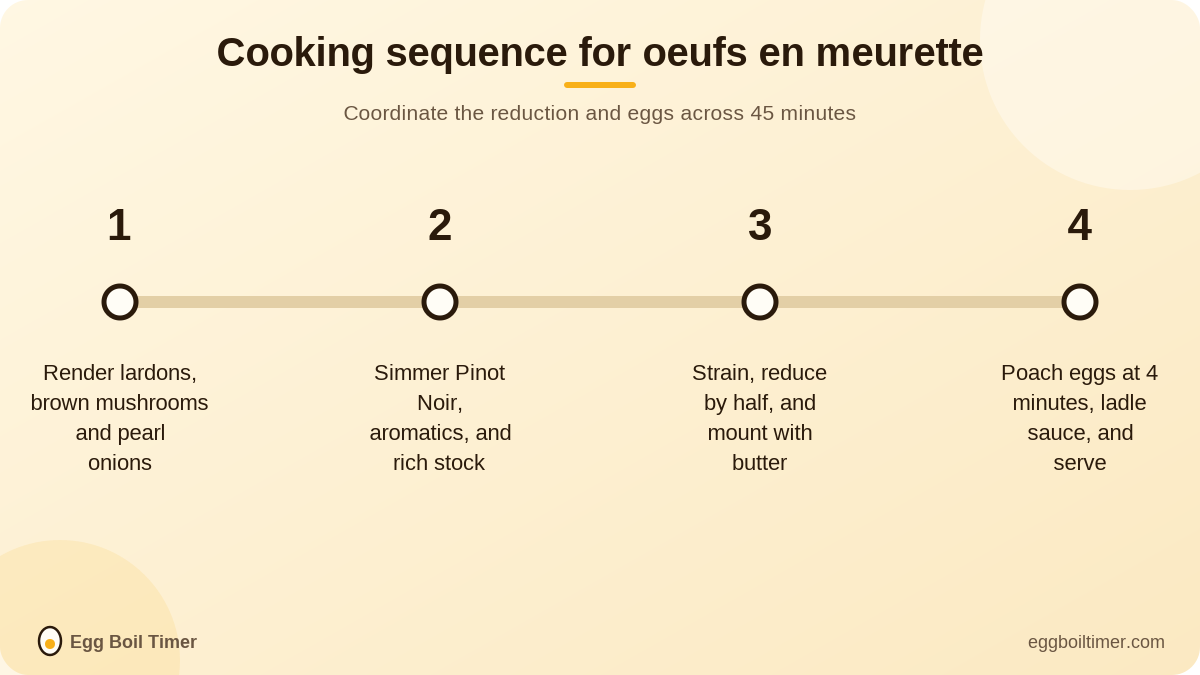
- Render the lardons: Add the bacon matchsticks to a wide saucepan with 15 ml water over medium heat. Simmer until the water boils away and the pork releases its fat, browning crisp in 8 to 10 minutes. Scoop out the crisp lardons with a slotted spoon, keeping the liquid fat hot in the pan.
- Sear the mushrooms and onions: Raise the burner to medium-high. Add the quartered mushrooms and pearl onions to the rendered bacon fat. Leave them untouched for 3 minutes to take on dark golden color, shake the pan for another 3 minutes until tender, and remove them to the plate holding the lardons.
- Soften the shallots: Drop the minced shallots and crushed garlic into the hot pan fat. Cook over gentle heat for 2 minutes until soft and clear, avoiding any scorch marks that would turn the sauce bitter.
- Boil down the wine: Pour in the 750 ml bottle of red wine, scraping the pan floor to lift the browned meat drippings. Add thyme and the bay leaf. Bring to a rolling boil, then adjust to an active simmer until the wine shrinks by half, taking about 18 to 22 minutes.
- Add stock and concentrate: Pour in the beef stock and continue simmering briskly until the volume reduces by another third, leaving approximately 320 ml of deep purple liquid.
- Mount the sauce: Strain out the spent herbs and garlic. Whisk the kneaded flour-and-butter paste into the bubbling liquid in small pinches. Simmer for 2 minutes to cook out raw flour starch. Turn off the heat entirely and whisk in the remaining 15 g of cold butter cubes until the sauce turns mirror-glossy. Return the browned bacon, mushrooms, and onions to the pan to warm through.
The reduction relies on natural collagen to build body. As wine simmers, its water content evaporates, concentrating tartaric and malic acids. Unsalted beef stock provides the gelatin needed to round out that sharpness. If using store-bought stock that lacks natural gelatin, sprinkle 5 g of unflavored powdered gelatin over cold stock before adding it to the pan. This step recreates the velvety mouthfeel of traditional veal demi-glace.
Precise Egg Poaching and Liquid Control
A successful plate demands a firmly coagulated white that holds its structure while encasing a liquid yolk. The timer tool above is calibrated for a medium-poached egg. In our cooking model, a 55 g fridge-cold egg cooked in simmering water at sea level requires 4 minutes (240 seconds) to hit an internal yolk target of 67 °C.
Heat 2 liters of water in a deep pot until boiling, then lower the heat until small bubbles rise quietly from the base at 90 to 95 °C. Stir in 30 ml of white vinegar. The acid accelerates ovotransferrin and ovalbumin coagulation on contact, preventing loose tendrils. Do not add salt to poaching water. Salt decreases water surface tension and causes the outer white to disperse into ragged foam.
Crack each egg first into a fine-mesh strainer over a cup. Swirling the strainer drains off the thin outer albumen that creates wisps in the pot. Tip the egg into a small ramekin, swirl the hot water into a gentle vortex, and drop the egg directly into the center. Cook for 4 minutes. Lift the egg out with a slotted spoon and set it on folded kitchen paper to blot excess water, preventing liquid from diluting the red wine reduction.
Egg mass alters heat conduction through the white to the yolk center. Larger eggs require additional seconds in the water to set the outer albumen while keeping the yolk fluid.
| Egg Size Classification. | Average Shell Weight. | Target Yolk Consistency. | Simmering Poach Duration. |
|---|---|---|---|
| Small (S). | 45 grams. | Warm fluid yolk (67 °C). | 3 minutes 30 seconds. |
| Medium (M). | 50 grams. | Warm fluid yolk (67 °C). | 3 minutes 45 seconds. |
| Large (L, default). | 55 grams. | Warm fluid yolk (67 °C). | 4 minutes 00 seconds. |
| Extra Large (XL). | 60 grams. | Warm fluid yolk (67 °C). | 4 minutes 15 seconds. |
For alternative timing profiles across different heat methods, visit Poached Egg Timer: Exact Water Times and Pro Technique or review morning preparations in Egg Recipes: Breakfast, Lunch, and Dinner Ideas. You can also explore soft-boiled variations directly on our Egg Boil Timer timer.
Wine Selection Matrix for Sauce Meurette
As red wine boils down, its sugar, water, and tannins undergo heavy physical concentration. Bottlings with high oak contact or harsh grape tannins turn astringent and metallic when simmered to a glaze.
| Wine Varietal. | Flavor Profile in Reduction. | Acidity Level. | Suitability Rank. |
|---|---|---|---|
| Burgundy Pinot Noir. | Earthy red cherry, light spice, mild tannin. | High. | Authentic standard (Best). |
| Beaujolais (Gamay). | Bright tart raspberry, soft grip, clean finish. | High. | Top alternative (Great value). |
| Côtes du Rhône (Grenache blend). | Dark plum, peppery bite, and medium weight. | Medium. | Warming and hearty (Acceptable). |
| Cabernet Sauvignon. | Harsh wood tannins, sharp bitterness. | Low to Medium. | Unsuitable (Avoid). |
Solving Texture and Flavor Imbalances
Balancing wine acid, gelatin thickness, and soft egg cookery requires simple adjustments if heat or timing drifts.
| Observed Issue. | Probable Root Cause. | Direct Kitchen Solution. |
|---|---|---|
| Sauce tastes sour or acrid. | Wine boiled down too fast without enough stock to balance the acid. | Whisk in 30 ml rich stock or beat in an extra 10 g cold butter off the flame. |
| Sauce runs thin on the plate. | Liquid was not reduced enough or lacked starch binding. | Simmer for 4 additional minutes or whisk in half a teaspoon of beurre manié. |
| Egg whites feather into water. | Water was boiling too violently or the egg contained watery old white. | Reduce heat to 92 °C and strain watery albumen through a fine sieve before poaching. |
| Toast turns wet immediately. | Slices were cut thin or eggs went onto the bread straight from the pot. | Cut bread 2 cm thick, toast until dehydrated, and blot poached eggs on paper towels. |
Assembly Logistics and Make-Ahead Planning
Toast sourdough slices until stiff and deep brown across both sides. Rub the rough crust with a cut clove of garlic. The coarse surface of dry-toasted bread behaves like a microplane grater, rasping the raw garlic into a fine aromatic paste without unpleasant chunks.
Alternatively, fry the bread slices in clarified butter in a cast-iron skillet over medium heat. Clarified butter crisps the exterior crumb into a golden crust that resists liquid penetration even longer than oven toasting.
Place each prepared slice in the bottom of a shallow, warmed bowl. Spoon the warm bacon, mushroom, and onion mixture over the toast. Place one or two warm, blotted poached eggs on top of the garnish. Ladle the glossy reduction sauce evenly over the whites, letting excess sauce puddle into the rim of the bowl. Finish with cracked black pepper and fresh minced flat-leaf parsley.
The entire sauce, along with the bacon, mushrooms, and onions, can be cooked up to 48 hours ahead and refrigerated in a sealed glass dish. Reheat slowly over low heat, whisking in a spoonful of water or stock if the gelatin tightens the sauce too far.
You can also poach eggs up to 2 hours ahead for dinner guests. Cook them for 3 minutes and 30 seconds. Transfer immediately into a bowl of ice water to halt residual cooking, and leave them submerged. Right before serving, lower the chilled eggs into steaming 80 °C water for 60 seconds to reheat the exterior without setting the yolk.


