Authentic Roman carbonara achieves its velvet gloss without a single drop of cream. The rich sauce emerges from a rapid mechanical emulsion of warm rendered pork fat, finely grated sheep cheese, starchy pasta water, and raw eggs. Cooking happens entirely off direct flame, using the residual thermal mass of bronze-cut spaghetti to thicken the yolks without curdling them.
The Roman Balance: Why Real Carbonara Rejects Cream
Adding heavy cream to carbonara masks the savory depth of cured pork and sharp sheep milk cheese. Traditional Roman cooking relies on a handful of rustic pantry items, balancing rich animal fat against the spicy bite of cracked peppercorns. Cream blunts these sharp edges, turning a punchy working-class dinner into a heavy soup.
The glossy texture that many cooks mistake for heavy dairy is actually a fluid suspension. Egg yolks contain lecithin, an effective natural emulsifier that binds rendered pork fat with cooking water. When suspended starch granules from the pasta water enter this mixture, they coat the fat droplets and prevent separation. Heavy cream floods the skillet with excess water and dairy butterfat. This excess liquid disrupts the delicate egg matrix, leaving the noodles greasy rather than coated.
Mastering this balance requires zero culinary shortcuts. Just as preparing delicate poached eggs for Classic Eggs Benedict Recipe: Poached Eggs and Silky Hollandaise requires managing water heat, carbonara demands respect for gentle thermal transfer. Heat the yolks too much and they curdle into scrambled curds. Keep them too cold and the sauce remains watery and raw. The ideal thermal window sits between 62 °C and 68 °C (144 °F to 154 °F). In this narrow range, egg proteins unravel and bind liquid without seizing.
The Roman Pasta Quartet: Carbonara in Culinary Context
Roman pasta cooking follows a strict genealogical tree built on four core ingredients: pasta, Pecorino Romano, black pepper, and cured pork jowl. Understanding where carbonara sits among its sister dishes clarifies why outside additions like cream, garlic, or butter alter its fundamental identity.
| Pasta Dish. | Pork Component. | Cheese Type. | Sauce Base and Defining Additions. |
|---|---|---|---|
| Cacio e Pepe. | None. | Pecorino Romano. | Toasted black pepper and high-starch pasta cooking water. |
| Pasta alla Gricia. | Guanciale. | Pecorino Romano. | Rendered pork fat emulsified with starchy pasta water. |
| Amatriciana. | Guanciale. | Pecorino Romano. | Pork fat simmered with peeled San Marzano tomatoes and chili. |
| Carbonara. | Guanciale. | Pecorino Romano. | Rich egg yolks, whole egg, rendered fat, and coarse pepper. |
Pasta alla gricia represents the direct ancestor of carbonara. When Roman cooks added eggs to gricia in the mid-twentieth century, they created carbonara. When they added tomatoes to gricia, they created amatriciana. Because carbonara is essentially gricia enriched with raw egg, introducing cream completely breaks this historical continuum.

Pork, Cheese, and Egg Selection: Traditional Ratios and Practical Swaps
Four primary components dictate the flavor profile of carbonara: cured pork, grated cheese, eggs, and freshly cracked black pepper. The authentic Roman recipe demands guanciale, an unsmoked cured pork jowl packed with savory herbs and luxurious fat. If specialty Italian salumi is unavailable at your local butcher, precise substitutions preserve the structural integrity of the sauce.
| Element. | Traditional Roman Standard. | Practical Supermarket Alternative. | Culinary Impact on the Dish. |
|---|---|---|---|
| Cured Pork. | Guanciale (cured pork jowl). | Unsmoked thick-cut pancetta or slab bacon. | Pancetta yields clean pork flavor; smoked bacon adds wood notes alien to Rome. |
| Aged Cheese. | Pecorino Romano DOP (100%). | 50/50 blend of Pecorino Romano and Parmigiano Reggiano. | Cuts aggressive salt and sheep sharpness with sweet, nutty cow milk notes. |
| Egg Ratio. | 1 whole egg plus 3 large yolks (for 2 portions). | Equal whole eggs to yolk count. | Extra yolks contribute pure lecithin, deep golden color, and thick velvet body. |
| Pasta Cut. | Spaghetti or Rigatoni (bronze-extruded). | Standard long spaghetti or bucatini. | Rough bronze die ridges shed essential starch directly into the boiling water. |
When selecting your cheese, avoid pre-shredded varieties sold in plastic tubs. Commercial bagged cheeses contain cellulose powders and potato starch to prevent clumping on store shelves. These anti-caking agents ruin carbonara by absorbing moisture unevenly, transforming smooth egg paste into a stringy, gummy clump that refuses to melt.
For the pork, cut your meat into matchsticks or thick lardons roughly 0.5 cm wide by 2 cm long. Paper-thin slices shrivel into dry bits before their intramuscular fat melts into the skillet. Thick lardons develop a crisp golden exterior while retaining a tender, chewy core that yields savory richness with every bite.

Starch Concentration and Toasted Pepper
Two hidden factors govern sauce texture: pasta water starch and freshly toasted black pepper. Controlling both turns ordinary dry pasta into glossy trattoria-grade noodles.
Most home cooks boil pasta in massive volumes of water, using 5 to 6 liters for a standard box of spaghetti. For carbonara, this dilutes your most valuable asset. Cooking 350 grams of pasta in only 3 liters of water concentrates the amylose starch shed by the noodles. This murky, cloudy liquid functions as an active culinary glue. When splashed into warm pork fat, the concentrated starch surrounds oil droplets, holding them in permanent suspension alongside the egg yolks.
Black pepper should never be treated as an afterthought shaken from a tabletop jar. Coarsely crush whole black peppercorns in a mortar or crack them with the bottom of a heavy skillet. Toasting the cracked pepper in a dry pan for 60 seconds before assembling the dish awakens volatile piperine oils. Blooming the spice releases woody floral aromas that cut through the intense richness of pork fat and egg yolk.
Pan to Plate: Assembling Spaghetti alla Carbonara
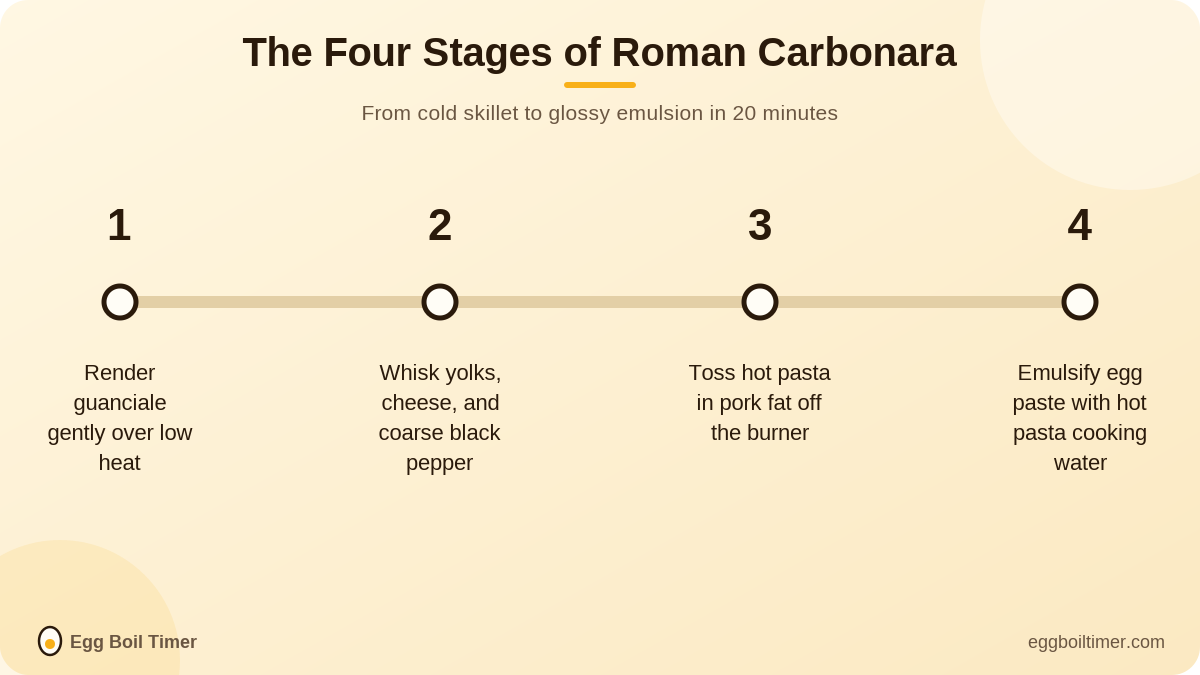
Timing in carbonara is unforgiving. Have every ingredient measured, eggs whisked, cheese grated, and plates warmed before the pasta enters boiling water. Once the pasta reaches the pan, the entire emulsion process takes less than ninety seconds.
- Boil the pasta water with modest salt: Bring 3 liters of water to a rolling boil. Add only 12 grams of coarse sea salt, about half your normal measure. Guanciale and Pecorino Romano already carry intense salinity. Drop 350 grams of bronze-cut spaghetti and cook two minutes short of package instructions.
- Render the guanciale slowly: Place sliced lardons into a cold, wide skillet without added olive oil or butter. Set the burner to medium-low heat. Let the pork fat render gently for 8 to 10 minutes until crisp and golden amber. Turn off the flame, transfer half the crispy bits to a plate, and leave the liquid fat in the skillet.
- Whisk the egg and cheese paste: In a ceramic mixing bowl, whisk 1 whole large egg and 3 large egg yolks. Gradually fold in 60 grams of finely microplaned Pecorino Romano and 2 grams of freshly cracked black pepper. Mix thoroughly until a thick, uniform paste forms.
- Coat pasta in rendered fat: Use long kitchen tongs to transfer the al dente spaghetti directly into the lukewarm skillet. Toss the noodles vigorously for 30 seconds off the flame so every strand absorbs the savory pork fat.
- Temper the egg paste: Ladle approximately 45 milliliters of cloudy pasta cooking water into your bowl of egg paste. Whisk continuously. This gentle warmth loosens the thick paste and raises yolk temperature without setting egg proteins.
- Create the pan emulsion off the heat: Ensure the skillet rests completely off the hot burner. Pour the tempered egg mixture over the pasta. Stir and toss rapidly with tongs. Splash in another 30 milliliters of hot pasta water until the fat and yolks form a glossy coating.
- Plate and garnish immediately: Twirl the pasta into warmed serving bowls. Crown each portion with the reserved crispy guanciale, extra grated Pecorino, and a final flourish of cracked pepper. Serve immediately while hot.
The Physics of Pan Emulsion: Temperature and Coagulation
Carbonara behaves according to fundamental protein physics. Egg whites contain ovalbumin and ovotransferrin, proteins that begin setting firmly at 62 °C (144 °F) and coagulate completely by 80 °C (176 °F). Egg yolks coagulate slightly higher, between 65 °C and 70 °C (149 °F to 158 °F).
Pouring raw eggs into a pan over active heat instantly scrambles the sauce. Metal surfaces easily exceed 120 °C (248 °F), far above the coagulation point of yolks.
The starch extracted from boiling pasta provides thermal protection. Amylose and amylopectin molecules swell and disperse into the cooking water, forming a microscopic structural net. When you agitate hot pasta water with liquid pork fat and egg yolk, the starch molecules physically wedge themselves between fat globules, keeping them suspended. Much like crafting the custard base for Classic Quiche Recipe: Flaky Crust and Silky Egg Custard or whisking warm butter, stable emulsions require controlled mechanical movement and moderate heat.
Residual heat from the pasta noodles does the actual cooking. Drained spaghetti carries enough internal thermal energy to cook the yolks gently and melt the fine cheese proteins without triggering curdling. Continuous tossing exposes the mixture to ambient kitchen air, cooling the skillet rim while distributing heat evenly throughout the serving.
Troubleshooting Texture: Fixing Common Carbonara Flaws
Even seasoned home cooks occasionally face texture issues when managing pan temperatures. Diagnosing the physical state of the sauce allows you to apply quick corrective adjustments before taking the bowl to the dining table.
| Observed Texture. | Underlying Cause. | Immediate Kitchen Fix. |
|---|---|---|
| Scrambled egg flecks in pan. | Pan remained on the flame or metal was too hot. | Remove from pan immediately. The curdling is permanent, but adding cool pasta water halts further coagulation. |
| Watery, pooling puddle at bowl bottom. | Insufficient heat to melt cheese, or excess pasta water. | Place pan over a pot of steaming water (bain-marie) for 30 seconds while stirring rapidly to gently tighten. |
| Stringy, clumping cheese webs. | Cheese grated too coarsely or pasta water had cooled too much. | Whisk 2 tablespoons of boiling pasta water rapidly into the clumped pocket to dissolve cheese proteins. |
| Dull, greasy, separated coating. | Too much rendered fat without enough starchy water to emulsify. | Splash in 30 ml of hot, rolling-boil pasta cooking water and toss vigorously to re-bind the emulsion. |
If your sauce appears dry or matte, do not add more oil or raw egg. A dry appearance almost always signals lack of free moisture. Add pasta cooking water one tablespoon at a time. The water's suspended starches immediately relax the protein strings, restoring the mirror-like shine characteristic of authentic trattoria pasta.
Beyond Spaghetti: Selecting the Optimal Pasta Shape
While spaghetti is the traditional choice for carbonara, short tubular cuts deliver an equally compelling texture. In Rome, rigatoni alla carbonara rivals long noodles in popularity throughout the Testaccio neighborhood. The hollow interior of rigatoni scoops up loose pools of egg cream, while small cubes of crispy guanciale tuck securely inside the tubes.
Bucatini provides another worthy long option. Its central straw-like channel pulls sauce upward as you twirl your fork. However, thick bucatini requires vigorous handling to coat evenly without splashing yellow emulsion across your countertops. Delicate long cuts like angel hair or fresh egg tagliolini fail completely. Angel hair absorbs sauce instantly and turns mushy. Rich fresh egg pasta doubles down on yolk density, turning the plate excessively heavy.
Always inspect the surface texture of commercial dry pasta before buying. Look for packages labeled trafilata al bronzo (bronze-die extruded). Bronze dies leave a chalky, sandpaper-like white coating along the dried semolina dough. Teflon-extruded pastas produce smooth, shiny yellow strands that allow rich egg sauces to slip off and pool uselessly at the bottom of the plate.
From Coal Miners to Allied Rations: How Carbonara Evolved
Unlike century-old Italian classics like pasta alla gricia or cacio e pepe, carbonara is a relatively young twentieth-century recipe. One popular legend attributes the dish to Italian charcoal workers (carbonari). These workers cooked hearty meals over coal braziers using shelf-stable sheep cheese, dry pasta, and cured pork. Yet written historical records of the recipe before World War II remain absent from classic Italian culinary texts.
Most culinary historians trace the dish to the Allied liberation of Rome in 1944. American soldiers brought powdered eggs and bacon rations into Italy in 1944. Resourceful Roman tavern chefs combined these provisions with dry pasta and Pecorino cheese. The pairing proved remarkably successful, evolving rapidly across Rome's postwar trattorias into the standardized technique cooks celebrate today.
During the 1960s and 1970s, international chefs across Europe and North America altered the dish by folding in double cream, sautéed onions, garlic, and frozen peas. These additions provided kitchen stability in high-volume commercial dining rooms, where holding raw eggs at precise emulsion temperatures presented operational hurdles. Today, culinary consensus firmly honors the unadorned Roman formula, recognizing that technical precision yields far greater richness than dairy additives.
Food Safety and Egg Handling Considerations
Because carbonara sauce cooks through gentle residual contact heat rather than boiling temperatures, egg handling demands practical kitchen hygiene. In traditional preparation, egg yolks reach temperatures between 60 °C and 68 °C (140 °F to 154 °F). This temperature range thickens proteins nicely. However, it sits below the standard instantaneous pasteurization threshold of 71 °C (160 °F) established by the USDA FSIS.
For healthy adults, consuming fresh grade A eggs with clean, uncracked shells carries negligible risk when kept continuously refrigerated before use. Vulnerable populations, including pregnant women, older adults, toddlers, and individuals with compromised immune systems, should practice extra caution. Using commercially pasteurized in-shell eggs provides the exact same culinary performance, emulsifying into glossy creaminess while safeguarding against Salmonella bacteria.
This is general information, not medical advice. Always handle raw eggs with clean hands and discard cracked shells immediately. Avoid leaving prepared carbonara at room temperature for longer than two hours. For leftover portions, safety dictates proper chilling, though reheating requires delicate technique to prevent the set sauce from breaking.
Explore other yolk-driven culinary traditions, such as Classic Deviled Eggs Recipe: Creamy Filling and Easy Peeling for cold service or savory Twelve Eggs, Five Lunches: A Week of Egg Salad That Does Not Get Boring for weekly meal prep, or test your water-temperature timing with our precision Egg Boil Timer.


