Crème brûlée is a classic French dessert with a smooth vanilla custard base. It is made from egg yolks, heavy cream, and sugar, crowned with a thin shell of hard caramelized sugar. Creating the contrast between cold custard and hot caramel requires baking the cream in a gentle water bath at 150 °C (300 °F). Bake for 35 to 40 minutes, then chill for 4 hours before torching.
What Gives Crème Brûlée Its Signature Texture
Traditional crème brûlée relies on two contrasting layers: a chilled, velvety custard base and a paper-thin, brittle disk of caramelized sugar on top. When struck with a spoon, the glass-like top cracks cleanly to reveal the set cream underneath. A quick clock like our Egg Boil Timer helps time poached or boiled eggs, but baked custards require steady heat control over half an hour.
Unlike flour-thickened puddings or gelatin gels, the structure of this dessert relies entirely on egg yolk proteins trapping butterfat and liquid in a soft gel. For broader context on how egg proteins set baked desserts, explore our detailed guide to Custard Recipe and Science: Perfecting Egg-Thickened Creams.
The name means burnt cream, but the sugar top should taste like toasted caramel rather than bitter ash. Serving the dish chilled ensures the top hardens instantly after torching, keeping the custard cold while the sugar shell stays hot and brittle.
How Yolk Proteins Set in Heavy Cream
Egg yolks perform two jobs here: emulsification and gelation. Yolks carry lecithin and lipids, which bind water and milk fat into a single smooth liquid. As heat rises in the oven, unfolded yolk proteins build a fine network that traps moisture. Because this recipe uses egg yolks without whites, the set cream stays rich and tender instead of rubbery or spongy. Read more about protein structure in our breakdown of Egg Yolk Science: Composition, Nutrition, and Culinary Mechanics.
Heavy cream with 36% to 40% butterfat shields yolk proteins during baking. Fat molecules cluster between protein strands, preventing them from bonding too tightly and squeezing out water. Yolk proteins begin setting at 80 °C (175 °F). Placing ramekins in a hot water bath (bain-marie) stabilizes the baking temperature. This shields the custard from sudden oven heat spikes.

Vanilla Bean Crème Brûlée Recipe
This recipe yields four 180 ml (6 oz) shallow ramekins. Using a real vanilla bean provides deep floral aroma, though pure vanilla extract works cleanly as a substitute.
- Heavy cream: 2 cups (480 ml), minimum 36% butterfat.
- Egg yolks: 6 large egg yolks, separated cleanly from whites.
- Granulated sugar: 1/2 cup (100 g) total, split into two equal portions.
- Vanilla: 1 whole vanilla bean (split and scraped) or 1 teaspoon pure vanilla extract.
- Salt: 1 pinch of fine sea salt.
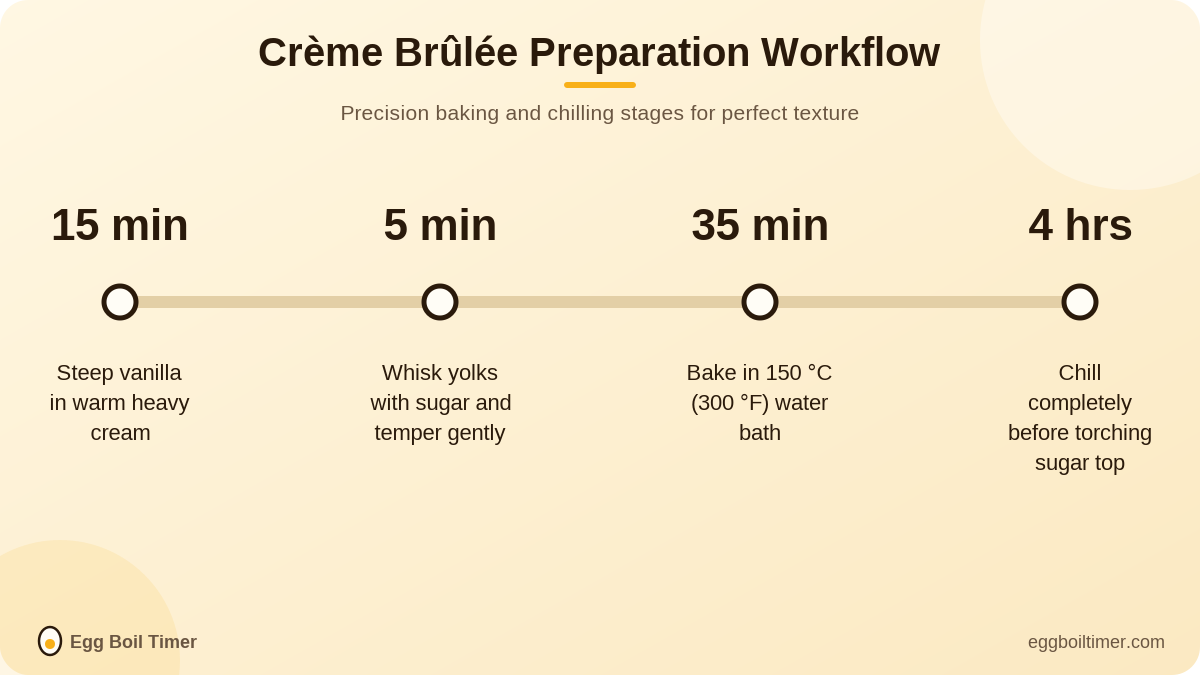
- Infuse the cream: Pour heavy cream into a saucepan. Add scraped vanilla seeds and the split pod. Heat over medium until tiny bubbles appear along the edges (about 80 °C / 175 °F). Remove from heat and steep for 15 minutes.
- Whisk yolks and sugar: In a medium bowl, stir 6 egg yolks, 1/4 cup (50 g) sugar, and salt together until combined. Avoid vigorous whipping, which introduces air bubbles that mar the smooth surface.
- Temper the mixture: Remove the vanilla pod from the cream. Pour warm cream into the egg yolks in a thin stream while stirring constantly with a whisk to prevent scrambling the eggs.
- Strain for smoothness: Pour the liquid through a fine-mesh sieve into a pitcher. This removes any stray chalazae or accidental cooked egg bits.
- Bake in a water bath: Place four shallow ramekins in a baking dish lined with a kitchen towel. Divide custard among ramekins. Place dish on oven rack set to 150 °C (300 °F). Pour boiling water into the dish until it reaches halfway up the ramekin walls. Bake for 35 to 40 minutes.
- Chill completely: Remove ramekins from water bath when edges are set but centers still jiggle gently. Cool at room temperature for 30 minutes, then refrigerate uncovered for at least 4 hours.

Ramekins and Pans for Water-Bath Baking
Bakeware shapes alter heat transfer significantly. Wide, shallow ceramic ramekins with a 2.5 cm (1 inch) depth cook evenly. They yield more crispy sugar crust per spoonful than narrow, deep cups. Deep ramekins often leave the bottom cold while overcooking the outer rim.
Lining your baking pan with a clean dish towel prevents ramekins from sliding on the metal and insulates their bases from direct bottom heat. Filling ramekins while the baking pan sits on the pulled-out oven rack prevents splashing hot water into the raw custard.
Torch Versus Broiler for the Sugar Top
Plain white granulated sugar yields the crispest caramelized top because its fine crystals melt predictably at 160 °C (320 °F). Brown sugar holds excess moisture that causes clumping, while coarse raw sugar burns before melting through.
| Tool | Technique | Texture Result | Custard Impact |
|---|---|---|---|
| Kitchen Torch | Pass a sweeping flame 5 cm above the sugar for 45 seconds per ramekin. | This produces a thin, glass-like crust that cracks cleanly. | The underlying custard stays completely cold. |
| Oven Broiler | Set the ramekins on the top rack under a preheated broiler for 2 minutes. | This creates a slightly uneven crust with dark spots. | The top layer of custard warms slightly. |
To blowtorch effectively, sprinkle 1 teaspoon of granulated sugar over chilled custard. Tilt the ramekin to spread it evenly, then tap out any excess. Hold the flame 5 cm away and keep it moving. Once the sugar bubbles and turns deep golden amber, set the ramekin aside for 2 minutes to harden before serving.
Diagnosing Watery, Grainy, or Curdled Custard
Custard failures usually come down to temperature control during mixing or baking. Identifying physical signs makes it easy to adjust your technique next time.
- Watery or runny middle: The custard came out of the oven too early or was cut before chilling. Internal temperature should reach 77 °C to 80 °C (170 °F to 175 °F), followed by the full 4-hour chill.
- Grainy, curdled texture: Oven heat spiked or the water bath boiled dry. Keep the oven at 150 °C (300 °F) and make sure water surrounds the ramekins throughout baking.
- Bubbles on surface: Air got whipped into the yolks or cream was poured too quickly. Skim foam off raw custard with a spoon, or sweep a torch flame briefly over the unbaked surface to pop air pockets.
- Soft, dissolved sugar top: Sugar was caramelized hours ahead of time or torched onto warm custard. Moisture in the custard dissolves sugar disks over time. Torch the sugar within 15 minutes of serving.
Infusing Tea, Coffee, and Spices into the Cream
Butterfat holds aromatic compounds well. You can steep whole spices, tea leaves, or coffee beans directly in warm heavy cream before stirring it into the egg yolks. Strain all solids thoroughly before tempering.
Crushed espresso beans (2 tablespoons) produce a clear mocha note without changing cream fat ratios. Fresh citrus zest, cinnamon sticks, or Earl Grey tea offer clean variations. When adding liqueurs like Grand Marnier or dark rum, use 1 tablespoon per 2 cups of cream. Stir it in after removing the pan from the heat.


