Submerging a whole raw egg in vinegar dissolves its hard outer shell over roughly 48 to 72 hours. Acetic acid breaks down the mineral shell, releasing bubbles of carbon dioxide gas and leaving behind an intact, flexible pair of protein membranes. The resulting naked egg expands slightly, feels rubbery, and bounces gently from low heights.
Dissolving the Shell: Three Steps to a Naked Egg
Preparing a bouncy egg requires patience, a wide-mouth glass container, and basic pantry supplies. Standard supermarket distilled white vinegar with an acidity level around 5 percent works best. Stronger cleaning vinegars act too aggressively, while dark vinegars leave heavy sediment that obscures the view.
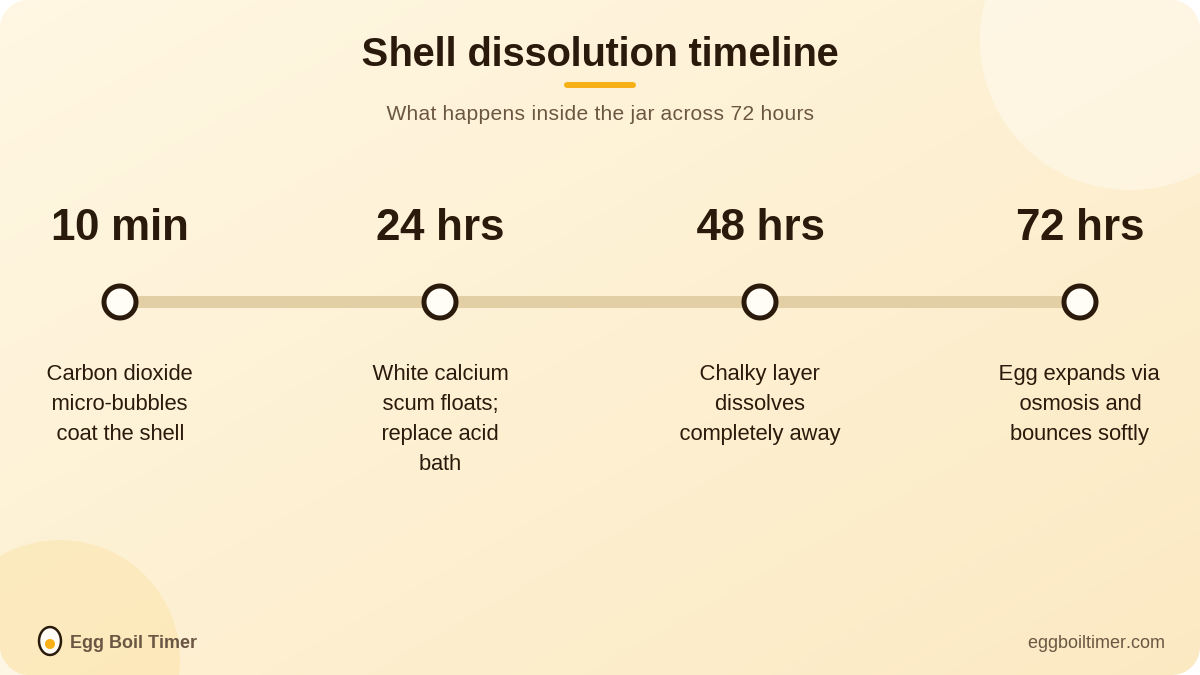
- Lower a raw poultry egg into the bottom of a wide glass jar. Handle the egg gently to avoid hairline fractures. Pour enough distilled white vinegar over the egg until liquid covers the top by at least 2 centimeters. Within minutes, tiny bubbles collect across the shell.
- Cover the jar loosely with plastic wrap or rest a lid on top without tightening it. Gas must vent freely as the reaction runs. Leave the jar undisturbed at room temperature for 24 hours. A thick layer of chalky foam will float to the surface.
- Pour off the spent acid down the sink drain, holding the egg inside the jar with your fingertips. Pour fresh vinegar into the container to submerge the egg again. Let it rest for another 24 to 48 hours. When no chalky patches remain, rinse the egg under a slow stream of lukewarm water while rolling off loose white residue.
Reaction Chemistry: Acid Breakdown and Osmotic Swelling
The disappearance of the shell illustrates an acid-base neutralization. Poultry eggshells consist of roughly 95 percent calcium carbonate crystals held together by an organic protein matrix. Vinegar contains approximately 5 percent acetic acid dissolved in water. When the acid contacts the mineral crystals, a double replacement reaction takes place.
CaCO₃ + 2 CH₃COOH → Ca(CH₃COO)₂ + H₂O + CO₂.
Solid calcium carbonate transforms into soluble calcium acetate, liquid water, and gaseous carbon dioxide. The effervescence visible within seconds represents carbon dioxide gas escaping the liquid as bubbles. Because calcium acetate dissolves readily in water, the rigid structural lattice collapses into solution, exposing the two thin, keratin-rich shell membranes underneath.
While the shell dissolves, a secondary physical process changes the size of the egg. The inner and outer shell membranes form a semi-permeable boundary. Small water molecules pass through microscopic pores freely, but larger proteins dissolved in the albumen remain trapped inside. The concentration of dissolved solutes inside the raw egg white exceeds the solute concentration of standard vinegar. Therefore, water flows inward through osmosis. Over three days, the egg absorbs water weight and swells tightly against its flexible boundary like a filled water balloon.

Vinegar Strength and Eggshell Types: What Changes
Different vinegars and egg varieties introduce distinct variables to the reaction rate and final appearance. Standard distilled white vinegar remains the ideal choice for clean observation, but other pantry liquids behave differently.
Brown eggs and white eggs react at identical chemical speeds, yet their appearance diverges during the soak. Brown shells contain an outer pigment coating called protoporphyrin. As the acid dissolves the underlying calcium carbonate, this brown pigment separates and floats to the surface as dark, frothy scum. Once you rinse the egg on day three, the remaining membrane is just as clear and translucent as that of a white egg.
Acid concentration also changes the outcome. Standard grocery vinegar contains 4 to 5 percent acetic acid. Concentrated cleaning vinegar at 10 to 30 percent dissolves mineral shells much faster, but it carries a severe drawback. The strong acid penetrates the membrane rapidly and curdles the raw albumen into a rubbery, cloudy clump. Interestingly, pure 100 percent glacial acetic acid barely dissolves the shell at all. Acid-base reactions require water molecules to ionize hydrogen ions and dissolve calcium acetate salts. Without water in the solution, the chemical breakdown stalls completely.

Failure Modes: Ruptures, Cloudiness, and Acid Coagulation
Kitchen science experiments encounter mechanical and chemical issues when variables stray outside normal ranges. Handling a naked egg requires an understanding of how thin protein membranes respond to impact, pressure, and acidic environments.
| Observed Symptom. | Underlying Chemical or Physical Cause. | Practical Correction. |
|---|---|---|
| Membrane bursts on a table. | Dropping the egg from higher than 5 centimeters onto a rigid surface. | Bounce solely inside a broad rimmed baking sheet lined with wet paper towels. |
| White spots remain on shell. | Spent vinegar became saturated with calcium acetate. | Refresh the vinegar bath at 24 hours to reintroduce fresh hydronium ions. |
| Opaque, solidified yolk. | Glacial or 10-percent-plus acidity penetrating membranes and denaturing albumen. | Use standard 5 percent culinary vinegar instead of high-strength cleaning acid. |
| Punctured shell on day one. | Pre-existing microscopic crack expanded under osmotic internal pressure. | Inspect eggs with a flashlight before immersion to identify hairline faults. |
| Persistent sour odor. | Acetic acid vapor permeating porous shell membranes during prolonged storage. | Discard the egg after 5 days or keep it submerged in cold water in the refrigerator. |
A frequent disappointment occurs when testers drop the treated egg onto hard countertops expecting the resilience of solid vulcanized rubber. The egg remains raw inside. Its elasticity comes entirely from the taut membrane holding liquid albumen and a floating yolk. Dropping the sphere from higher than 5 centimeters will rupture the membrane and splatter liquid white across the surface. For a look at how thermal stress breaks an intact shell, see Why Your Eggs Crack the Second They Touch the Water.
Acids also trigger protein changes over extended soaking times. Household vinegar at 5 percent works slowly enough that the interior stays fluid for two days. Leaving the egg submerged for a full week allows acetic acid to migrate deep into the core. Acid alters electric charges along protein chains. The chains unfold and bond together in a process known as acid denaturation. The raw egg white thickens and turns opaque white. It mimics the firm texture of an egg prepared using our Egg Boil Timer timing methods without ever touching heat.
Liquid Density Variants: Testing Membrane Permeability
Once you produce a naked egg, the intact semi-permeable membrane enables comparative biological demonstrations. You can alter the dimensions and internal mass of the egg by changing the solute concentration of the surrounding bath.
To demonstrate reverse osmosis, place a rinsed naked egg into a glass filled with concentrated light corn syrup. Corn syrup consists of dense sugar molecules with very low free water availability. Because water concentration is higher inside the egg than in the surrounding syrup, water molecules migrate outward through the membrane pores. Within 24 to 48 hours, the egg deflates into a wrinkled pouch floating atop the heavy syrup. The large sugar polymers cannot cross the membrane inward, so the interior loses volume without gaining sweetness.
Transferring that shriveled egg into a jar of plain distilled water reverses the collapse. Pure water contains zero dissolved solutes, so water rushes through the pores into the concentrated interior. The wrinkled sac reinflates into a firm sphere within 24 hours. Adding a few drops of food dye provides visual proof of fluid transport. Within hours, colored water fills the albumen chamber, turning the transparent white bright blue or red while leaving the central yellow yolk intact.
Comparing raw eggs to hard-cooked specimens yields another useful contrast. Hard-boiling an egg before submerging it in vinegar produces an identically bare, shell-free sphere. Because heat has already cross-linked the albumen and yolk into solid protein gels, the hard-cooked naked egg exhibits far higher rebound elasticity. It can survive drops from 15 to 20 centimeters without bursting.


