An operational egg farm coordinates flock housing, nutrition, and daily collection to produce unfertilized table eggs. Production follows a continuous avian hormonal rhythm. Mature hens release an ovum and construct the surrounding egg over twenty-four to twenty-six hours without requiring a rooster.
Inside the Oviduct: The 25-Hour Formation Cycle
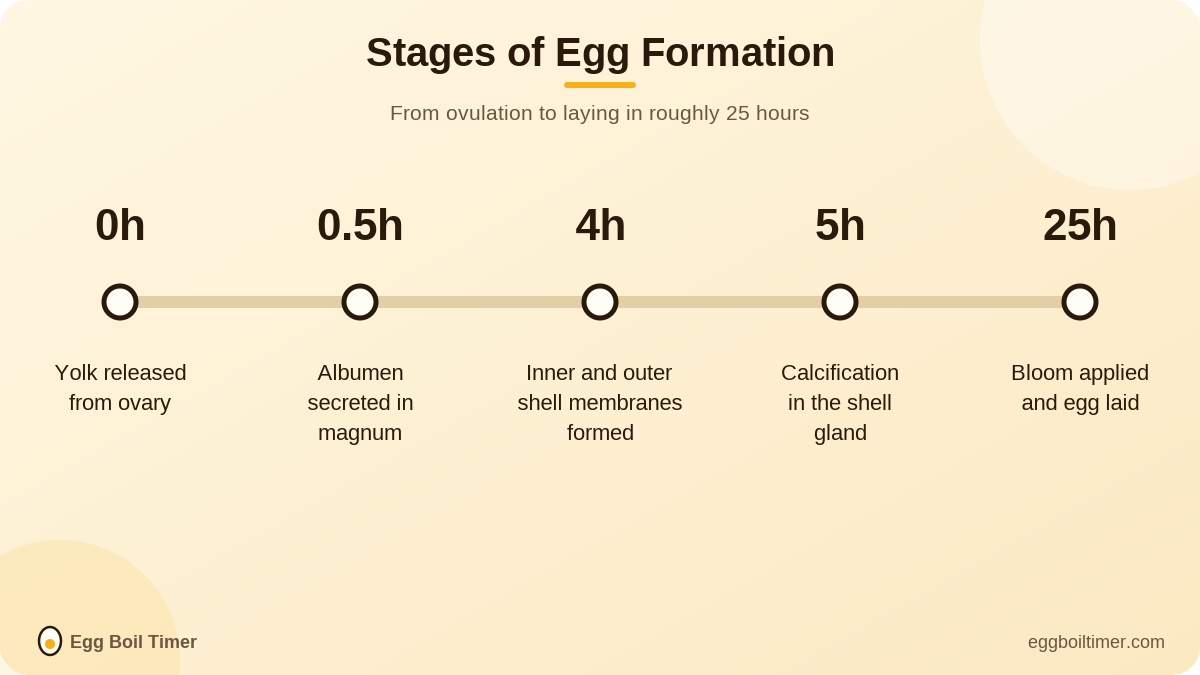
An egg begins inside the ovary of a hen. The ovary resembles a cluster of small grape-like follicles containing developing ova. Once an individual ovum matures, the follicle ruptures and releases the yellow yolk into the oviduct. This muscular tract guides the egg through sequential biochemical stages over a period of 24 to 26 hours.
The ovum first pauses for fifteen minutes in the infundibulum. If a male bird were present in a breeding flock, fertilization would occur in this upper funnel. For commercial table eggs, flocks contain no roosters. The yolk remains sterile and unfertilized throughout its passage.
Next, the yolk enters the magnum, where it remains for three hours. Glandular tissue deposits concentric layers of dense albumen protein, commonly known as egg white. Smooth muscular contractions rotate the descending yolk, twisting structural protein fibers into chalazae. These two opaque cords anchor the yolk securely in the center of the albumen cushion.
The developing egg then enters the isthmus for seventy-five minutes. The isthmus secretes keratin-like fibers that form the inner and outer shell membranes. These flexible barriers retain the albumen while remaining permeable to gas exchange. As the laid egg cools, thermal contraction pulls these two membranes apart at the wide end, forming the air cell.
The final phase occurs in the shell gland, or uterus, spanning roughly twenty hours. Specialized cells pump calcium ions and bicarbonate into the lumen, crystallizing calcium carbonate onto the outer membrane. A finished shell contains between 7,000 and 17,000 microscopic pores. In the final hours before oviposition, pigment cells deposit protoporphyrin or biliverdin if the hen belongs to brown or colored-shell Best Laying Hens: Top Egg Breeds, Output, and Flock Care. A proteinaceous cuticle seals the dry pores immediately prior to lay.
Housing Standards Across Modern Flocks
Flock management systems differ primarily in stocking density, indoor freedom, and pasture access. While egg nutritional content remains biologically consistent, living environments vary significantly across commercial tiers.
| Housing System | Indoor Confinement | Outdoor Access | Feed & Medication Limits | Stocking Standard |
|---|---|---|---|---|
| Conventional Caged | Enclosed wire battery cages | None | Standard commercial feed; no hormones | Roughly 430–560 cm² per hen |
| Enriched Colony | Large wire pens with perches | None | Standard layer ration with calcium | At least 750 cm² per bird |
| Cage-Free Barn | Multi-tier aviary or open floor | None | Standard grain and vitamin mix | Unlimited vertical movement indoors |
| Free-Range | Open floor barns with perches | Mandatory daytime outdoor access | Foraged vegetation plus grain ration | Designated outdoor yard allowance |
| Pasture-Raised | Mobile trailers or fixed coops | Rotated open pasture daily | Pasture forage, seeds, insects, feed | Typically 10 m² per bird outdoors |
| Certified Organic | Cage-free indoor barns | Continuous outdoor ground access | 100% certified organic non-GMO feed | Strict chemical and antibiotic bans |
Conventional cage systems house hens in stepped wire units with sloped floors. Eggs roll automatically onto collection belts away from droppings. Enriched colony units introduce perches, scratching mats, and private nesting curtains within larger wire enclosures.
Barn systems house birds in expansive indoor aviaries without cages. Hens move across multi-tiered platforms to access feed lines, perches, and communal nest boxes. Free-range systems combine open barn housing with daytime access to fenced outdoor runs.
Pasture-based operations use mobile housing units or fixed sheds set inside open grassland. Farmers rotate paddocks regularly to let vegetation recover and give birds fresh foraging ground for insects and seeds. These outdoor dynamics mirror conditions in an attentive Chicken Coop Design: Space, Roosts, and Ventilation Rules coop, but operate at regional distribution scale.

Nutritional Inputs, Light Schedules, and Shell Quality
Egg production depends on precise metabolic inputs. Young hens lay their first small pullet eggs around twenty to twenty-two weeks of age. Egg production peaks between eighteen months and two years, after which annual laying output declines by roughly ten percent each year.
Light exposure controls the endocrine system of the bird. If daily lighting falls below fourteen hours, the pituitary gland throttles the reproductive hormones that trigger ovulation. Commercial facilities provide fourteen to sixteen hours of artificial light daily to maintain regular production throughout winter. Seasonal backyard flocks without supplemental lamps pause laying until spring daylight returns.
Shell integrity requires substantial mineral replenishment. A hen draws two grams of elemental calcium to construct each shell, sourcing mineral stores from feed and spongy medullary bone tissue. Layer feeds contain between 3.5% and 4.5% calcium, supplied through ground limestone and coarse oyster shell. Deficiencies produce brittle, soft-shelled eggs that fail mechanical washing.
Feed composition directly dictates yolk coloration. Carotenoid pigments like lutein and zeaxanthin in yellow corn, alfalfa, and fresh pasture grasses accumulate inside the lipid core of the yolk. Pale yolks and deep amber yolks share comparable protein quality when timed on the Egg Boil Timer counter.

Shell Candling, Washing Protocols, and International Standards
Post-lay processing methods diverge sharply between regulatory jurisdictions. In the United States, USDA and FDA regulations mandate that processing plants wash and sanitize table eggs. Mechanical washers spray eggs with warm potable water maintained at least 11 °C higher than the internal temperature of the egg. This positive pressure differential prevents wash water and surface bacteria from being pulled through shell pores. After washing, processors dry the shells, apply an odorless food-grade mineral oil coating, and transfer eggs into refrigeration held below 7 °C.
European Union regulations take the opposite regulatory path. EU standards prohibit washing Grade A table eggs. Washing removes the natural outer cuticle, which leaves pores exposed if ambient moisture condenses on the shell. European farms keep shells dry, maintain clean nesting boxes, and distribute eggs at moderate ambient temperatures to prevent condensation.
Every commercial facility runs eggs through candling stations. High-intensity light beams illuminate the internal contents on rapid conveyor lines. Optical sensors or human inspectors examine the depth of the air cell, check for blood spots, and detect microscopic hairline fractures in the shell. Eggs with thick whites and small air cells qualify as Grade AA or Grade A. Eggs with enlarged air cells or minor defects are sorted into Grade B or diverted to commercial bakeries as liquid egg product.
Biosecurity Protocols and Pathogen Defense
Salmonella enteritidis represents the primary biological hazard in commercial egg production. While bacteria can occasionally infect the reproductive tract before the shell calcifies, most microbial transfers occur when fecal matter contacts the warm outer shell.
Biosecurity protocols minimize disease introduction from wild birds. Farms install sealed air filtration, mandatory boot-wash stations, and protective suits for flock handlers. Flocks are isolated from wild migratory waterfowl to stop the spread of highly pathogenic avian influenza. Federal law strictly prohibits the use of added growth hormones in poultry operations. Labels stating no added hormones merely restate this universal baseline.
Laying Interruptions and Production Drops
Flock production rates fluctuate under environmental or nutritional strain. Identifying symptoms allows farm operators to intervene before losses compound across the flock:
Seasonal feather loss accompanied by an empty nesting box signals natural molting. Hens shed old feathers and pause laying for eight to twelve weeks to divert metabolic protein into new plumage. Increasing dietary protein accelerates flock feather regeneration.
Thin, wrinkled, or pimpled shells point to high heat stress or calcium imbalance. When summer barn temperatures spike, hens hyperventilate to cool themselves. Rapid panting expels carbon dioxide and triggers respiratory alkalosis, depleting the blood bicarbonate ions required for shell crystallization. Cool misting fans and water-soluble electrolytes stabilize flock blood chemistry.
A sudden halt in laying from young, healthy birds often reflects predatory stress or hormonal broodiness. Rodent incursions or nocturnal disturbance disrupt laying patterns for days. When a hen remains flattened on a nest box, growls, and pecks approaching hands, broodiness has halted ovulation. Breaking the broody state requires moving the hen to an airy wire-bottom cage, an instinct managed differently when managing a dedicated Egg Incubator Guide: Hatching Chicken Eggs Step by Step setup.


