Perfecting the visual craft of egg tart art demands controlling pastry structure and egg protein coagulation simultaneously. A classic Hong Kong egg tart features a glossy, pale yellow custard held within a crisp, golden shell. Achieving that mirror-smooth finish requires slow stirring without foam, double filtration through a sieve, and strict temperature control so the custard never puffs or craters.
The Architecture of an Egg Tart Custard and Pastry
An egg tart is an exercise in textural equilibrium. The shell provides structural rigidity and salt-tinged richness, contrasting with an interior filling dominated by delicate milk solids and egg yolk proteins. In classic Cantonese bakeries, egg tarts sit in dim sum carts as miniature showpieces of balance, where the surface must reflect light without burning.
Traditional custard relies on whole eggs tempered with a warm sugar syrup and evaporated milk. Unlike Western dessert custards that depend on heavy cream and cornstarch for thickness, Cantonese custard coagulates strictly through egg protein denaturation. When heated between 80 °C and 85 °C, ovotransferrin and ovalbumin form a three-dimensional gel network that traps free water. If the oven temperature spikes higher, those proteins contract violently, expelling moisture and producing a weeping, rubbery curd.
The crust acts as a heat barrier. Because metal tart molds conduct heat rapidly, the pastry must crisp completely before the delicate interior overcooks. Achieving bakery-quality egg tarts means coordinating oven rack positions, mold thickness, and sugar hydration so that both elements reach their peak at the exact same second.
Shortcrust Versus Laminated Puff Dough
Bakers choose between two distinct styles for the shell: shortcrust pastry and laminated puff pastry. Each creates a fundamentally different visual and textural frame for the custard.
| Pastry Type. | Fat Source. | Texture. | Handling Difficulty. | Best Suited For. |
|---|---|---|---|---|
| Cookie Shortcrust. | Butter or lard. | Crumbly cookie snap. | Beginner to intermediate. | Clean fluted edges. |
| Laminated Dough. | Butter and shortening layers. | Brittle, airy flakes. | Advanced. | Traditional dim sum. |
Cookie shortcrust uses softened butter, confectioners' sugar, egg, and low-protein cake flour. Confectioners' sugar dissolves rapidly without requiring heavy creaming, which keeps gluten development minimal. The baked shell resembles rich shortbread that cleanly snaps when bitten. This dough holds intricate fluted edges against metal tart molds without slumping.
Laminated puff pastry relies on alternating sheets of flour dough and fat blocks. During baking, moisture within the dough vaporizes into steam, pushing the flour layers apart while the melting fat fries each paper-thin sheet. While puff pastry offers airy flakiness, it requires resting and chilling intervals to prevent the butter from melting during handling. If your kitchen is warm, shortcrust delivers far more consistent, elegant lines.

Mixing and Straining for a Mirror-Smooth Custard
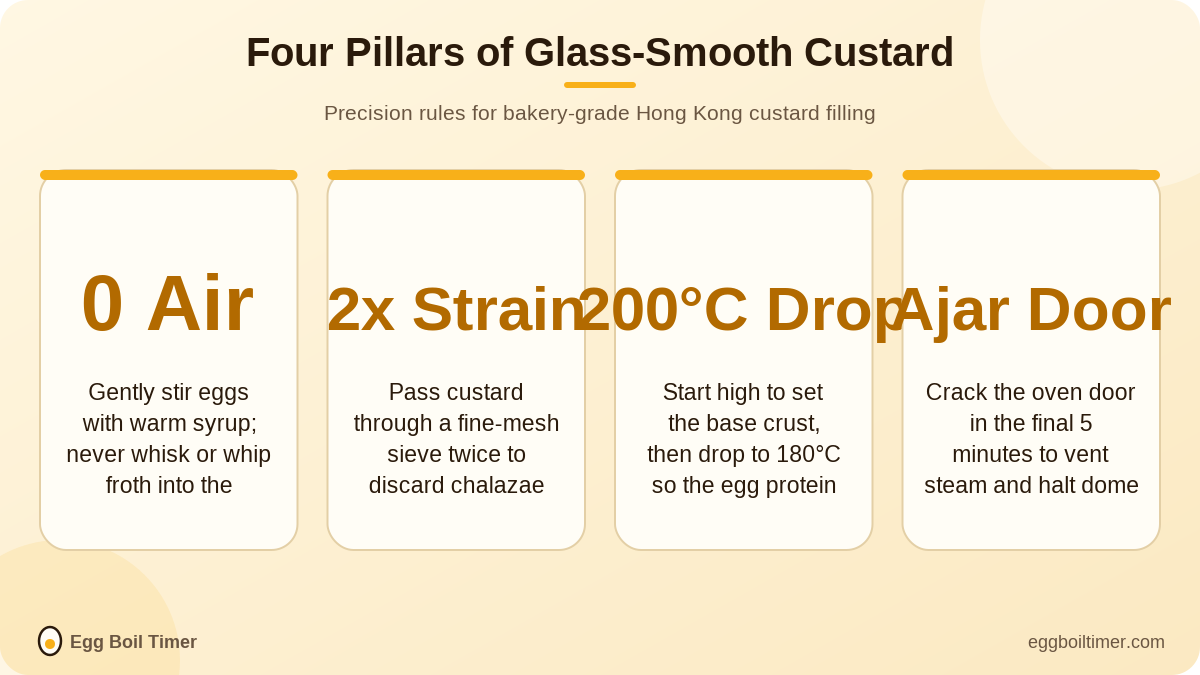
A flawless custard surface begins long before the pan enters the oven. Bubbles are the enemy of smooth custard surfaces. Any air pocket whipped into the mixture during preparation expands under heat, rises to the surface, and bursts into rough pits.
- Dissolve the sugar syrup completely. Stir granulated sugar into boiling water until the liquid turns transparent. Let this syrup cool to lukewarm (under 40 °C) before combining it with milk or beaten eggs to avoid scrambling raw yolks on contact.
- Blend without incorporating air. Whisk whole eggs and evaporated milk with gentle circular strokes. Keep the whisk tines submerged against the bottom of the bowl. Never lift or whip vigorously; you want a uniform liquid emulsion without foam.
- Pass the mixture through a fine-mesh sieve twice. Straining separates stubborn albumen cords, chalazae, and unincorporated yolk membranes. Discard the strained solids caught in the mesh.
- Skim surface micro-bubbles. Let the strained custard rest on the counter for 15 minutes. Draw a clean sheet of kitchen paper towel across the liquid surface to pull away remaining surface froth.

Hong Kong Egg Tart Recipe from Scratch
This master formula produces 12 bakery-standard egg tarts using fluted metal molds measuring 7 cm across the top. The cookie shortcrust holds its shape effortlessly while baking into a golden, buttery frame.
Pastry Shell Ingredients
- 170 g all-purpose flour.
- 100 g unsalted butter, softened to 18 °C.
- 35 g sifted confectioners' sugar.
- 25 g beaten whole egg.
- 1 g fine sea salt.
- 2 ml pure vanilla extract.
Custard Filling Ingredients
- 2 large eggs, about 100 g liquid.
- 65 g granulated sugar.
- 140 ml hot water.
- 60 ml evaporated milk.
- 2 ml pure vanilla extract.
Assembly and Baking Method
- Prepare the sweet pastry base. Beat the softened butter and sifted confectioners' sugar in a bowl with a silicone spatula until creamy and pale. Add salt, vanilla, and 25 g beaten egg. Stir until absorbed. Sift in the flour and fold gently until flour streaks vanish. Flatten dough into a disk, wrap in parchment, and chill in the refrigerator for 30 minutes.
- Mix the custard filling. Stir granulated sugar into 140 ml hot water until dissolved. Allow syrup to cool until barely warm. In a separate bowl, stir two large eggs, evaporated milk, and vanilla with a spoon. Pour the warm syrup into the egg mixture slowly while stirring continuously. Pass the custard through a fine-mesh strainer twice into a measuring pitcher with a pour spout.
- Shape the tart shells. Divide chilled dough into 12 equal portions of roughly 27 grams each. Roll each portion into a smooth ball. Place one ball in the center of an ungreased 7 cm fluted tart mold. Using your floured thumbs, press outward from the center base toward the edges, working the dough evenly up the fluted walls. The rim should sit slightly higher than the mold edge. Dock the base once with a small fork. Transfer tart shells to the freezer for 15 minutes.
- Fill the cold shells. Preheat oven to 200 °C (392 °F) with a heavy baking sheet set on the lowest oven rack. Arrange frozen shells on the hot sheet. Pour prepared custard into each shell until 85% full, leaving 3 mm of pastry rim exposed.
- Execute the two-stage bake. Bake on the bottom rack at 200 °C for 10 minutes until the pastry base begins firming. Reduce oven heat to 180 °C (356 °F). Bake for another 10 to 12 minutes. Check the custard: it should show a slight wobble in the center without ballooning upward.
- Cool and unmold. Set baking sheet on a wire rack. Let tarts cool undisturbed for 10 minutes. Invert each mold gently into your palm; the firm butter crust will release cleanly. Serve warm.
Two-Stage Oven Temperatures and Visual Doneness
Baking egg custard pastry requires managing two conflicting rates of heat penetration. The flour-and-butter base requires direct, intense heat from below to crisp completely and melt raw starches. The custard filling demands mild, steady heat to set without boiling its internal moisture.
Placing the baking tray on the lowest oven rack delivers direct conductive heat into the base of the tart tins. Starting at 200 °C (392 °F) shocks the butter in the crust, setting the fluted walls before they can melt or slouch downward. After 10 minutes, lowering the oven dial to 180 °C (356 °F) protects the egg proteins from curdling.
Observe the center of the tart through the oven glass during the final minutes. The custard should form a level, glossy sheet that quivers gently when the pan is nudged. If the custard begins doming upward like a muffin top, the internal temperature has exceeded 88 °C. Immediately prop the oven door open by 2 to 3 cm with a wooden spoon handle. Venting cool ambient air drops the chamber temperature quickly, halting excess steam expansion before the custard tears open.
To confirm doneness without scarring the glossy skin, test with a single clean toothpick. Insert it 5 mm deep into the direct center of the custard. If the toothpick stands upright without tilting, the protein matrix is fully set. Remove the baking sheet immediately.
Troubleshooting Matrix: Shrinking Pastry to Collapsed Centers
Minor errors during crust shaping or temperature regulation produce distinct visual defects. Use this troubleshooting guide to identify and fix common egg tart flaws.
| Visual Defect. | Primary Cause. | Corrective Action. |
|---|---|---|
| Dough walls slide down molds. | Overworked gluten or warm dough placed in oven. | Chill shaped tart tins in the freezer for 15 minutes before filling with liquid custard. |
| Pale, doughy, soggy bottom. | Insufficient bottom heat; crust rolled too thick. | Bake on the lowest rack on a preheated heavy metal baking sheet. Keep base dough under 3 mm thick. |
| Pitted, blistered custard skin. | Foam whipped into mixture; baking temperature too high. | Stir gently with a spoon. Pass liquid through a fine-mesh sieve twice and rest before pouring. |
| Center balloons up, then craters. | Severe overbaking; internal moisture boiled into steam. | Reduce bake time by 3 minutes. Crack the oven door ajar if filling begins to swell. |
| Cracked crevasse across top. | Direct dry top heat baking outer rim faster than center. | Lower oven rack position; tent loosely with foil if upper heating elements run hot. |
| Crust breaks apart upon unmolding. | Unmolded while piping hot, or pastry lacked fat hydration. | Let rest 10 minutes in tins to let butter solids firm before gently tapping out. |
Plating Aesthetics: From Dim Sum Tins to Modern Pastry Displays
The visual appeal of egg tarts relies on contrast between geometric, fluted pastry edges and a flawless, liquid-gold center. High-end Cantonese tea houses serve tarts within small fluted greaseproof paper collars to keep fingers clean while highlighting the pastry ridges.
For bakery-style displays, arrange tarts on slate, unglazed earthenware, or matte white porcelain platters. The deep, warm yellow of the custard stands out vividly against cool gray and white tableware. Pair egg tarts alongside dark oolong, Pu-erh, or Jasmine tea in clean ceramic cups to echo traditional dim sum dining.
Keep garnishes minimal. Classic Hong Kong tarts are defined by their pristine, unblemished yellow surface; dustings of powdered sugar or cinnamon mask the craftsmanship rather than improve it. If you want a modern accent, place a single fresh raspberry or a sliver of edible gold leaf on the rim of the crust right before serving.
Hong Kong Dan Tat Versus Portuguese Pastéis de Nata
Hong Kong egg tarts and Portuguese Pastéis de Nata represent distinct culinary traditions. While both are custard pastries, they feature contrasting flavor profiles, pastry styles, and visual standards.
| Feature. | Hong Kong Egg Tart (Dan Tat). | Portuguese Egg Tart (Pastel de Nata). |
|---|---|---|
| Crust Style. | Tender shortcrust cookie dough. | Laminated puff pastry rounds. |
| Surface Finish. | Smooth, glossy, solid yellow. | Deeply blistered dark caramel spots. |
| Custard Base. | Whole eggs, milk, sugar syrup. | Egg yolks, milk, flour-thickened syrup. |
| Aromatics. | Vanilla extract. | Cinnamon bark and fresh lemon peel. |
| Baking Heat. | Moderate: 180 °C to 200 °C. | Extreme: 260 °C to 290 °C. |
| Historical Roots. | Cantonese cha chaan tengs. | Jerónimos Monastery in Lisbon. |
Pastéis de Nata originated in Lisbon's Jerónimos Monastery, where monks used leftover egg yolks from starching habits to create dense, caramelized pastries. Their custard is thickened with flour and boiled syrup, allowing it to withstand blistering furnace heat up to 290 °C without breaking. By contrast, the Hong Kong Dan Tat emerged in British-influenced Guangzhou and Hong Kong tea houses. Cantonese cooks refined the Western custard tart into an elegant dim sum pastry that prizes pure yellow color, low sugar levels, and delicate, glass-like smoothness.
Storing, Freshness, and Reheating Rules
Egg tarts deliver their best flavor and flakiest bite within two hours of leaving the oven. During this window, the contrast between the brittle, warm pastry and the luscious custard is at its peak.
Leave leftover tarts uncovered on a wire rack until completely cool. Storing warm tarts traps evaporating steam inside containers, turning the crisp crust soggy within minutes. Once cold, transfer tarts to an airtight container lined with paper towels. You can hold them at room temperature for up to 24 hours, or refrigerate them for up to 3 days.
Never reheat egg tarts in a microwave. Microwave radiation heats water molecules directly inside the custard, making the filling boil and bubble while softening the crust into grease. Instead, re-crisp tarts in a toaster oven or air fryer preheated to 175 °C (350 °F) for 3 to 4 minutes. The dry circulating heat restores the shell's snap without scorching the custard surface.
Master Egg Boil Timer egg cooking fundamentals to control delicate protein coagulation. You can also explore classic custard bakes such as savory Classic Quiche Recipe: Flaky Crust and Silky Egg Custard, comforting Filipino Egg Pie Recipe: Golden Crust and Silky Custard, or rich French Toast: The Ratio, Bread Choice, and Pan Heat within our broader Egg Recipes: Breakfast, Lunch, and Dinner Ideas collection.


