
Healthy adults can safely consume 1 to 2 eggs per day without increasing their risk of heart disease or stroke. Mainstream health institutions have moved away from strict daily cholesterol caps, recognizing that saturated fat in the overall diet influences blood cholesterol far more than the dietary cholesterol found in egg yolks. For individuals with existing heart conditions, high LDL cholesterol, or type 2 diabetes, guidelines recommend limiting yolk consumption to 3 or 4 per week while allowing unlimited egg whites.
Saturated fat versus dietary cholesterol: how body chemistry handles yolk fats
For decades, public health advice capped daily dietary cholesterol at 300 milligrams. A single 50-gram egg contains approximately 186 mg of cholesterol, all stored within the yolk. Because high low-density lipoprotein (LDL) correlates with arterial plaque buildup, early nutrition guidelines assumed eating egg yolks directly raised circulating blood cholesterol.
Modern lipidology distinguishes between cholesterol absorbed from food and cholesterol synthesized by the body. The liver produces roughly 70 to 80 percent of circulating blood cholesterol every day. In most individuals, a negative feedback loop regulates this internal balance. When you eat dietary cholesterol from eggs, the liver compensates by lowering its own baseline production.
Saturated fats disrupt this internal feedback system. Consuming excess saturated fat reduces the density and activity of LDL receptors on liver cells, hindering the body's capacity to extract LDL particles from the bloodstream. Because an egg contains only 1.6 grams of saturated fat alongside 4.8 grams of total fat, its effect on circulating LDL remains minor compared to butter, palm oil, or fatty cuts of meat. Consequently, the 2020–2025 Dietary Guidelines for Americans eliminated the rigid 300-milligram daily cholesterol cap, shifting focus toward limiting overall saturated fat intake.
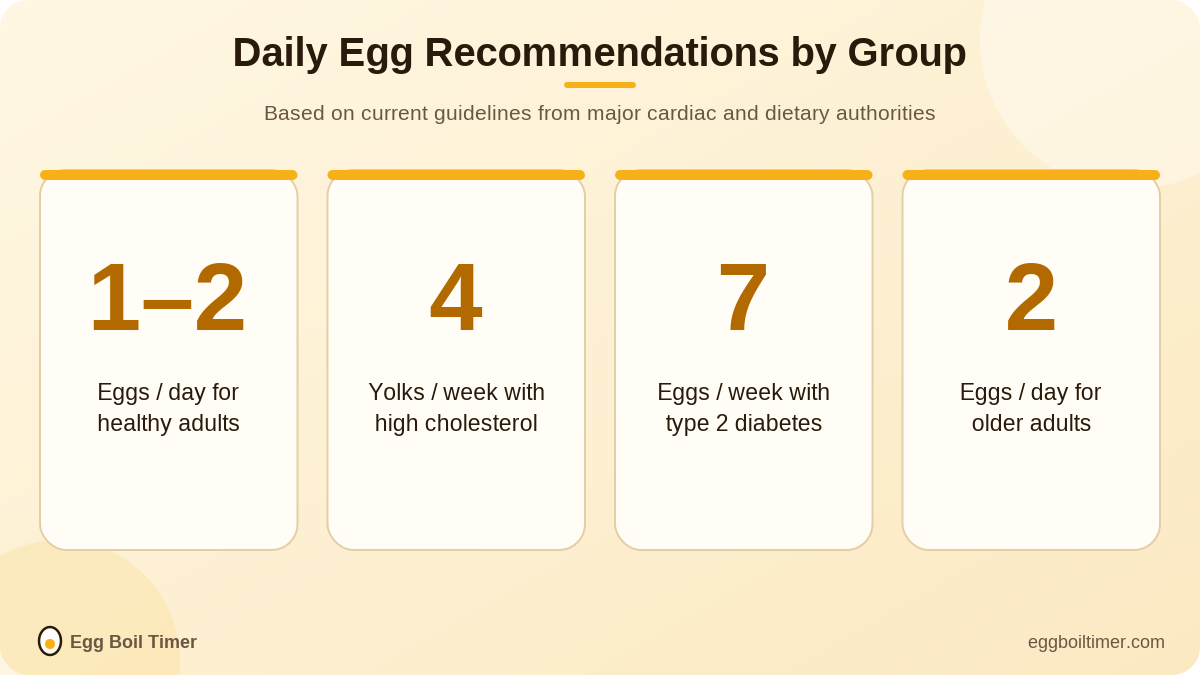
Official daily egg recommendations by health condition and age group
Nutritional guidance varies based on individual cardiovascular risk, age, and existing metabolic conditions. Leading international heart health organizations establish specific boundaries to help balance nutrient intake against potential lipid changes.
| Health Profile | Recommended Intake | Primary Authority Guidelines |
|---|---|---|
| Healthy Adults | 1 to 2 whole eggs daily | NHS (UK), Australian Heart Foundation |
| High LDL or Heart Disease | Up to 4 yolks per week (unlimited whites) | American Heart Association |
| Type 2 Diabetes | Up to 7 whole eggs per week | Australian Heart Foundation |
| Older Adults (Normal Cholesterol) | Up to 2 whole eggs daily | American Heart Association |
| Children (Ages 1 to 8) | 1 whole egg daily (scaled to energy needs) | Pediatric Dietary Guidelines |
The American Heart Association notes that healthy individuals can include up to seven whole eggs per week as part of a heart-healthy diet. For older adults with normal cholesterol profiles, eating up to two eggs per day provides an accessible source of high-quality protein to counteract age-related muscle decline.
For people diagnosed with hypercholesterolemia, coronary artery disease, or heart failure, doctors advise tighter yolk boundaries. About 30 percent of the population falls into the category of hyper-responders. In these individuals, eating dietary cholesterol causes a parallel rise in both LDL and HDL blood levels. Restricting whole eggs to 3 or 4 per week while utilizing pure egg whites allows hyper-responders to meet protein targets without overloading their cholesterol clearance pathways.

Hyper-responders and blood lipids: who needs stricter yolk limits
Understanding your personal response to dietary cholesterol depends on baseline blood tests and genetic factors. Standard lipid panels measure total cholesterol, LDL, HDL, and triglycerides. Advanced testing may examine apolipoprotein B (ApoB) and particle number, which offer precise indications of cardiovascular risk.
In hypo-responders (representing roughly 70 percent of people), eating two eggs daily alters circulating LDL levels by negligible amounts. The liver smoothly adjusts internal synthesis downward. In hyper-responders, dietary cholesterol causes circulating LDL levels to rise alongside HDL levels. Although the ratio between LDL and HDL often remains stable, the total particle burden can increase.
Genetics, particularly variations in the APOE gene, influence how efficiently your intestines absorb dietary cholesterol and how your liver processes it. People carrying specific genetic variants frequently show sharp LDL increases when adding daily egg yolks to their meals. Individuals with type 2 diabetes also face higher cardiovascular risks, as insulin resistance affects how blood vessels respond to circulating lipids. For this group, keeping whole egg intake around 7 per week maintains safety while delivering essential nutrients.

Micronutrient profile of whole eggs versus egg whites
Evaluating an egg purely by its cholesterol count misses its nutrient density. A standard 50-gram egg provides 72 calories, 0.4 grams of carbohydrates, and 6.3 grams of protein containing all nine essential amino acids needed for tissue repair and muscle synthesis.
The yolk stores nearly all the fat-soluble vitamins and specialized antioxidants. Yolks are one of the primary dietary sources of choline, providing over 100 milligrams per large egg. Choline supports cell membrane integrity, liver function, and neurotransmitter synthesis involved in memory and muscle control. Yolks also supply lutein and zeaxanthin, carotenoid compounds that concentrate in the macula of the eye to shield retinal tissues from light damage. Vitamin D, vitamin B12, folate, and selenium fill out the remainder of the yolk's nutritional package.
Egg whites consist almost entirely of water and ovalbumin protein, delivering 3.6 grams of protein with zero fat and zero cholesterol. Combining one whole egg with two egg whites creates a high-protein, low-fat meal structure. You can measure precise cooking times for soft or hard yolks using our Egg Boil Timer tool. Anyone tailoring their daily protein intake for athletic recovery can review Eggs Protein: Exact Grams, Amino Acids, and Daily Targets parameters, while individuals managing calorie deficits can check Egg Calories: Exact Counts by Size, Component, and Cooking Style numbers. Athletes seeking muscle building options can read Eggs for Gym Performance: Protein, Yolks, and Timing, and those following low-carbohydrate eating plans can explore Keto Eggs: Macros, Daily Limits, and the Egg Fast.
Preparation methods and companion foods that alter cardiovascular risk
The health impact of eating eggs daily depends heavily on how you cook them and what sits on the plate alongside them. Boiling, poaching, or steaming eggs adds zero extra dietary fat, preserving their natural calorie and lipid values.
Frying eggs in butter, bacon grease, or lard introduces significant quantities of saturated fat. Cooked at high heat in saturated animal fats, an otherwise lean egg becomes part of a meal that raises blood LDL. Exposing egg yolks to prolonged, intense heat during frying or high-temperature baking can also cause dietary cholesterol to oxidize into oxysterols. Some research links oxidized cholesterol to vascular inflammation and arterial damage.
Side dishes also dictate the overall cardiovascular outcome. Serving two poached eggs with avocado, grilled tomatoes, and whole-grain toast provides dietary fiber and unsaturated fats that support healthy blood lipid ratios. Serving those same two eggs with processed sausage, refined white toast, and heavy butter introduces compounds that drive up inflammatory markers and circulating LDL. Monitoring your lipid panel through regular medical checkups gives you definitive feedback on how your personal cooking habits and daily egg intake influence your long-term heart health.


