An authentic Kaiserschmarrn recipe delivers a light, soufflé-style Austrian torn pancake balancing a pillowy crumb with crisp, butter-caramelized edges. Achieving this texture requires whipping the egg whites separately before folding them into a rested yolk-and-flour batter, searing the bottom on the stovetop, puffing the disk in a hot oven, and tearing it into shreds directly inside the skillet.
The Emperor's Sweet Mess: Origins of the Torn Skillet Pancake
Kaiserschmarrn takes its name from Austrian Emperor Franz Joseph I, who governed the Habsburg monarchy between 1848 and 1916. Viennese culinary lore attributes the dish to a court chef attempting to salvage an accidental tear in an imperial dessert, though an alternate alpine legend claims an innkeeper scrambled a thick pancake when the royal hunting party arrived unannounced in the Tyrolean mountains.
The word Schmarrn comes from regional Austrian dialect denoting a mishmash or shredded scramble. What began as humble farm fare rapidly gained aristocratic favor across Vienna and Salzburg. The preparation remains a core tradition among Austrian Egg Recipes: Breakfast, Lunch, and Dinner Ideas, eaten as an alpine ski-hut lunch, a sweet midday main course, or a shared dessert.
Why Separate Whipped Whites Replace Chemical Leaveners
Standard breakfast hotcakes rely on baking powder or baking soda to release carbon dioxide into the pan. Kaiserschmarrn uses mechanical aeration: trapped air pockets inside a beaten egg white foam that expand violently under intense skillet and oven heat.
Separate cold eggs straight from the refrigerator, when the membranes are sturdy and yolks resist breaking. Put the egg whites into a spotless, grease-free mixing bowl and the yolks into a separate basin. Let both rest at room temperature for 15 minutes before whipping. Warmer whites whip into greater volume because lower surface tension permits faster air entrapment.
Beat the egg whites with a tiny pinch of salt until they form stiff, glossy peaks that hold their shape when you lift the beaters. Underbeaten whites collapse under the heavy flour mix. Overbeaten whites turn dry and grainy, separating into clumps that never fold evenly.
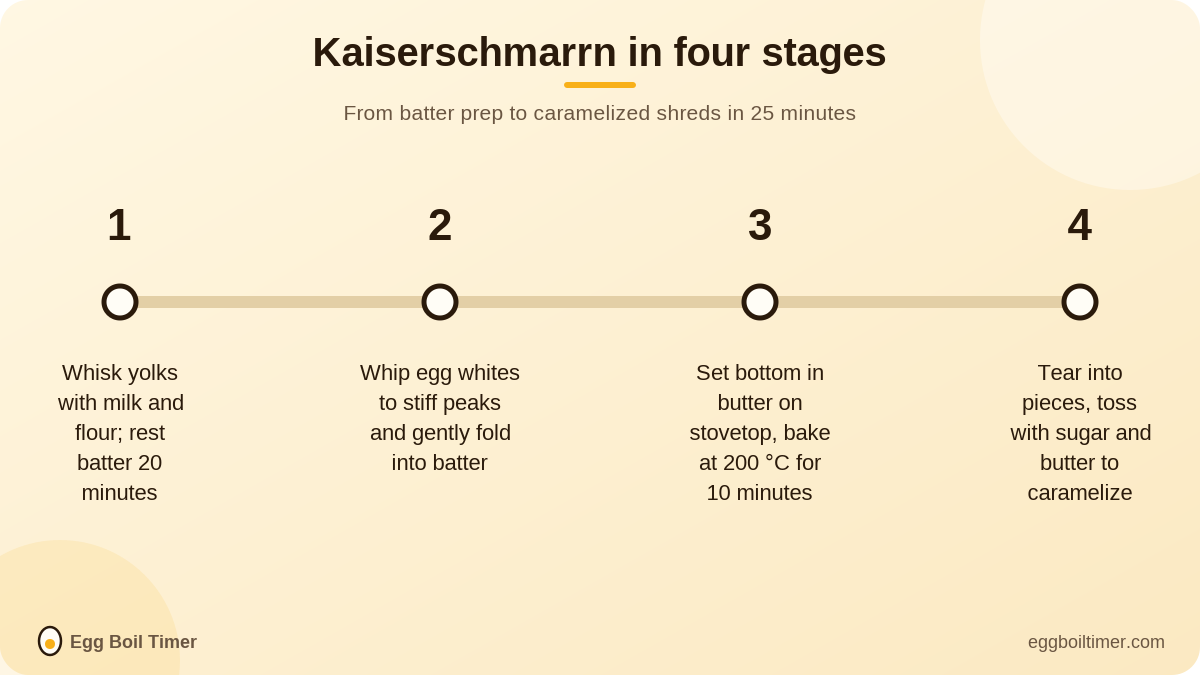
Resting the yolk batter matters just as much as whipping the whites. Whisk the egg yolks, whole milk, flour, and vanilla extract until smooth, then let the bowl stand undisturbed on the counter for 20 minutes. That interval gives the starch granules time to hydrate and relaxes gluten strands developed during whisking. Skipping this rest makes the cooked shreds dense and rubbery.

From Stovetop Sear to Oven Soufflé: The Skillet Method
This recipe yields two generous meal-sized portions or four shared dessert plates. Use an oven-safe 28 cm (11-inch) cast-iron skillet or heavy stainless steel pan.
Ingredients
- 4 large eggs, separated
- 240 ml whole milk (room temperature)
- 130 g all-purpose wheat flour
- 35 g granulated sugar (split into 20 g for batter and 15 g for skillet glazing)
- 1 pinch fine salt
- 1 teaspoon pure vanilla extract
- 40 g unsalted butter (divided into two equal 20 g portions)
- 30 g dark raisins, optionally soaked in 1 tablespoon dark rum for 30 minutes
- Powdered sugar for dusting
Preparation Steps
- Preheat the oven to 200 °C (390 °F).
- Whisk egg yolks, whole milk, flour, 20 grams of sugar, vanilla extract, and salt in a bowl until free of lumps. Set the bowl aside for 20 minutes.
- Whip egg whites with a clean whisk or electric mixer until stiff peaks form.
- Stir one-third of the whipped whites directly into the rested yolk batter to slacken the mixture. Add the remaining whites and fold gently with a flexible spatula, cutting down the center and sweeping up the sides in broad strokes. Stop once streaks vanish to preserve air volume.
- Melt 20 grams of butter in your oven-safe skillet over medium-low heat. When the butter foams, pour in the batter. Scatter the rum-soaked raisins across the wet surface so they settle naturally into the batter.
- Cook on the stovetop for 3 to 4 minutes until the underside sets into a golden crust while the top stays wet.
- Transfer the skillet to the preheated oven. Bake at 200 °C for 8 to 10 minutes until the top puffs like a soufflé and springs back to a light touch.
- Remove the skillet with a heavy oven mitt. Using two forks or spatulas, pull and tear the pancake into irregular, bite-sized pieces roughly 3 to 4 cm wide.
- Add the remaining 20 grams of butter and sprinkle 15 grams of granulated sugar across the shreds. Return the skillet to medium stovetop heat and toss continuously for 2 to 3 minutes until the sugar dissolves and coats the edges in a lustrous, caramelized glaze.
- Slide the shreds onto warm plates, dust with a thick veil of powdered sugar, and serve immediately alongside warm plum compote.

Dense, Rubbery, or Burnt: Skillet Fixes for Common Fails
Skillet heat management and delicate folding dictate whether you get an airy alpine treat or a heavy, flat omelet. Use this diagnostic matrix to isolate texture and baking faults.
| Symptom | Underlying Cause | Correction |
|---|---|---|
| Pancake collapses flat and dense | Whites were underwhipped, or folded with rapid circular stirring | Whip whites until tips stand firm; fold with a silicone spatula using fewer than 12 broad sweeps. |
| Batter sticks stubbornly to pan | Skillet was too cold when butter went in, or pan surface lacks seasoning | Use well-seasoned cast iron or heavy clad stainless; verify butter foams before pouring batter. |
| Scorched bottom with liquid raw center | Stovetop burner set too high during initial sear | Reduce heat to medium-low; let the crust establish over 3 to 4 minutes without smoking. |
| Tough, rubbery bite | Batter was beaten excessively or cooked without the starch rest | Whisk yolk base just until flour blends in, then maintain the 20-minute hydration rest before folding. |
| Bitter, burned sugar on finish | Caramelization phase ran too long or skillet lacked butter | Keep the heat at medium and toss for under 3 minutes, adding butter with the sugar to create an emulsion. |
Zwetschkenröster, Rum Raisins, and Classic Alpine Sides
American breakfast tables pair griddle cakes with maple syrup, but Austrian tradition relies on tart, stewed stone fruit to cut through butter and caramelized sugar. The standard accompaniment is Zwetschkenröster, a compote of damson plums simmered with cinnamon sticks, whole cloves, lemon peel, and minimal sugar. The fruit's bright acidity balances the custard-rich shredded pancake.
Stewed apples (Apfelmus) or tart mountain lingonberries (Preiselbeeren) serve as standard accompaniments in Carinthian and Tyrolean kitchens. If you want rum aromatics, steep dark raisins in Austrian Stroh rum for 30 minutes before baking. When cooking for children, skip the alcohol entirely or soak the raisins in hot orange juice to plump them up.
How Kaiserschmarrn Differs From Standard American Pancakes
The table below breaks down the technical differences between Austrian shredded pancakes and American hotcakes or Fluffy Eggnog Pancakes: Spiced Holiday Griddle Recipe, showing how egg volume and cooking technique produce completely distinct textures.
| Attribute | Austrian Kaiserschmarrn | American Hotcake |
|---|---|---|
| Egg Ratio | High: 4 large eggs to 130 g flour | Low to moderate: 1 or 2 eggs to 240 g flour |
| Primary Leavening | Mechanical volume from whipped egg white foam | Chemical gas from baking powder or baking soda |
| Cooking Method | Stovetop sear, oven bake, hand tearing, butter caramelization | Direct dual-side griddling on a flat stovetop plate |
| Crumb & Texture | Soufflé-light, custardy interior with crisp sugar glaze | Spongy, uniform crumb designed to soak up liquid syrup |
| Serving Presentation | Irregular shredded pieces dusted with powdered sugar | Neatly stacked circular disks with maple syrup |
For more egg breakfast ideas, compare this skillet technique with baked French Toast: The Ratio, Bread Choice, and Pan Heat or explore the timing tools on Egg Boil Timer for boiled eggs across every doneness level.


