Making mayonnaise requires suspending droplets of vegetable oil throughout a tight base of raw egg yolk, acidic liquid, and salt. Rapid mechanical shearing breaks the oil into microscopic spheres coated by yolk proteins, producing a thick, pale spread in under two minutes when blended at full speed.
The Chemistry of Egg Yolk and Oil Emulsion
Mayonnaise behaves in reverse of typical oil dressings. It contains up to eighty percent fat by volume, yet liquid water remains the continuous external phase. The oil droplets never dissolve into the liquid. They sit packed as microscopic spheres suspended inside moisture supplied by the egg yolk and lemon juice. When these spheres collide and fuse, the sauce breaks into a slick yellow pool.
The engine of this stability is egg yolk. A standard large yolk weighs roughly 17 grams, providing 2.7 grams of protein along with natural surface-active agents like lecithin (phosphatidylcholine). Lecithin molecules have a split chemical structure: a lipophilic tail that anchors into fat droplets, and a hydrophilic head that reaches outward into water. Rapid blades coat newly sheared oil droplets with these molecules, giving them identical surface charges that push them apart and prevent separation.
Water volume dictates sauce body. Adding more oil forces fat droplets closer together, leaving less room for liquid to move and creating a firmer texture. If your mayonnaise turns out stiff like paste rather than creamy, whisking in five milliliters of warm water expands the external matrix and restores spreadability. One large yolk provides enough surfactant to hold up to 200 milliliters of oil without splitting.
Tested Kitchen Method: Immersion Blender in a Narrow Jar
Hand whisking gives direct tactile control, but an immersion stick blender eliminates human inconsistency. High-speed spinning blades produce intense local shear, breaking oil into ultra-fine droplets within seconds.
Container shape determines success. Use a tall, narrow jar or beaker where the blender shroud sits flat against the floor with roughly five millimeters of perimeter clearance. Pouring oil into a wide bowl before blending causes the blades to whip air and splash fat instead of pulling the oil down into a steady vortex.
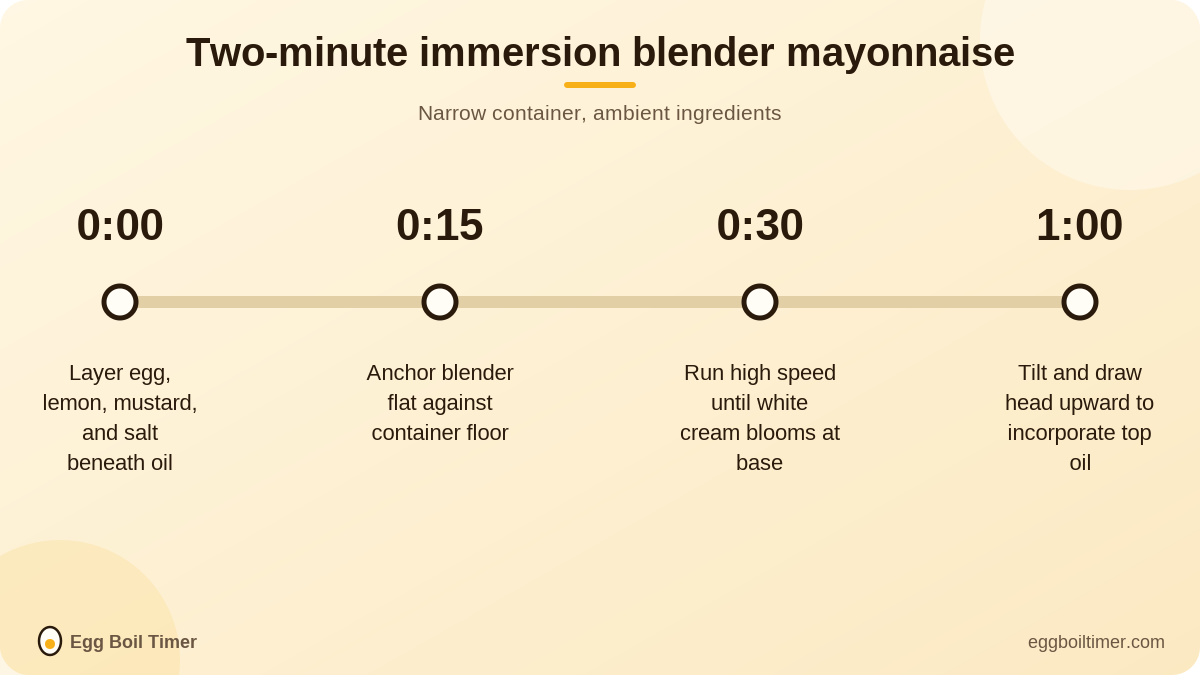
- Layer the base ingredients. Place one whole large egg (or two yolks) into the jar. Add 15 milliliters of lemon juice, five milliliters of Dijon mustard, and two grams of salt.
- Add the oil. Pour 240 milliliters of neutral vegetable oil on top. Let the layers settle for fifteen seconds. Because water carries higher density than plant lipids, the egg and citrus stay at the bottom while the oil floats above.
- Seat the blender head. Lower the stick blender straight down until the metal bell presses firmly against the jar floor. This traps the egg and mustard directly beneath the blades.
- Run at high speed. Turn the motor on maximum power without lifting the tool for ten seconds. The spinning blade emulsifies the egg yolk with the thin layer of oil beneath it, forming a thick white cream.
- Draw the vortex upward. Once thick cream rises around the blade shroud, tilt the blender head slightly. Pull it slowly toward the surface over ten to fifteen seconds. This vacuum pulls floating oil downward, converting all remaining fat into glossy mayonnaise.

Selecting Your Base Fat: Smoke Points, Bitterness, and Flavor
Oil makes up three-quarters of the recipe, so lipid choice sets both mouthfeel and flavor. Reaching for extra virgin olive oil often ruins a first batch. High-speed blender blades tear open olive polyphenols, releasing bitter glycosides that leave a harsh metallic taste in the back of your throat.
| Oil Variety. | Flavor Profile. | High-Shear Stability. | Best Culinary Application. |
|---|---|---|---|
| Refined Avocado Oil. | Clean finish, completely neutral. | Excellent. Free of bitter compounds. | Everyday sandwich spread, cold deli meats. |
| Sunflower or Safflower. | Light grain, subtle neutral body. | Excellent stability. | Chilled seafood bindings, lobster rolls. |
| Canola or Rapeseed. | Faint grassy tone. | Good. Check freshness before use. | All-purpose utility batches. |
| Extra Virgin Olive Oil. | Peppery, fruity, heavy body. | Poor with blenders. Whisk by hand. | Spanish alioli, Mediterranean dressings. |
| Toasted Sesame (10% blend). | Deep, roasted, aromatic. | Accent fat only. Blend with neutral oil. | Dipping sauces for cold poached proteins. |
To capture olive oil flavor without bitterness, emulsify 180 milliliters of neutral avocado or sunflower oil with the stick blender first. Once thick, fold in 60 milliliters of extra virgin olive oil by hand using a flexible silicone spatula.

Restoring a Broken Sauce: Temperature, Water, and Reset Yolks
An emulsion collapses when oil flows into the liquid base faster than surfactant molecules can coat it. Droplets collide, shed their water barriers, and leave behind a curdled, separated liquid. A broken emulsion does not waste your ingredients; it simply separates them.
| Symptom. | Root Cause. | Immediate Correction. |
|---|---|---|
| Sauce separates into oily liquid. | Fat introduced too fast. Shear speed too slow. | Whisk 5 ml warm water in a fresh bowl. Slowly drizzle broken sauce into it. |
| Thin consistency like cream. | Insufficient oil volume. Low droplet friction. | Keep blending while streaming in an extra 30 ml of neutral oil. |
| Harsh, burning bitter note. | Polyphenols sheared from extra virgin olive oil. | Stir in a teaspoon of whole milk or mild yogurt. Add a pinch of sugar. |
| Dense, greasy texture without fluidity. | Water phase exhausted by excessive fat. | Whisk in 5 to 10 ml of warm water or fresh lemon juice. |
If the warm water method fails, place a fresh egg yolk at room temperature in a clean bowl. Whisk the yolk with a half-teaspoon of lemon juice until frothy. Treat your broken mixture as pure oil: add it drop by drop into the new yolk while whisking vigorously. Once a thick base forms, pour the remaining mixture in a slow, steady stream to rescue the batch.
Raw Egg Microbial Risks and Cold Storage Windows
Raw shell eggs carry a small risk of internal contamination with Salmonella enteritidis. While commercial washing cleans the exterior, bacteria can occasionally exist within the yolk or albumen before the shell forms. For vulnerable individuals, including pregnant women, older adults, and young children, pasteurized in-shell eggs eliminate this risk while maintaining identical emulsifying power. This is general information, not medical advice.
Acidity serves as your main defense against microbial growth in raw sauces. Maintaining a pH level below 4.1 suppresses bacterial reproduction. Using at least 15 milliliters of fresh lemon juice or five-percent distilled vinegar per egg yolk lowers pH into a safe range while giving clean culinary bite. Commercial mayonnaise includes balanced acid stabilizers that allow multi-month shelf life, whereas fresh home preparations lack commercial preservatives.
Store freshly made mayonnaise in an airtight glass jar and refrigerate immediately below 4 °C (40 °F). Discard unused portions after seven days. Freezing homemade mayonnaise does not work. Cold temperatures turn liquid into sharp ice crystals that puncture the protein membrane, causing the emulsion to collapse into oil upon thawing.
Culinary Uses: From Cold Salads to Quick Herb Aiolis
Fresh mayonnaise forms the base for versatile cold sauces. Stirring in minced garlic transforms the emulsion into a sharp aioli for roasted potatoes and grilled fish. Chopping capers, tarragon, cornichons, and flat-leaf parsley into the cream produces a classic remoulade that cuts through fried seafood.
For packed lunches, two tablespoons bind ingredients for Twelve Eggs, Five Lunches: A Week of Egg Salad That Does Not Get Boring, coating chopped hard-cooked eggs without weeping water. It also anchors traditional Classic Deviled Eggs Recipe: Creamy Filling and Easy Peeling, where yolk paste whipped with mustard, vinegar, and mayonnaise creates a smooth filling that holds its shape. To boil your eggs to the exact yolk firmness needed, check the Egg Boil Timer timer before cooking.
Mayonnaise also handles high heat on the stovetop. Spread a thin film onto the outer bread slices of a grilled cheese sandwich. The uniform blend of fat and egg proteins browns into a crisp, even crust faster than butter. While warm emulsion sauces like hollandaise on Classic Eggs Benedict Recipe: Poached Eggs and Silky Hollandaise break easily if heated past 65 °C, cold mayonnaise tolerates daily kitchen handling without curdling.


