Liquid eggs consist of whole eggs, whites, or yolks cracked from their shells, blended, and heat-pasteurized for safety. Powdered eggs are whole eggs or separated parts spray-dried into a shelf-stable powder. Liquid eggs substitute 1:1 by weight for raw shell eggs in scrambles and baking, while powdered eggs need water reconstitution and suit long storage, dry mixes, or outdoor cooking.
Processing and Composition of Commercial Liquid Eggs
Commercial liquid eggs originate in high-speed shell-breaking plants. Automated blades crack fresh chicken eggs, separate or combine whites and yolks, and filter out chalazae strands and shell bits. The fluid passes through plate heat exchangers for pasteurization. Liquid whole egg holds at 60 °C (140 °F) for 3.5 minutes to eliminate Salmonella without setting the delicate albumen proteins. Liquid whites require a lower thermal target of 56.7 °C (134 °F) for 3.5 minutes because heat-sensitive conalbumin coagulates readily.
Packaged in aseptic cartons, liquid eggs maintain the moisture profile of shell eggs: 75% water, 12% protein, and 10% fat. Processors sometimes add 0.1% citric acid to prevent iron-sulfur reaction dark spots during high-heat cooking. Pure liquid egg whites contain no fat and roughly 10% protein. Some manufacturers include whipping stabilizers like triethyl citrate or guar gum to restore foam height lost during heat treatment.
Manufacturing and Chemical Changes in Egg Powders
Powdered eggs rely on rapid spray-drying. Fresh liquid egg pumps through fine atomizing nozzles into a drying tower charged with hot air at 120 °C to 150 °C (248 °F to 302 °F). Moisture flashes off in seconds while droplets float midair. The dried particles settle at the base as a pale powder containing under 5% water.
Before drying, commercial processors run an enzymatic desugaring step using glucose oxidase or yeast fermentation. Removing trace glucose prevents the Maillard reaction during long storage, which would otherwise turn the powder brown and create stale off-flavors over time. While flash heating preserves safety and protein content, heat slightly denatures ovalbumin. Reconstituted whole egg powder yields slightly firmer, less elastic gel structures than fresh eggs when cooked as plain scrambles, though its performance in doughs and batters remains strong.

Comparing Shelf Life, Storage, and Performance Metrics
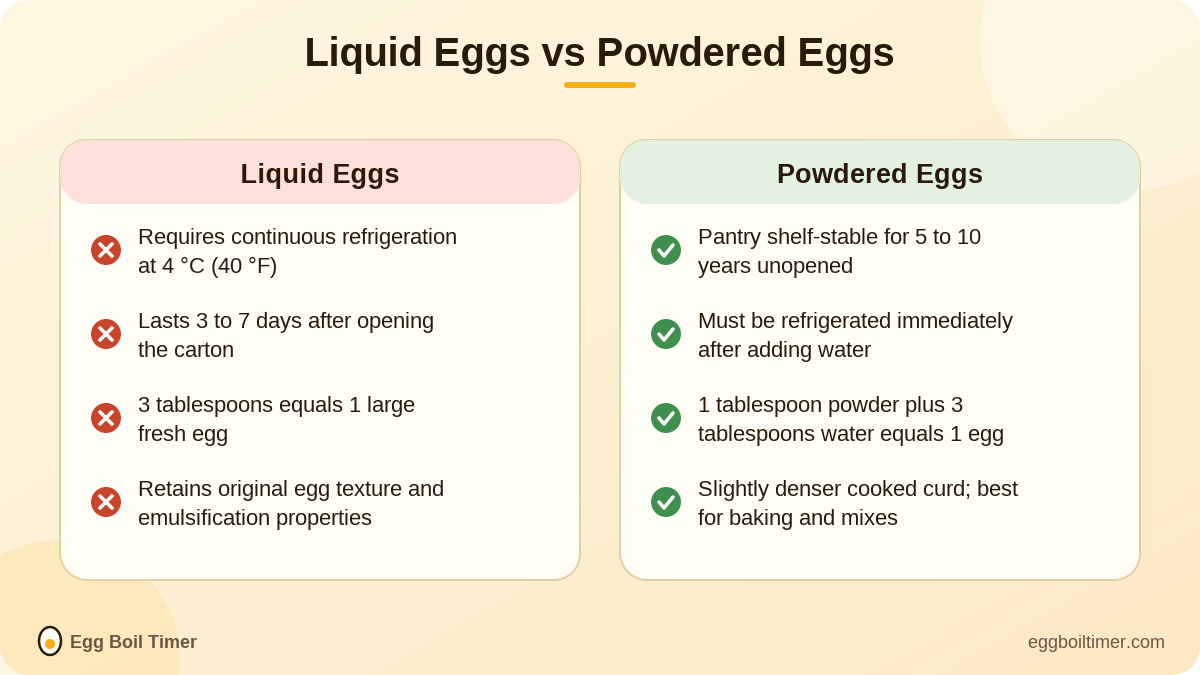
Deciding between liquid and powdered eggs comes down to refrigeration, storage space, and prep speed. Liquid eggs pour straight from the carton. Powdered eggs require measured cold water and a short whisking step before cooking.
| Characteristic | Liquid Eggs | Powdered Eggs |
|---|---|---|
| Storage Requirement | Refrigerated at 4 °C (40 °F) | Cool, dry pantry below 21 °C (70 °F) |
| Unopened Shelf Life | 2 to 12 weeks (pasteurized carton style) | 5 to 10+ years in vacuum-sealed tins |
| Opened Shelf Life | 3 to 7 days max under continuous chill | 6 to 12 months in an airtight container |
| Fresh Egg Ratio | 3 tablespoons (45 ml / 50 g) | 1 tbsp powder (13 g) + 3 tbsp water (45 ml) |
| Cooked Texture | Soft, fluffy, identical to shell eggs | Slightly firm and dense curds |
| Primary Kitchen Role | Scrambles, omelets, custard bases, quiches | Baking mixes, emergency supply, camping meals |
Dehydration causes minor lipid oxidation, which gives egg powder a faint cooked aroma. In baked cakes and quick breads, this aroma vanishes completely. In plain scrambled eggs, reconstituted powder tastes slightly flatter than liquid or fresh shell eggs.

Culinary Applications for Liquid Whites, Yolks, and Blends
Liquid whole eggs fit high-volume kitchen prep where cracking dozens of shells wastes minutes and clutters workspace. Pouring directly into a preheated pan speeds up omelets and scrambles. Because commercial liquid eggs are homogenized, they pour smoothly into custard bases and quiche fillings without yellow or clear streaks.
Liquid egg whites solve the problem of leftover yolks. Standard cartons supply pure albumen with zero yolk fat contamination, so they whip reliably into soufflé bases, angel food cake batters, and macarons. Check carton labels before buying: some liquid whites include added gums for stability that can suppress maximum meringue volume. Commercial pasteurized liquid yolks serve as emulsifiers in homemade hollandaise, mayonnaise, and rich ice cream bases without raw egg safety concerns.
Powdered Eggs in Baking, Storage, and Outdoor Cooking
Egg powder handles situations where refrigeration fails or weight matters. A 250-gram pouch of whole egg powder replaces roughly two dozen fresh eggs, eliminating fragile shells and bulk for backpackers. Sealed in metal cans with nitrogen flushes and oxygen absorbers, egg powder stays stable on pantry shelves for up to 10 years.
Dry baking mixes rely on egg powder for long shelf stability. Mixing powdered egg into pancake, waffle, or muffin bases means adding water later hydrates flour and egg at the same time. In commercial bread formulas, powdered egg whites strengthen crumb structure without adding excess liquid volume that could throw off hydration ratios.
Safety Standards and Thermal Pasteurization Rules
Processing guidelines establish strict microbial boundaries for liquid and dried eggs. The U.S. Department of Agriculture mandates thermal pasteurization for all commercial liquid egg products. This eliminates active Salmonella cells, making pasteurized liquid whites safe for raw applications like royal icing and mousses. Understanding how Pasteurized Eggs: Safety, Pasteurization Temp, and Cooking Uses protect vulnerable diners helps home cooks choose safe options for uncooked desserts.
After opening, liquid egg cartons require continuous refrigeration at or below 4 °C (40 °F) and spoil within 3 to 7 days. Unopened egg powder lasts years at room temperature, but once reconstituted with water, it becomes as perishable as raw egg. Reconstituted powder must be cooked immediately or chilled and used within 24 hours.
Troubleshooting Common Preparation and Texture Issues
Reconstituting and cooking processed eggs can occasionally produce unexpected textures. Identifying the underlying cause helps restore proper consistency in the kitchen.
- Lumps in Reconstituted Powder: Dumping water quickly onto a large pile of powder causes dry pockets trapped inside hydrated gel coatings. Always add a small portion of liquid first to form a paste, then whisk in the remaining water. Sifting egg powder with dry flour before adding liquid also prevents clumps in baking batters.
- Rubbery or Tough Scrambled Curds: Cooking reconstituted egg powder over high heat causes rapid protein shrinkage and water loss. Cook over low to medium-low heat and remove the pan from heat while curds remain soft. Letting reconstituted powder rest for 3 to 5 minutes before cooking allows full protein hydration.
- Grainy Liquid Egg Whites in Meringue: Liquid whites pasteurized at high heat may take longer to whip and can break if overbeaten. Add a pinch of cream of tartar (1/8 teaspoon per 3 liquid whites) to lower pH and stabilize protein bonds.
Conversion Ratios and Reconstitution Protocols
Replacing fresh eggs with liquid or powdered options requires precise volume measurements. Liquid eggs can be poured directly, while powdered eggs perform best when blended with cool or room-temperature water before cooking. Hot water should never be used for reconstitution because it prematurely cooks the egg proteins.
- 1 Large Fresh Whole Egg: Use 3 tablespoons (45 ml / 50 g) of liquid whole egg. For powder, mix 1 level tablespoon (13 g) of egg powder with 3 tablespoons (45 ml) of water.
- 1 Large Fresh Egg White: Use 2 tablespoons (30 ml / 30 g) of liquid white. For powder, mix 1 tablespoon (8 g) of egg white powder with 2 tablespoons (30 ml) of water.
- 1 Large Fresh Egg Yolk: Use 1.5 tablespoons (22.5 ml / 20 g) of liquid yolk. For powder, mix 1.5 teaspoons (6 g) of yolk powder with 1 tablespoon (15 ml) of water.
Timed boiling tools on our Egg Boil Timer help manage cooking precision whenever you prepare fresh in-shell eggs alongside convenient processed egg alternatives.


