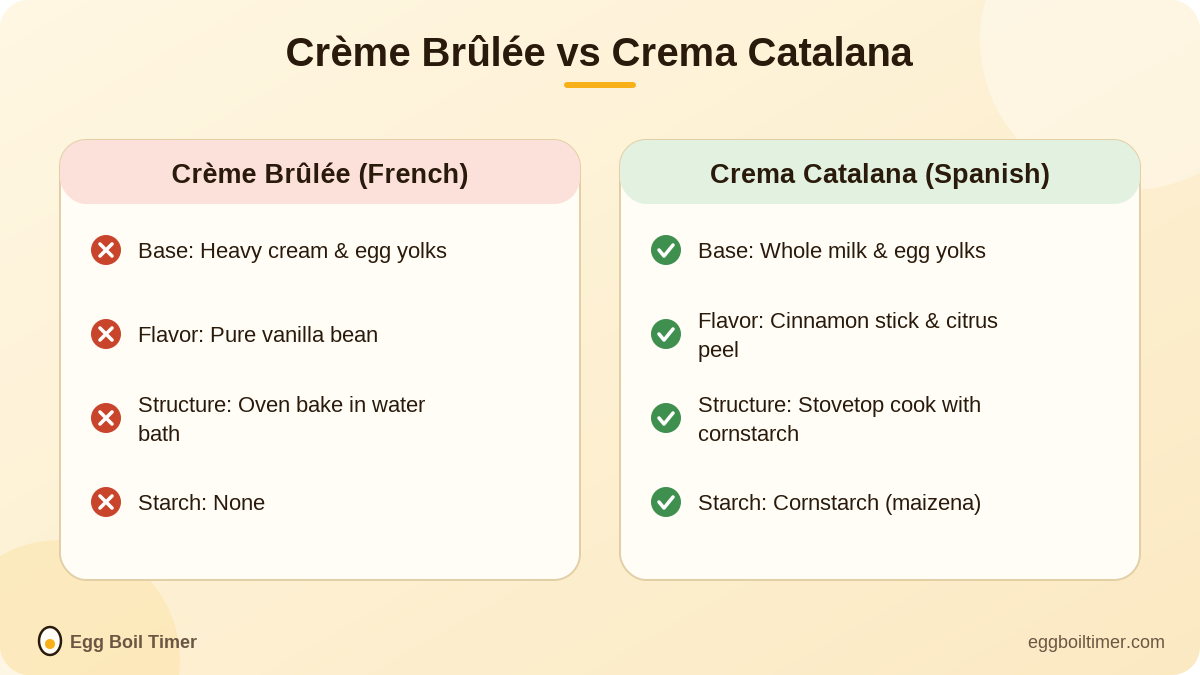
When comparing creme brulee vs crema catalana, the primary differences involve dairy fat, starch, flavorings, and cooking technique. Crème brûlée pairs heavy cream with egg yolks and vanilla. It bakes slowly in an oven water bath. Crema Catalana uses whole milk, egg yolks, cornstarch, lemon peel, and cinnamon. Cooks thicken it directly on the stovetop before torching a crisp sugar crust.
The Core Distinction: Cream vs. Milk, Oven vs. Stovetop
Both desserts feature a rich custard base crowned with caramelized sugar. You break the crisp shell with a spoon to reach the smooth filling beneath. Yet their mouthfeel and preparation follow completely different culinary rules.
Crème brûlée relies on the emulsifying power of egg yolks and heavy cream with 30% to 36% milkfat. Heat causes yolk proteins to form a gel network that traps milkfat and moisture. Liquid cream coagulates gently around 80 °C (176 °F). Because of this, the dessert bakes in a water bath inside a 150 °C (300 °F) oven to prevent curdling.
Crema Catalana, known as Crema de Sant Josep in Catalonia, uses whole milk instead of cream. Whole milk contains only about 3.5% fat. To gain structure, the custard relies on cornstarch. Starch granules gelatinize at 85 °C (185 °F), binding liquid and protecting yolk proteins from high heat. This stability allows cooks to prepare Crema Catalana directly in a saucepan on the stovetop.
Crème Brûlée: Heavy Cream and Bain-Marie Baking
The classic French formula depends on fat concentration for its velvety coating texture. Balancing liquid and yolk ratios ensures a firm set that yields cleanly to your spoon.
Standard proportions for four 150 ml ramekins:
- 400 ml heavy cream with at least 30% fat content.
- 50 g granulated sugar for the custard mixture.
- 4 large egg yolks.
- 1 whole vanilla bean, split and scraped.
- 20 g superfine sugar for torching.
- Infuse the cream: Heat heavy cream and vanilla bean in a pan until small bubbles outline the edge. Remove from heat, cover, and steep for 15 minutes.
- Combine yolks and sugar: Whisk 4 egg yolks with 50 g sugar in a bowl until blended. Avoid rapid whipping, as trapped air bubbles ruin the smooth surface.
- Temper the eggs: Slowly pour warm cream into the yolks while whisking continuously. Strain the custard through a fine sieve into a jug to remove chalazae.
- Bake in a water bath: Divide liquid among four wide ramekins. Set ramekins in a deep baking pan. Fill the pan with boiling water halfway up the ramekin sides. Bake at 150 °C (300 °F) for 30 to 35 minutes until the center wobbles slightly.
- Chill and torch: Cool for 30 minutes at room temperature, then refrigerate for 4 hours. Dust 1 teaspoon of superfine sugar across each cold custard. Melt the sugar with a torch held 5 cm away until deep amber. Serve within 15 minutes.

Crema Catalana: Citrus Infusion and Stovetop Thickening
Spanish Crema Catalana replaces heavy French cream with aromatic citrus and spice. Lemon peel and cinnamon yield a refreshing profile popular across Mediterranean Egg Recipes: Breakfast, Lunch, and Dinner Ideas.
Standard proportions for four shallow clay dishes:
- 500 ml whole milk.
- 4 large egg yolks.
- 75 g granulated sugar for the custard.
- 20 g cornstarch.
- 1 cinnamon stick.
- Peeled rind of 1 unwaxed lemon and half an orange with white pith removed.
- 25 g white sugar for caramelization.
- Infuse the milk: Warm 400 ml milk with cinnamon stick and citrus peels over medium-low heat until it simmers. Turn off heat and steep for 20 minutes.
- Dissolve the starch: Whisk 100 ml cold milk with 20 g cornstarch until completely smooth. Add 4 egg yolks and 75 g sugar, whisking until uniform.
- Thicken on stovetop: Strain warm milk into the yolk mixture while stirring. Return everything to the saucepan. Cook over medium-low heat while scraping the pan bottom continuously. When the liquid reaches 85 °C, cornstarch thickens the cream rapidly. Simmer gently for 1 minute to remove raw starch taste.
- Pour and cool: Strain custard into four shallow clay dishes. Let cool to room temperature. Unlike crème brûlée, Crema Catalana is traditionally served at room temperature or slightly chilled.
- Caramelize the sugar: Dust white sugar evenly over the surface. Sear with a red-hot iron plate or blowtorch until golden and crisp.

Side-by-Side Culinary Comparison
This comparison summarizes how structural choices dictate cooking method, texture, and serving conditions for both desserts.
| Feature | Crème Brûlée | Crema Catalana |
|---|---|---|
| Primary Dairy | Heavy cream (30% to 36% fat) | Whole milk (3.5% fat) |
| Thickener | Egg yolks only | Egg yolks and cornstarch |
| Dominant Aromatics | Vanilla bean | Lemon peel, orange peel, cinnamon stick |
| Cooking Method | Bain-marie water bath in oven | Direct stovetop simmer in saucepan |
| Texture | Ultra-dense, rich, silky melt | Smooth, light pudding, spoonable |
| Serving Temperature | Cold custard with warm sugar lid | Room temperature or slightly chilled |
| Traditions | French high dining, classic bistro | Catalan feast of St. Joseph (March 19) |
Historical Origins: Medieval Catalonia and 17th-Century France
Crema Catalana is widely recognized as the older dessert. Written recipes for Crema Catalana appear in Catalan manuscripts dating back to the 14th-century Llibre de Sent Soví. Catalans served it on Saint Joseph's Day on March 19 to celebrate spring milk production.
Recipes for Crème Brûlée appeared later. François Massialot published a famous version in his 1691 book Le Cuisinier Royal et Bourgeois. Massialot poured warm sugar over cooked custard, then seared it with a hot iron rod. English traditions also claim Trinity Cream from Cambridge in the late 17th century.
While both custards share ancient Roman roots, Crema Catalana shows Arab influences through citrus, cinnamon, and stovetop starch thickening. French crème brûlée refined the concept into a minimalist show of cream and vanilla.
Preventing Lumps, Graininess, and Soft Sugar Shells
Both custards feature clear chemical failure points during heating and torching. Precise heat management prevents texture defects.
Grainy Crème Brûlée: Without starch, egg yolks curdle at 85 °C. Overheated proteins link tightly and push out moisture. Always use a gentle water bath. Pull ramekins while the center still jiggles.
Lumpy Crema Catalana: Always dissolve cornstarch in cold milk first. Adding starch to warm liquid gelatinizes the outer layer, trapping dry powder inside lumps. If lumps form, strain the hot custard through a fine mesh before pouring.
Runny Custard Base: Crème brûlée stays liquid if baked at too low a temperature or with too few yolks. Use at least 1 egg yolk per 100 ml heavy cream. For Crema Catalana, bring the custard to 85 °C briefly. Heat activates starch gelatinization so the pudding sets upon cooling.
Melting Sugar Shell: Water vapor escaping cold custard dissolves burnt sugar into syrup within 20 minutes. Chill custards completely before torching. Wipe surface moisture with a paper towel. Torch quickly and serve immediately.
Kitchen Decisions: When to Prepare Which Custard
Select your dessert based on equipment, menu weight, and available time.
Choose Crème Brûlée when:
- You want an ultra-rich dessert for formal meals.
- You have shallow ramekins, a roasting dish, and an oven.
- You prefer pure vanilla over citrus and spice.
- You have surplus heavy cream in the fridge.
Choose Crema Catalana when:
- You need a fast dessert without heating the oven.
- You want a lighter profile featuring lemon, orange, and cinnamon.
- You have whole milk on hand.
- You serve guests who prefer lower-fat desserts.
Both dishes demonstrate how fat levels and starch chemistry reshape standard egg yolks into classic custards. For other egg dessert preparations, explore our guides on Silky Chinese Steamed Egg Custard: Ratio and Technique and Egg Tart Art: Hong Kong Custard Recipe and Technique. To calculate exact egg boiling times for other dishes, try our Egg Boil Timer.


