Guinea fowl eggs weigh between 40 and 45 grams, featuring a pointed teardrop profile, a speckled tan shell, and a high yolk-to-white ratio. Their culinary value comes from an oversized yolk. It produces rich emulsified sauces, golden egg noodles, and tender soft-boiled snacks without gamey funk.
Tear-Drop Shells: What Makes Guinea Fowl Eggs Unique
Guinea fowl lay eggs shaped distinctly like blunt pyramids or stout teardrops. One pole tapers to an acute point, while the opposite end remains broad and rounded. This pyriform geometry keeps the egg from rolling away if laid on bare ground.
Wild ancestors of the domestic guinea fowl nested in open savannas across sub-Saharan Africa. Ground predators, thorny scrub, and dry heat demanded tough physical defenses. As a result, the shell is nearly twice as thick as that of commercial Chicken Eggs: Anatomy, Formation, Nutrition, and Cooking.
The calcified wall measures roughly 0.55 millimeters across. Calcium carbonate crystals pack tightly within the shell matrix, minimizing microscopic pore space. This dense barrier restricts gas exchange and preserves vital moisture during hot afternoons.
Directly beneath the shell sits a fibrous inner membrane. This protein lattice binds tightly to the egg white. It creates a secondary barrier against bacteria and environmental dirt.
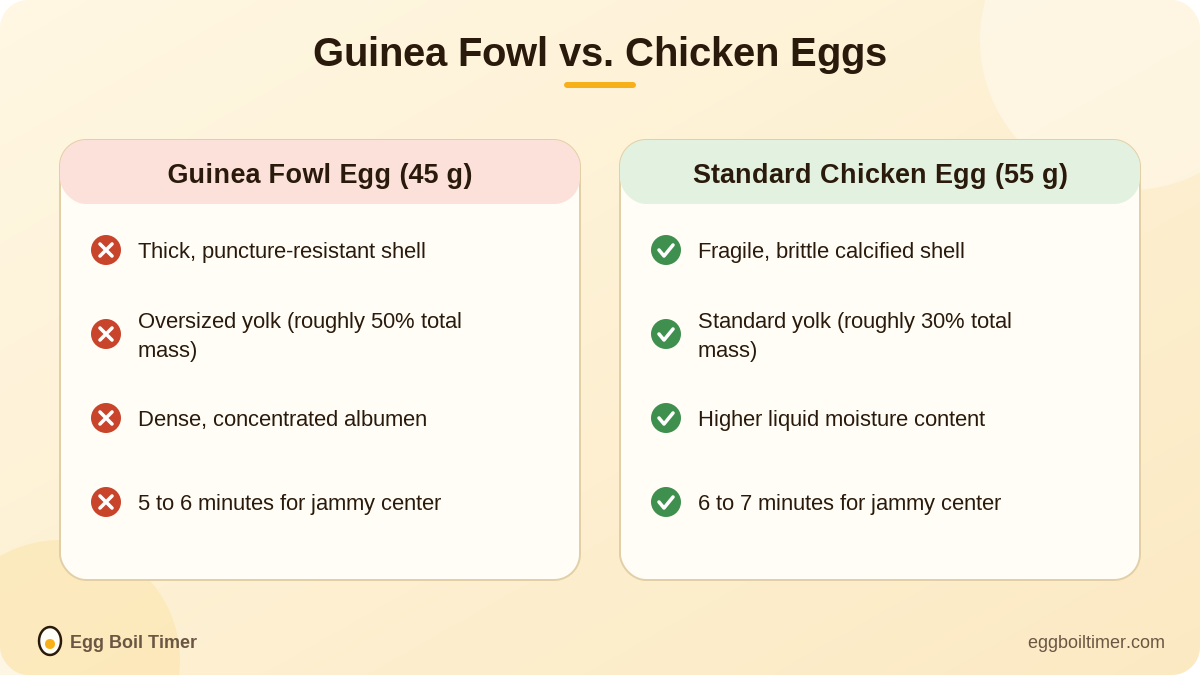
The interior architecture reveals an amber yolk that commands almost half the total volume. In a standard hen egg, the yolk rarely exceeds thirty percent of the weight. The surrounding albumen is compact, glossy, and noticeably low in free water.
Flavor Profile and Texture: Richness Without Gameyness
Many cooks assume that active, semi-wild poultry produce pungent eggs. In reality, a fresh guinea fowl egg has a sweet, clean, and buttery flavor. You will not detect mineral twang, swampy odors, or musky bitterness.
The culinary difference lies entirely in mouthfeel. Because lipid concentration is higher than in chicken eggs, guinea fowl yolks coat the tongue like light pastry cream. They taste decadent when seasoned with coarse sea salt.
Whisked into scrambled eggs, the curds set into soft, velvety ribbons without added cream. The dense albumen holds together neatly during pan frying. It resists weeping watery liquid onto the plate, a common flaw of industrial supermarket eggs.
For fresh pasta dough, guinea yolks provide radiant yellow color and superior tensile strength. The extra lecithin emulsifies flour rapidly, yielding noodles with a firm, toothsome bite. When used in custards, these eggs produce a glossy sheen and a silky finish.
In cold emulsions like mayonnaise or aioli, the dense yolk absorbs oil effortlessly. You get a thick, stable sauce using fewer yolks than traditional French recipes require.

Physical Measures: Guinea Fowl Versus Standard Poultry Eggs
Poultry species produce eggs tailored to their environment and reproductive biology. Waterfowl like How to Boil Duck Eggs: Times for Runny, Jammy and Hard Yolks store massive fat reserves for cold aquatic conditions. Petite How to Boil Quail Eggs (and Peel Them Without Losing Your Mind) offer high shell surface area, while larger Turkey Eggs: Flavor, Nutrition, Cooking Times, and Scarcity provide substantial volume. Guinea eggs concentrate rich nutrients into a compact frame.
| Characteristic. | Guinea Fowl Egg. | Large Chicken Egg. |
|---|---|---|
| Average Weight | 40 to 45 g. | 50 to 55 g. |
| Shell Thickness | 0.50 to 0.60 mm. | 0.30 to 0.35 mm. |
| Yolk Share of Volume | 45% to 50%. | 30% to 32%. |
| Calories | 65 to 70 kcal. | 72 kcal. |
| Protein Content | 5.5 to 6.0 g. | 6.3 g. |
| Fat Content | 5.2 to 5.6 g. | 5.0 g. |
| Choline Density | Exceptionally high. | High. |
Although a guinea fowl egg is smaller in overall mass, its absolute fat content equals a large hen egg. Gram for gram, each bite provides higher quantities of fat-soluble vitamins, including vitamin A, lutein, and zeaxanthin.
The albumen contains less diluted free water than conventional chicken albumen. This dense protein structure means baked goods rise with smaller, more uniform air pockets. It also requires careful attention to liquid balance in hydration-sensitive doughs.
Mineral concentrations are also notable. Guinea eggs contain higher shares of bioavailable iron and phosphorus. These minerals support red blood cell production and muscular energy transfer.

Boiling Times for Soft, Jammy, and Firm Centers
Boiling guinea fowl eggs requires careful clock monitoring. Their compact 40 to 45 gram weight heats through quickly. However, the thick shell slows early heat transfer compared to fragile hen eggs.
Our cooking models at Egg Boil Timer calculate thermodynamic conduction based on egg mass, shell density, and target core temperature. Lowering cold eggs directly into rolling water at 100 °C produces reliable doneness intervals across different egg weights.
| Target Doneness. | 40 g Egg. | 45 g Egg. | Yolk Texture. |
|---|---|---|---|
| Runny (dippy) | 4 min 50 sec. | 5 min 15 sec. | Liquid core, softly coagulated white. |
| Jammy (custardy) | 5 min 40 sec. | 6 min 10 sec. | Fudge-like border, thick warm center. |
| Firm / Hard | 8 min 05 sec. | 8 min 45 sec. | Solidified golden yolk, tender white. |
Fill a deep saucepan with enough water to submerge the eggs by at least two centimeters. Bring the water to a rolling boil over medium-high heat. Add a half-teaspoon of salt to assist with water circulation.
Use a slotted spoon to lower the cold eggs gently onto the bottom of the pan. Start your timer immediately. Adjust the stove flame so the water stays at a steady simmer rather than a violent, rattling boil.
At high altitudes, atmospheric pressure drops and water boils at lower temperatures. If you cook at 1,200 meters, water boils at roughly 96 °C. Add 30 seconds to the times listed above to achieve identical yolk firmness.
Prepare an ice bath while the eggs cook. Mix equal parts cold tap water and ice cubes in a wide bowl. As soon as the timer sounds, transfer the eggs straight into the ice bath for five minutes.
Cracking and Peeling: Managing the Fibrous Inner Membrane
The thick shell of a guinea fowl egg resists gentle kitchen taps. Striking an egg lightly against a flat counter often leaves the shell unbroken. Striking it too hard can shatter the shell into messy shards.
To open raw eggs cleanly, strike the waist firmly against the rim of a ceramic bowl. You can also tap the midline using the back of a butter knife. The concentrated impact creates a clean horizontal fracture across the calcified wall.
Boiled guinea eggs present another challenge. The inner shell membrane binds tightly to fresh albumen. If you boil an egg gathered yesterday, large chunks of egg white will tear away with the shell.
Age solves this mechanical issue. Store fresh eggs in the refrigerator for seven to ten days before boiling them. During storage, gradual moisture loss enlarges the air pocket, while rising albumen pH loosens the membrane bond.
After a five-minute ice bath, tap the blunt bottom of the egg on a hard surface to crack the air cell. Roll the egg gently between your palm and the work surface to create fine hairline fractures.
Peel the shell under a thin stream of cool running water. The water pressure slips between the fractured shell fragments and the egg white. It gently lifts the tough inner membrane away from the coagulated protein.
Culinary Techniques: Pastry, Pasta, and Pan Cooking
Adapting guinea fowl eggs to standard recipes requires only minor adjustments. In quick pan preparations, their rich yolk produces outstanding sunny-side-up dishes. Fry them in olive oil over low heat until the base crisps while the yolk remains warm and runny.
Poaching guinea fowl eggs is remarkably straightforward. Because their fresh albumen is naturally dense, the white stays bundled around the yolk without trailing feathery threads into the water. Poach them for three minutes in barely simmering water.
For fresh egg pasta, replace standard whole eggs by weight. Four guinea fowl eggs equal approximately three large chicken eggs. The resulting dough rolls out with incredible elasticity and dries into an amber pasta that holds heavy meat ragùs beautifully.
In sponge cakes and light batters, the lower water content in the white can make mixtures slightly stiff. If your cake crumb turns out too dense, add one tablespoon of whole milk per two guinea eggs. This extra hydration balances the rich lipid concentration.
Meringues made from guinea whites whip into stiff, durable peaks. However, because the whites contain less liquid, they take about two minutes longer to foam under an electric mixer. Add a pinch of cream of tartar to support steady foam expansion.
Seasonal Laying Habits, Sourcing, and Cold Storage
Unlike commercial chickens bred to produce eggs year-round under artificial light, guinea fowl remain seasonal layers. They begin laying clutches in late spring when ambient temperatures warm and day lengths exceed thirteen hours.
Laying production naturally tapers off in late summer as days grow shorter. A single healthy guinea hen produces between 60 and 100 eggs each year. Because of this brief window, you will find them mostly at farmers markets from May to August.
When shopping at farm stands, inspect shells for hairline fractures. Guinea hens often drop eggs in hidden ground nests among tall grasses. Reputable farmers collect nests daily to ensure optimal freshness.
Their dense shell structure provides a substantial storage advantage. Unwashed eggs retain a protective natural bloom that seals the shell pores against moisture loss and bacterial entry. In a cool pantry at 14 °C, clean unwashed eggs remain fresh for three weeks.
Refrigerated below 4 °C, unwashed or washed eggs stay fresh for eight to ten weeks without noticeable flavor loss. Always store them pointed end down in a covered carton. This orientation keeps the internal air cell positioned properly at the blunt top.


