Standard chicken eggs anchor everyday cooking through a dependable balance of water, protein, and fat. Formed across an internal cycle of 24 to 26 hours, each shell holds a self-contained biological system designed either to sustain an embryo or build stable custards, batters, and emulsified sauces.
Anatomy of an Egg: Protective Barriers and Structural Whites
A fresh egg consists of seven distinct structural components. On the outside sits the calcium carbonate shell, which is pierced by thousands of microscopic pores that allow oxygen and carbon dioxide exchange. Immediately beneath the hard exterior lie the outer and inner shell membranes. These protein sheets defend against bacterial invasion while enclosing the fluid albumen.
The egg white splits into two distinct layers: a firm inner white that clings to the center and a thinner outer white that spreads across a pan. Suspended within the albumen are the chalazae, two twisted strands of mucin protein that anchor the yolk in the center of the shell. The yolk itself remains bound by the transparent vitelline membrane. As an egg ages, this membrane weakens and absorbs moisture from the albumen, causing older yolks to flatten and break easily upon cracking.
At the blunt end of the shell sits the air cell. When a hen lays an egg at body temperature, the contents cool and contract, drawing ambient air through the porous shell to separate the inner and outer membranes. This pocket widens over time as internal moisture evaporates during storage, providing an accurate indicator of culinary age.
The Biological Cycle: How Hens Build an Egg in 25 Hours
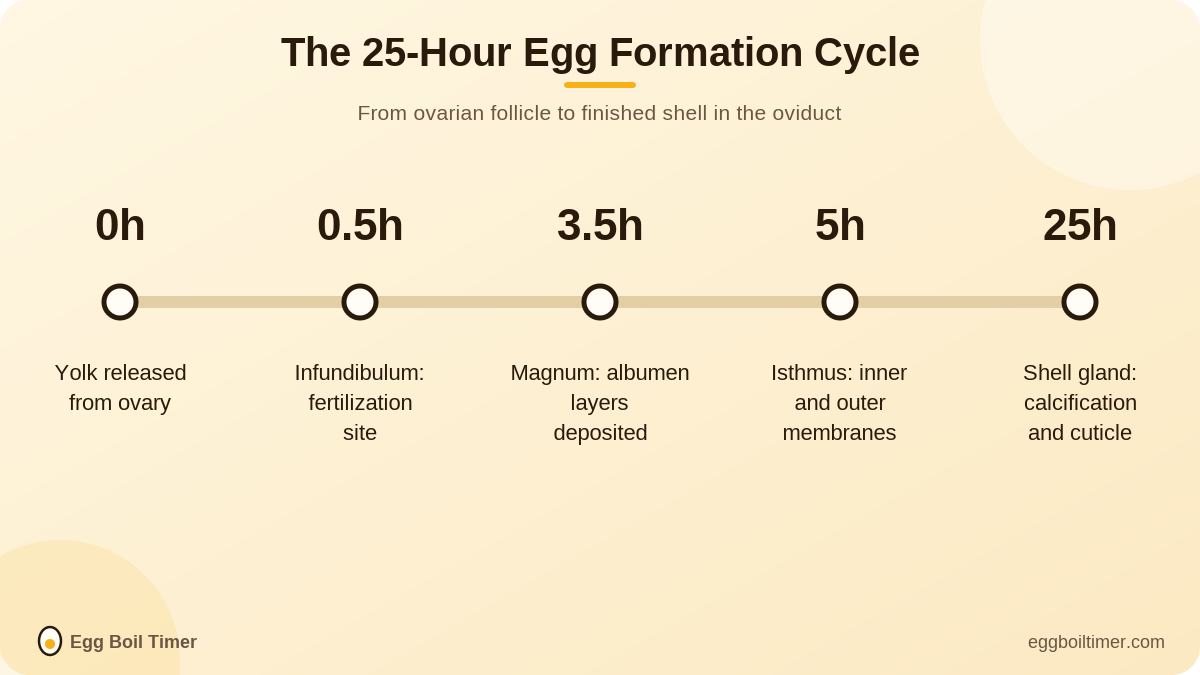
Egg formation begins in the hen's ovary with ovulation. The ovary releases a mature yolk follicle into the oviduct, a specialized muscular tube where sequential biological layers develop over roughly 25 hours. Fertilization can occur only in the first segment, the infundibulum, during a narrow 15-minute window before protective whites encase the yolk.
The traveling yolk enters the magnum, where glandular tissue secretes the thick and thin albumen over three hours. Next, the egg moves into the isthmus for approximately 75 minutes, where keratin and collagen fibers form the dual inner and outer shell membranes. The developing egg then rests in the shell gland, also known as the uterus, for 20 hours.
During this uterine phase, the hen deposits calcium carbonate crystals onto the membranes, creating the hard shell. In the final hours before laying, the shell gland applies the cuticle, or bloom. This protein film seals the pores against environmental microbes like Salmonella. The hen then expels the finished egg through the cloaca, and the reproductive cycle resets roughly 30 minutes later.

Fertility and Embryo Myths: What Store Shells Actually Contain
Commercial grocery stores sell unfertilized eggs produced by hens kept without roosters. A hen ovulates and lays eggs on a regular schedule regardless of whether a male bird is present. Without mating, the germinal disc on the yolk surface remains a flat, microscopic blastodisc that cannot develop into an embryo.
Backyard flocks that include a rooster produce fertilized eggs containing a blastoderm with genetic material from both parents. Despite common misconceptions, fertilized eggs do not contain blood embryos or developing chicks when gathered promptly. Development halts completely once the egg cools below 20 °C (68 °F), remaining suspended unless kept in an incubator at 37.5 °C (99.5 °F) for several days. Fertilized and unfertilized eggs share identical nutrient profiles, culinary behavior, and flavor.
Red flecks occasionally found on the yolk are blood spots, caused by a ruptured capillary on the ovarian follicle during ovulation. They do not indicate fertility or spoilage. Commercial candling lights remove most eggs with visible spots, but any that slip through remain safe to cook, or you can lift them out with the tip of a clean knife.

Pigment Genetics: Earlobes, Feed Carotenoids, and Shell Hue
Shell color reflects the breed of the hen and carries zero influence on taste, protein density, or baking performance. White-feathered breeds with white earlobes, such as Single Comb White Leghorns, lay pure white shells. Breeds with red or pink earlobes, like Rhode Island Reds and Plymouth Rocks, deposit a brown pigment called protoporphyrin onto the exterior during the final hours in the shell gland.
Certain specialized breeds carry genetic variations that alter pigment deposition. Araucana and Ameraucana hens secrete oocyanin, a bile pigment that permeates the entire shell structure to create solid blue hues. Crossing blue-egg layers with brown-egg layers produces Olive Eggers, whose brown surface wash over a blue base creates deep green tones. For everyday cooking, Brown or White: Does the Colour of the Shell Change the Boiling Time? perform identically under heat.
Unlike the shell, yolk color responds directly to diet rather than genetics. Hens fed yellow corn, alfalfa, or marigold petals consume high levels of xanthophylls and carotenoids, resulting in deep orange yolks. Grain-fed hens consuming wheat or barley yield pale yellow yolks. While pasture-raised hens with varied forage produce intensely pigmented yolks, yolk shade alone does not alter structural thickening or emulsification power.
Chicken Eggs Compared with Duck, Quail, and Goose Varieties
While chicken eggs represent the universal standard in home and commercial recipes, other avian species offer distinct fat-to-protein ratios and physical properties. Waterfowl eggs feature significantly thicker shells, higher fat concentrations, and larger yolk volumes relative to their total weight.
| Attribute | Chicken Egg | Duck Egg | Quail Egg | Goose Egg |
|---|---|---|---|---|
| Average Weight | 50 g (Large) | 70 g | 11 g | 145 g |
| Yolk-to-White Ratio | 1:2 (33% yolk) | 1:1.5 (40% yolk) | 1:1.5 (39% yolk) | 1:1.2 (45% yolk) |
| Albumin Moisture | 88% water | 85% water | 87% water | 84% water |
| Shell Thickness | 0.35 mm | 0.50 mm | 0.20 mm | 0.60 mm |
| Primary Culinary Role | Universal baking, emulsifying, boiling | Rich custards, hearty pasta, lamination | Canapés, decorative garnishes, quick frying | Heavy baking, large-batch enriched doughs |
Because chicken albumen contains more moisture and less dense ovalbumin than duck albumen, it whips into stable meringues with less effort. Conversely, the high yolk fat percentage of waterfowl makes them exceptional for pasta doughs. You can explore specialized techniques by learning How to Boil Quail Eggs (and Peel Them Without Losing Your Mind) or mastering How to Boil Duck Eggs: Times for Runny, Jammy and Hard Yolks on precise heat schedules.
Nutritional Composition: Protein Quality and Micronutrient Density
A single large raw chicken egg weighing 50 grams delivers 6.28 grams of complete protein, 4.79 grams of fat, and 0.36 grams of carbohydrates. Egg protein contains all nine essential amino acids in balanced proportions, earning it an exceptionally high biological value score in human nutrition. The white supplies 3.6 grams of pure protein with negligible fat, while the yolk contains the remaining 2.7 grams of protein alongside essential lipids.
The yolk concentrates essential micronutrients, providing 1.86 micrograms of Vitamin D, 0.45 micrograms of Vitamin B12, and 74.5 micrograms RAE of Vitamin A per large unit. It also supplies choline, an essential nutrient for cellular membrane integrity and brain health. While a large yolk carries approximately 186 mg cholesterol, dietary studies demonstrate that saturated fat intake influences blood serum cholesterol far more significantly than moderate dietary egg consumption.
For recipes requiring raw or partially set yolks, cooks concerned about food safety often turn to commercial Pasteurized Eggs: Safety, Pasteurization Temp, and Cooking Uses. These undergo controlled low-temperature water baths to destroy pathogens without denaturing the albumen proteins.
Freshness Assessment, Washing Risks, and Temperature Control
The buoyant density test provides an accurate, non-destructive method to gauge shell age. Place an intact egg in a deep bowl of cold tap water. A freshly laid egg lies flat horizontally on the bottom because its air cell remains tiny. An egg several weeks old tilts upward or stands vertically on its point as the air cell expands from moisture loss.
If an egg bobs to the surface and floats completely, significant evaporation has occurred. Floating does not automatically mean rot; it simply confirms an enlarged air cell. Always crack floating eggs into a small ramekin to verify freshness before use. A spoiled egg emits an unmistakable sulfur odor caused by hydrogen sulfide gas released by degrading albumen proteins.
Handling rules depend on whether the bloom remains intact. In North America and Japan, commercial processing facilities wash eggs to sanitize shells, stripping the protective cuticle and requiring strict refrigeration at or below 4 °C (40 °F). In Europe, regulations prohibit commercial shell washing, preserving the cuticle so eggs can sit safely at room temperature. Never wash farm-fresh eggs until immediately before cracking, as wetting the porous shell draws surface bacteria inward.
From Emulsions to Custards: Harnessing Distinct Proteins
Culinary success relies on managing the separate denaturation temperatures of egg components. Ovalbumin and ovotransferrin in the white begin coagulating at 62 °C (144 °F) and become completely firm at 80 °C (176 °F). Yolk proteins thicken between 65 °C (149 °F) and 70 °C (158 °F). This temperature separation makes it possible to produce a firm white encasing a warm, liquid yolk using our Egg Boil Timer guidelines.
In emulsion sauces like mayonnaise and hollandaise, yolk lecithin acts as an amphiphilic binder, holding vegetable oil droplets suspended within an acidic water phase. When folding beaten whites into soufflés, mechanical shearing denatures globulin proteins to trap air bubbles, which expand under oven heat while ovotransferrin sets the perimeter walls.
Beyond fresh cooking, cultural methods transform chicken eggs through chemical curing and fermentation. Alkaline pickling produces translucent Century Eggs: How They Are Made, Flavor, and Safe Preparation, while Southeast Asian street traditions utilize partially incubated duck or chicken eggs to prepare What Is Balut? Incubation, Flavor, Safety, and Culture. Industrial food production also relies heavily on stabilized Liquid Eggs vs Powdered Eggs: Uses, Storage, and Ratios for bulk baking efficiency.
General safety reminder: raw or undercooked egg products carry a minor baseline risk of foodborne bacteria. Vulnerable groups, including infants, pregnant individuals, and older adults, should consume eggs cooked until both the white and yolk are completely firm. This advice serves as general culinary information, not medical guidance.


