Classic hollandaise sauce is a warm emulsion of melted butter suspended in lightly cooked egg yolks, balanced by fresh lemon juice and salt. A standard batch uses three large egg yolks for every 115 grams of butter. This ratio yields an airy, velvety coating that clings to food without feeling heavy or turning greasy.
Codified by Auguste Escoffier as one of the five French mother sauces, hollandaise anchors classic dishes like Classic Eggs Benedict Recipe: Poached Eggs and Silky Hollandaise and steamed asparagus. Unlike cold emulsified sauces such as Homemade Mayonnaise: Ratios, Oil Chemistry, and Technique, hollandaise depends on precise thermal control. Yolk proteins scramble into grainy curds above 68 °C, while butter fat solidifies and separates below 45 °C.
Emulsion Architecture: How Yolks Suspend Butterfat
An emulsion forces two repelling liquids, water and lipid fats, to form a stable mixture. Egg yolk serves as the surfactant bridge in this physical reaction. A single raw yolk contains roughly 50 percent water, 30 percent fat, and 16 percent protein. It is packed with natural emulsifiers including lecithin and low-density lipoproteins.
Yolk proteins possess hydrophilic heads that attract water and lipophilic tails that embed into liquid lipids. Rapid whisking shears melted butter into microscopic droplets. Yolk emulsifiers wrap around these droplets, preventing them from colliding and separating into clear oil.
Temperature governs whether these proteins maintain their protective structure. Below 45 °C (113 °F), butterfat begins to crystallize, squeezing liquid fat out of the matrix. Above 68 °C (155 °F), egg proteins denature completely into rigid curds. The ideal operational window for hollandaise stays between 50 °C and 57 °C (122 °F to 135 °F), where yolk proteins remain flexible while butter fat stays completely liquid.
Yolk to Butter Ratios and Chemical Balance
Specific ingredient ratios maintain emulsion stability while preventing a greasy texture. In raw form, 100 grams of egg yolk supplies approximately 322 calories, 16 grams of protein, and 26 grams of fat. Unsalted butter contains 717 calories and 81 grams of fat per 100 grams. The proportion of fat to yolk determines whether the emulsion holds or breaks.
A classic formula provides 35 to 40 grams of butter per egg yolk. Using less than 30 grams of butter per yolk produces a thin sauce dominated by egg flavor. Exceeding 55 grams of butter per yolk overloads the available lecithin, causing fat globules to crowd together and split the continuous liquid matrix.
Acid contributes both structural stability and flavor balance. Fresh lemon juice lowers the yolk pH, encouraging proteins to unfold gently without forming tight curds. Adding 5 milliliters of water or citrus juice per yolk supplies the continuous water phase required to suspend fat droplets. Without sufficient water, fat globules coalesce into clarified oil.

Comparing Prep Paths: Double Boiler Versus Immersion Blending
Home cooks choose between manual whisking over steam and high-speed mechanical shearing based on batch size and preferred sauce body. Whisking incorporates micro-bubbles of air for expanded volume, while motorized blades tear butter into uniform microscopic droplets instantly.
| Technique Factor. | Stovetop Bain-Marie. | Immersion Stick Blender. |
|---|---|---|
| Physical Texture. | Airy, light, mousseline-like volume. | Dense, glossy, rich body. |
| Active Whisking Time. | 8 to 12 minutes of whisking. | 60 to 90 seconds of blending. |
| Heat Source. | Steam heating bowl base. | Thermal energy from 85 °C butter. |
| Batch Scalability. | Scales from 2 to 12 servings. | Requires minimum volume for blades. |
| Curdling Risk. | Moderate if bowl overheats. | Low due to rapid blending speed. |
The stovetop bain-marie yields an expanded, airy sauce through manual whipping. An immersion blender creates a denser, velvet matrix by applying high shear force in seconds. Explore technique variations across our collection of Egg Recipes: Breakfast, Lunch, and Dinner Ideas.

Double-Boiler Execution for Velvet Texture
A classic bain-marie applies indirect steam to prevent sudden thermal spikes. Set a rounded heatproof bowl over a saucepan filled with 3 centimeters of gently simmering water. Ensure the bowl bottom remains 2 centimeters above the water line, as direct metal contact cooks egg yolks instantly.
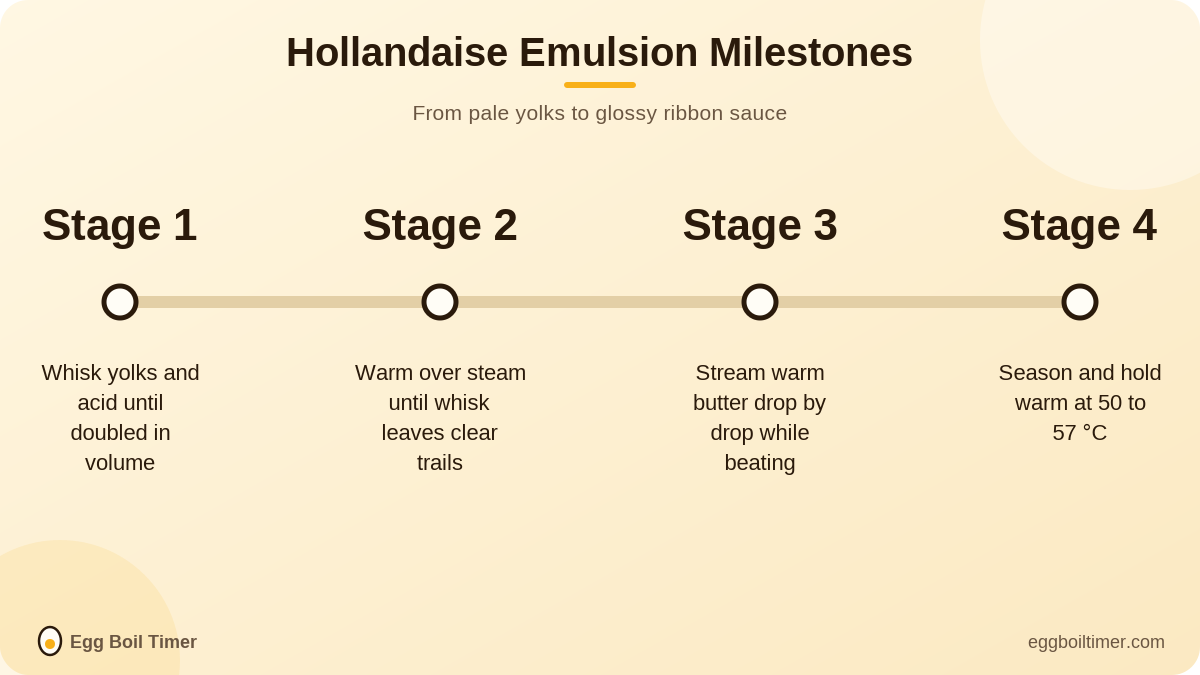
- Build the acidic base: Combine 3 large egg yolks, 15 milliliters of lemon juice, and 15 milliliters of cold water in your bowl. Whisk off the heat for 60 seconds until pale and frothy.
- Cook the sabayon base: Place the bowl over steaming water set to medium-low heat. Whisk continuously in wide figure-eight strokes. In 2 to 4 minutes, the mixture thickens until the whisk leaves distinct ribbon tracks.
- Incorporate the warm fat: Set the bowl on a damp dish towel to stabilize it. Whisk in 115 grams of warm melted butter drop by drop initially. Once the emulsion takes hold, pour the remaining butter in a slow, steady stream while whisking continuously.
- Season and adjust: Stir in a quarter teaspoon of fine salt and a pinch of cayenne pepper. If the sauce thickens excessively, whisk in warm water half a teaspoon at a time to loosen.
Rapid Blender Emulsification in Two Minutes
Immersion blenders minimize emulsification failures by shearing fat droplets instantly into an egg base. Hot butter cooks the raw yolks lightly while forming the emulsion simultaneously.
- Position base ingredients: Combine 3 large egg yolks, 15 milliliters of lemon juice, 5 milliliters of warm water, and a pinch of salt in a narrow immersion container. Ensure the blender blades fully submerge into the yolk mixture.
- Heat the butter: Heat 115 grams of unsalted butter in a small pan until bubbling between 80 °C and 85 °C (176 °F to 185 °F). Skim surface milk solids if a clearer gloss is desired.
- Engage and blend: Place the immersion head at the very bottom of the jar. Blend on high speed for 5 seconds to aerate the yolk and acid base.
- Feed the stream: Pour hot melted butter down the inner wall of the jar in a thin, continuous stream. As the emulsion forms at the base, slowly draw the blender head upward to incorporate top fat over 15 seconds.
Diagnosing and Rescuing Split, Curdled, or Thin Sauces
A broken hollandaise occurs when fat droplets separate from the liquid phase due to thermal stress or adding butter too quickly. Discarding a split batch is unnecessary because mechanical whisking and water adjust the emulsion grid easily.
| Symptom. | Underlying Cause. | Corrective Action. |
|---|---|---|
| Oily separation. | Butter added too quickly or cooled below 45 °C. | Whisk 15 ml warm water in a clean bowl, then slowly beat in split sauce drop by drop. |
| Grainy yellow flecks. | Yolks overheated past 68 °C. | Strain sauce through mesh. Beat a fresh yolk with 5 ml water, then slowly whisk strained fat into it. |
| Runny texture. | Yolks undercooked or insufficient fat added. | Whisk over gentle steam for 60 seconds, or beat in 20 grams of warm melted butter. |
| Seized thick paste. | Butter cooled or ratio lacks liquid water. | Whisk in warm water, one teaspoon at a time, until smooth and fluid. |
When oily separation appears, adding more butter makes the problem worse because the continuous water phase has run out of space to hold fat droplets apart. Whisking a splash of warm water into a clean bowl re-establishes the water foundation. Slowly pouring the broken sauce into this fresh base allows yolk emulsifiers to re-coat the fat droplets, restoring a smooth, glossy texture within 60 seconds.
Holding Temperatures, Storage Limits, and Food Safety
Hollandaise sauce requires strict temperature management due to microbial considerations and delicate thermal boundaries. Holding conditions must keep butter melted without cooking yolk proteins into solid curds.
According to official regulatory safety standards, raw shell eggs broken for immediate service must reach 63 °C (145 °F) for 15 seconds. Egg mixtures not prepared for immediate service require cooking to 68 °C (155 °F) for 17 seconds. General consumer safety guidelines suggest cooking egg dishes thoroughly to 71 °C (160 °F).
Because classic hollandaise breaks above 60 °C, regulatory guidelines specify strict holding parameters:
- The two-hour rule: Discard hollandaise held at room temperature after two hours. If ambient temperatures exceed 32 °C (90 °F), the safe window drops to one hour.
- Thermal holding: Store fresh sauce in a pre-warmed vacuum flask. This holds the sauce at a safe 52 °C for up to 90 minutes without splitting or cooling.
- Vulnerable groups: Pregnant individuals, young children, older adults, and immunocompromised individuals should use in-shell pasteurized eggs. Federal inspection standards mandate pasteurized egg products to destroy Salmonella while preserving liquid yolk properties.
- Cold storage and reheating: Refrigerate unused sauce at 4 °C (40 °F) or below for up to two days. Reheat slowly over lukewarm water while whisking in hot water until smooth, ensuring reheated portions reach 74 °C (165 °F).
This guidance provides general culinary information and does not replace professional medical advice.
Classic Pairings and Derivative French Sauces
Rich hollandaise enhances poached eggs, lean seafood, and tender vegetables by providing fat and acidity. Pour warm sauce over poached eggs on toasted English muffins, spoon over Eggs Florentine Recipe: Poached Eggs, Spinach & Hollandaise, or drizzle across steamed asparagus.
Hollandaise functions as the structural base for several classic French derivative sauces:
- Béarnaise sauce: Replaces lemon juice with a reduction of white wine, tarragon, shallots, and black peppercorns.
- Sauce Mousseline: Folds stiffly whipped heavy cream into warm hollandaise just before serving, creating a lighter, airy mouthfeel.
- Sauce Choron: Blends concentrated warm tomato paste into Béarnaise sauce to pair with grilled meats and poultry.
- Sauce Maltaise: Swaps lemon juice for fresh blood orange juice and finely grated blood orange zest, serving as a bright accompaniment for roasted vegetables.
To achieve your ideal egg yolk consistency underneath your hollandaise, consult our interactive Egg Boil Timer to calculate precise boiling times based on egg size and temperature.


