A basic meringue is a foam of whipped egg whites and sugar. Hard cookies use a 2:1 sugar-to-white ratio by weight, while soft pie toppings use 1:1. Adding superfine sugar gradually after soft peaks form, along with 1/8 teaspoon of cream of tartar per egg white, stabilizes the protein network. This structure traps air without weeping or collapsing.
Protein Denaturation: How Whipping Converts Albumen to Foam
Egg white consists of 90% water and 10% protein, primarily ovalbumin, conalbumin, and ovotransferrin. In their raw state, these proteins float as tightly folded spheres suspended in water. Mechanical agitation from whipping breaks the weak bonds holding these spheres together. This forces the amino acid chains to unfold and stretch across the liquid.
Unfolded protein molecules reveal two distinct ends. The hydrophobic ends avoid water and align toward trapped air pockets. The hydrophilic ends attract water and remain in the surrounding liquid. This orientation creates a protective film around every air bubble, preventing the foam from collapsing.
Adding sugar reinforces this delicate film. As sugar dissolves into the water phase, it increases liquid viscosity and slows down drainage. However, sugar must be added gradually. Introducing sugar too early weighs down the expanding protein chains and reduces total foam volume. If you need a plant-based binder without whipped aeration, see our guide on Flax Egg White Guide: Ratios, Baking Uses, and Whipping Limits">flax egg white options.
Acidity plays an equally critical role in foam longevity. Adding 1/8 teaspoon of cream of tartar per egg white supplies hydrogen ions that lower the pH of the mixture. This slight acidification stops sulfur groups in ovalbumin from bonding too quickly. Rapid bonding squeezes water out and turns the foam grainy.
French, Swiss, and Italian Meringues Compared
Pastry chefs categorize meringue into three classic styles based on how heat and sugar are applied during whipping. Each technique alters the final foam's density, stability, and food safety profile. Choosing the right method depends directly on whether the dessert will be baked or served raw.
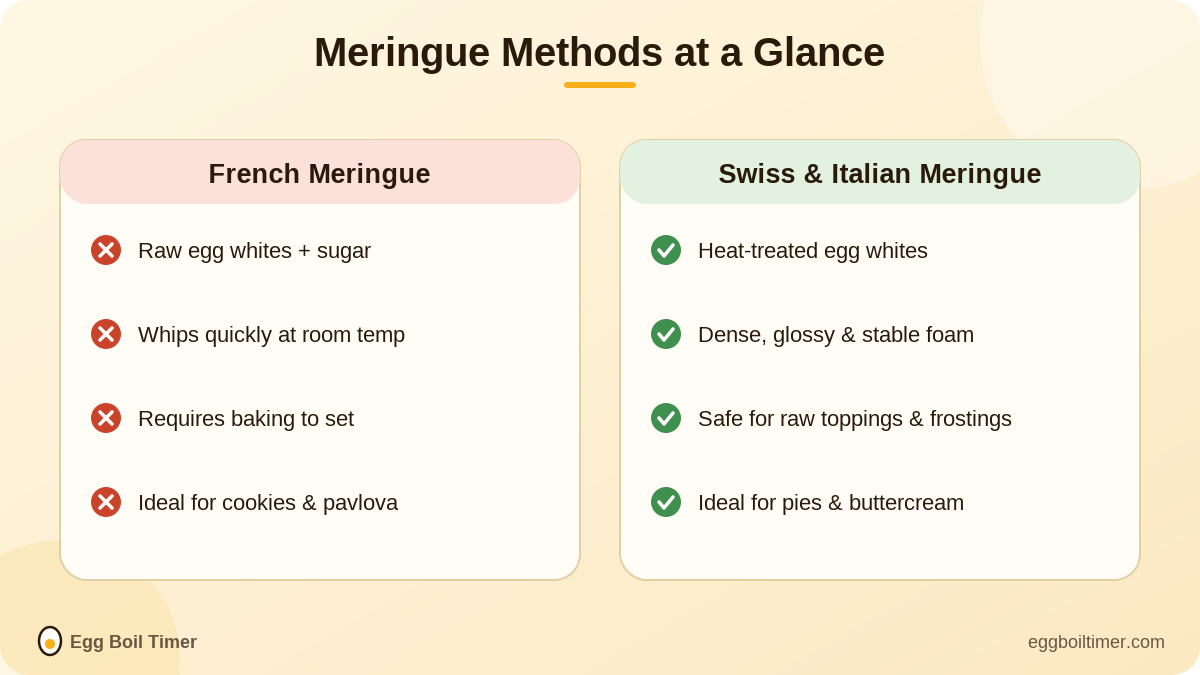
French meringue relies on cold egg whites whipped with raw sugar. It expands rapidly to generate maximum volume, making it exceptionally light. Because the proteins remain uncooked during whipping, French meringue must be baked immediately to set its structure. Unbaked French foam collapses quickly.
Swiss and Italian meringues incorporate heat early in the process. Swiss meringue involves warming raw whites and sugar together over a double boiler to 71 °C before beating. Italian meringue relies on pouring sugar syrup heated to 118 °C directly into whipping whites. Both thermal methods pasteurize the egg proteins and yield dense, satin-smooth foams that remain stable at room temperature.
| Meringue Type. | Preparation Temperature. | Foam Density. | Stability Level. | Primary Culinary Application. |
|---|---|---|---|---|
| French. | Cold / Room Temp (20 °C). | Very light and delicate. | Moderate (requires baking). | Meringue cookies, pavlova, soufflés. |
| Swiss. | Double Boiler (71 °C). | Dense and marshmallow-like. | High (pasteurized). | Pie toppings, Swiss buttercream, pavlova bases. |
| Italian. | Hot Syrup (118 °C). | Ultra-dense and glossy. | Highest (heat-set). | Macarons, chiboust cream, baked Alaska. |

Step-by-Step French Meringue Cookie Protocol
Baking crisp French meringue cookies requires low heat and steady air circulation to evaporate moisture. Preheat your oven to 100 °C and line two heavy baking sheets with parchment paper.
- Separate whites cleanly: Crack 4 large egg whites (120 grams) into a clean glass or stainless steel bowl. Ensure zero yolk traces enter the bowl, as lipids destroy foam formation.
- Establish the foam base: Whip egg whites on medium speed until frothy. Add 1/4 teaspoon of cream of tartar and 1/8 teaspoon of fine salt, beating until soft peaks form.
- Incorporate superfine sugar: Increase speed to medium-high. Add 200 grams of superfine sugar one tablespoon at a time over 5 minutes. Beat until stiff, glossy peaks hold their shape straight up.
- Pipe and dry slowly: Transfer the mixture to a piping bag. Pipe 4 cm mounds onto prepared sheets. Bake at 100 °C for 90 minutes, then turn off the oven and let cookies cool inside for 2 hours. For standard boiling benchmarks outside dessert baking, check our Egg Boil Timer">egg boiling timer.

Sugar Ratios and Heat Thresholds Across Applications
The balance of sugar to egg white determines whether a meringue bakes into a soft topping or a crisp shell. Soft pie meringues use a 1:1 ratio by weight. This provides enough structure to set during 15 minutes at 175 °C while remaining tender under a knife.
Hard meringue shells require a 2:1 sugar-to-white ratio. This higher concentration of sugar crystallizes during low-temperature drying, producing a rigid matrix that withstands ambient moisture. Adding 1 teaspoon of cornstarch and 1/2 teaspoon of white distilled vinegar per 4 egg whites creates a classic pavlova texture. The result is a crackly outer shell enclosing a chewy interior.
| Application. | Sugar to White Ratio. | Baking Temperature. | Bake Time. | Finished Texture. |
|---|---|---|---|---|
| Soft Pie Topping. | 1:1 (30 g sugar per white). | 175 °C. | 12–15 minutes. | Tender, lightly browned top. |
| Pavlova Base. | 1.5:1 (45 g sugar per white). | 120 °C (reduce to 100 °C). | 75 minutes. | Crisp crust, marshmallow center. |
| Hard Cookies / Shells. | 2:1 (60 g sugar per white). | 100 °C. | 90–120 minutes. | Completely dry, brittle, snap crust. |
Diagnosing Weeping, Beading, and Structural Collapse
Moisture and temperature errors cause most failures in home meringue preparation. Diagnosing the exact symptom reveals the underlying chemical or mechanical cause.
Syrup weeping beneath the crust indicates undissolved sugar crystals. During baking, these coarse crystals melt into syrup and leak from the foam. Solution: Use superfine sugar. Rub the raw batter between your fingers before piping to confirm no grit remains.
Golden beads forming on top of baked pie topping signal overcoagulation of egg white proteins. Excessive heat shrinks the protein walls, forcing water out. Solution: Bake soft meringues at higher heat for shorter durations. Alternatively, place them over hot pie filling so the underside cooks evenly.
Whites that remain flat and watery usually suffer from lipid contamination. Even a microdrop of oil or egg yolk coats the albumen proteins, blocking them from binding around air bubbles. Solution: Degrease metal bowls and beaters with lemon juice before starting.
Deep fissures across meringue shells result from abrupt temperature changes. Rapid contraction tears the rigid sugar matrix. Solution: Leave baked meringues inside the closed, turned-off oven until completely cool.
Storage Guidelines and Environmental Controls
Baked meringues are intensely hygroscopic, meaning they readily absorb moisture from surrounding air. High ambient humidity turns crisp meringue soft and sticky within hours. Store finished cookies in an airtight container at room temperature immediately after cooling.
Avoid storing baked meringues in the refrigerator. Cold air inside domestic refrigerators carries high relative humidity, which dissolves surface sugar crystals and destroys crispness. Unbaked Swiss or Italian meringues can be refrigerated in a sealed bowl for up to 24 hours before piping.


