An ostrich egg is the largest single cell produced by any living animal on Earth. Weighing roughly 1.4 kilograms (3.1 pounds), a single egg contains the volume of 24 large chicken eggs, delivering 2,000 calories and 250 grams of protein. Cooking one whole requires two hours of continuous simmering to set the massive center, while opening its 2-millimeter calcified shell demands a hammer or drill.
Physical Scale and Shell Dynamics of the Ostrich Egg
Native to Africa, the ostrich (Struthio camelus) lays eggs measuring roughly 15 centimeters in length and 12 centimeters in diameter. The egg represents only about 1.5% of the mother bird's body weight, in stark contrast to smaller birds where an egg can weigh up to 10% or more of the hen's total mass. The shell consists of heavy calcium carbonate designed to endure the weight of nesting adults weighing up to 150 kilograms.
At 2 millimeters thick, an ostrich shell is six times thicker than a standard chicken egg shell. Strike an ostrich egg against the rim of a pan, and calcified fragments shatter directly into the raw albumen. Opening one safely requires a center punch, a small ball-peen hammer, or a hand drill with a 6-millimeter bit.
Drilling a single clean hole at the pointed apex allows you to insert a thin skewer to puncture the vitelline membrane, draining the liquid cleanly while preserving the outer shell structure. The dense porcelain-like mineral wall retains heat far longer after boiling than the calcite layers evaluated in Brown or White: Does the Colour of the Shell Change the Boiling Time?.
Volume Ratios and Yield Compared to Chicken Eggs
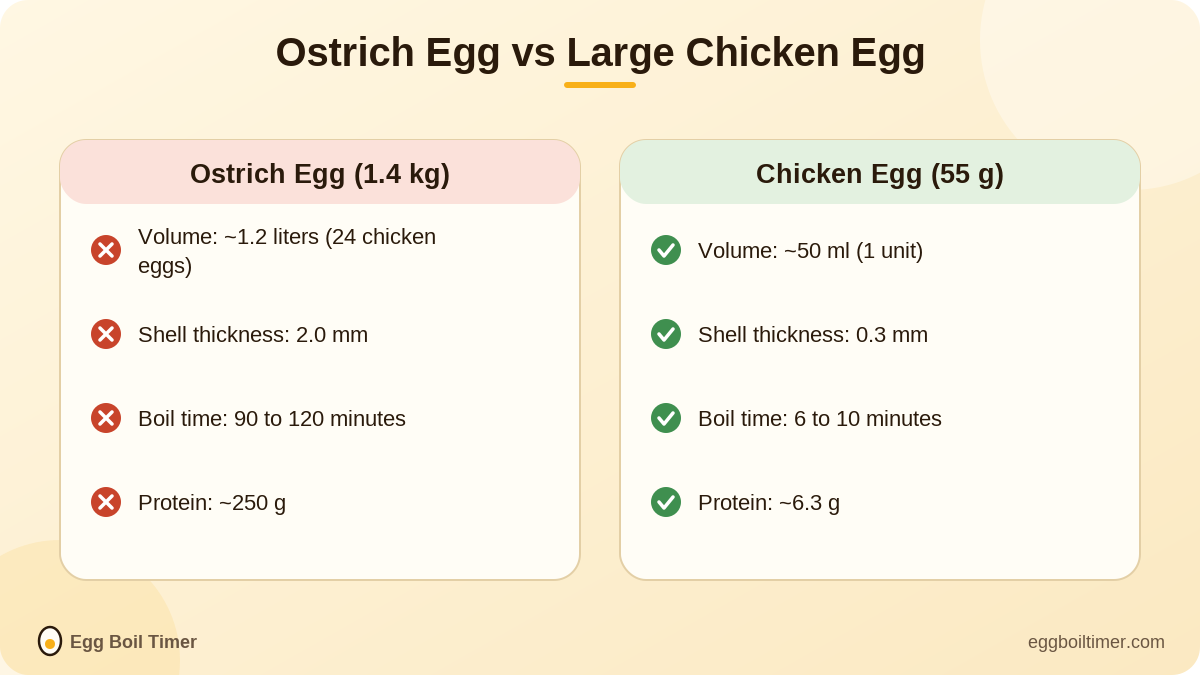
A single ostrich egg yields approximately 1.2 liters (5 cups) of raw liquid egg. While a standard large chicken egg consists of roughly 60% albumen, 30% yolk, and 10% shell by weight, an ostrich egg carries a higher yolk proportion, reaching nearly 35% of its total internal mass. That central yolk weighs around 450 grams, roughly the size of a softball.
| Metric | Ostrich Egg | Large Chicken Egg | Ratio (Ostrich / Chicken) |
|---|---|---|---|
| Average Total Weight | 1,400 g (3.1 lbs) | 55 g (1.9 oz) | 25.5x |
| Liquid Volume | 1,200 ml (5 cups) | 50 ml (3.3 tbsp) | 24x |
| Shell Thickness | 2.0 mm | 0.3 mm | 6.6x |
| Yolk Diameter | 8 to 9 cm | 3.5 to 4 cm | 2.3x |
| Edible Protein Yield | 250 g | 6.3 g | 39.6x |
| Total Calorific Value | 2,000 kcal | 78 kcal | 25.6x |
For household cooking, measure raw ostrich egg liquid by volume rather than cracking full units. Liquid egg volume of 50 milliliters (3.5 tablespoons) replaces one standard large chicken egg in any recipe. When managing large volumes of raw whisked egg, pour unused portions into sealed glass jars and refrigerate immediately, or freeze them in portioned ice cube trays. Standard raw egg handling guidelines discussed in Pasteurized Eggs: Safety, Pasteurization Temp, and Cooking Uses apply directly to ratite eggs.

Micronutrients, Fat Profile, and Cholesterol
A whole raw ostrich egg supplies roughly 2,000 calories, 250 grams of protein, and 150 grams of lipid fats. Evaluated per 100 grams of edible portion, its total energy density matches chicken eggs closely at 140 calories per 100 grams, but its internal fatty acid balance and micronutrient distribution show distinct differences.
Ostrich egg fat contains a higher proportion of monounsaturated fatty acids (primarily oleic acid) and lower saturated fat per gram of yolk than chicken eggs. Cholesterol levels sit at roughly 1,700 milligrams per whole egg. Divided across its mass, that equals about 120 milligrams of cholesterol per 100 grams of whole liquid egg, significantly lower than the 370 milligrams per 100 grams found in standard chicken eggs.
The yolk offers abundant vitamin A, vitamin E, B-complex vitamins (especially B12 and folate), iron, and phosphorus. Higher magnesium concentrations in the albumen alter protein binding during mixing, yielding lighter and airier foams when whipped.

Thermal Physics, Boiling Durations, and Ice Bath Protocols
Boiling an ostrich egg whole is a lesson in thermodynamics. Heat transfer from surrounding hot water through a 2-millimeter calcified shell into a 12-centimeter mass of albumen requires substantial time. Standard chicken eggs on our Egg Boil Timer boiling timer require 6 to 10 minutes, but an ostrich egg demands up to two hours of continuous simmering.
- Select an 8-to-10-quart stockpot: Fill with water so the egg sits submerged under at least 5 centimeters of water. Bring to a rolling boil at 100 °C.
- Submerge gently: Lower the 1.4-kilogram egg into the water using a wire skimmer basket or silicone sling. Avoid dropping it against the pot bottom.
- Maintain a steady simmer: Reduce heat slightly to a gentle boil (95–98 °C). Keep the pot covered to prevent evaporative cooling.
- 60 to 75 minutes: Soft-boiled result with a warm, liquid yolk and tender albumen.
- 90 minutes: Jammy, custard-like yolk with firm whites.
- 120 minutes (2 hours): Fully firm, hard-boiled yolk and white throughout.
- Chill in an ice water bath: Transfer the cooked egg into a large tub filled with ice and water for 30 minutes. Rapid cooling contracts the inner egg contents away from the shell wall and arrests residual internal cooking.
- Peel the calcified wall: Tap firmly along the equator with the spine of a chef's knife or small hammer to fracture the shell plates. Peel away the thick calcified shell along with the tough outer membrane.
While chemically transformed eggs like Century Eggs: How They Are Made, Flavor, and Safe Preparation rely on alkaline curing solutions over several months, ostrich eggs depend entirely on prolonged thermal conduction to denature their dense protein core.
Frying, Scrambling, and Baking Adaptations
Scrambling is the most efficient method for preparing fresh ostrich egg. The high yolk lipid ratio provides a smooth, velvety curd structure similar to double-yolk waterfowl eggs analyzed in How to Boil Duck Eggs: Times for Runny, Jammy and Hard Yolks.
To scramble, whisk the raw liquid with a pinch of salt until uniform. Melt butter in a wide 30-centimeter skillet over low heat. Pour in the egg mixture and sweep gently with a silicone spatula. Keep heat low; excessive surface temperature causes water expulsion (syneresis), making the curds rubbery before the interior sets. One scrambled ostrich egg easily serves a group of 8 to 10 adults.
Pan-frying a whole ostrich egg sunny-side up requires a broad, heavy-bottomed skillet and patience. Cook over low heat for 15 to 20 minutes with a tight lid on the pan. Trapped steam cooks the top layer of albumen surrounding the tall yolk without scorching the bottom shell of the egg white. In baking, ostrich whites whip into rigid meringue structures, providing excellent lift for angel food cakes or soufflés.
Non-Culinary Uses: Shell Carving, Canteens, and Art
Thanks to their thick, porcelain-like structure, ostrich shells have functioned as water canteens, storage flasks, and decorative items for thousands of years. Archaeological sites in Southern Africa, including the Howiesons Poort shelter, have revealed engraved shell fragments dating back more than 60,000 years, left by ancient hunter-gatherers.
Contemporary artists use high-speed rotary carving tools, diamond bits, and scrimshaw etching techniques to transform dried shells into artwork. To prepare a shell for crafting, artisans drill a small 6-millimeter hole at one end, flush out the interior contents with warm water and a mild bleach solution, and let it air dry completely. Empty carved shells retain their structural integrity indefinitely and are frequently converted into lamps or display globes.
Sourcing, Cost Analysis, and Shelf Storage
Domesticated ostriches begin laying around two to three years of age and can remain fertile for three decades. Breeding seasons run from spring through late summer. A single hen lays one egg every 48 hours during peak cycles, producing 40 to 80 eggs annually.
Fresh unfertilized culinary eggs sell for $30 to $65 USD directly from ratite farms or online specialty purveyors. Empty, pre-drilled decorative shells typically cost $15 to $35 USD. Inspect fresh eggs for a clean, uncracked surface with a natural satin sheen.
Stored at 2 °C to 4 °C in refrigeration, intact unwashed ostrich eggs remain fresh for 60 to 90 days due to their thick mineral barrier and low pore permeability. Cooked ostrich egg dishes should be refrigerated promptly and consumed within three days.


