When assessing eggs salmonella risks, contamination occurs either inside the yolk during egg formation or on the shell after laying. Industry data indicates roughly 1 in 20,000 commercial U.S. eggs carries Salmonella enteritidis (a 0.005% chance). Refrigeration below 40 °F (4 °C) halts bacterial growth, while cooking eggs firm destroys the bacteria completely.
How Salmonella Enters the Yolk and Shell
Salmonella enters an egg through two distinct biological pathways. Transovarian transmission happens inside the hen before shell formation. If a hen carries an asymptomatic infection in her reproductive tract, Salmonella enteritidis colonizes the ovary or oviduct. The bacteria pass directly into the yolk or albumen before the shell seals. The resulting laid egg looks spotless, displaying no cracks, stains, or foul odor.
Horizontal transmission happens after the egg is laid. Fecal matter or contaminated nest bedding contacts the dry shell exterior. Because chicken eggshells contain thousands of microscopic pores for respiratory gas exchange, rapid cooling pulls surface bacteria through the shell membranes into the albumen. Warm ambient moisture accelerates this invasion, allowing bacteria to multiply rapidly inside the egg white.
What Are the Odds of Getting a Contaminated Egg?
In regulated commercial supply chains, internal Salmonella contamination affects roughly 1 in 20,000 U.S. eggs. For an individual eating two eggs daily, that frequency equals an average statistical exposure rate of once every twenty-seven years.
Most large foodborne outbreaks originate in commercial food service rather than individual home kitchens. Commercial kitchens often pool dozens of cracked raw eggs into large containers for hollandaise, scrambled egg batches, or batters. Combining raw eggs disperses bacteria from a single infected yolk across hundreds of portions. If staff leave that pooled mixture above 40 °F (4 °C), bacterial colonies double every twenty minutes.

Why American and European Egg Safety Rules Differ
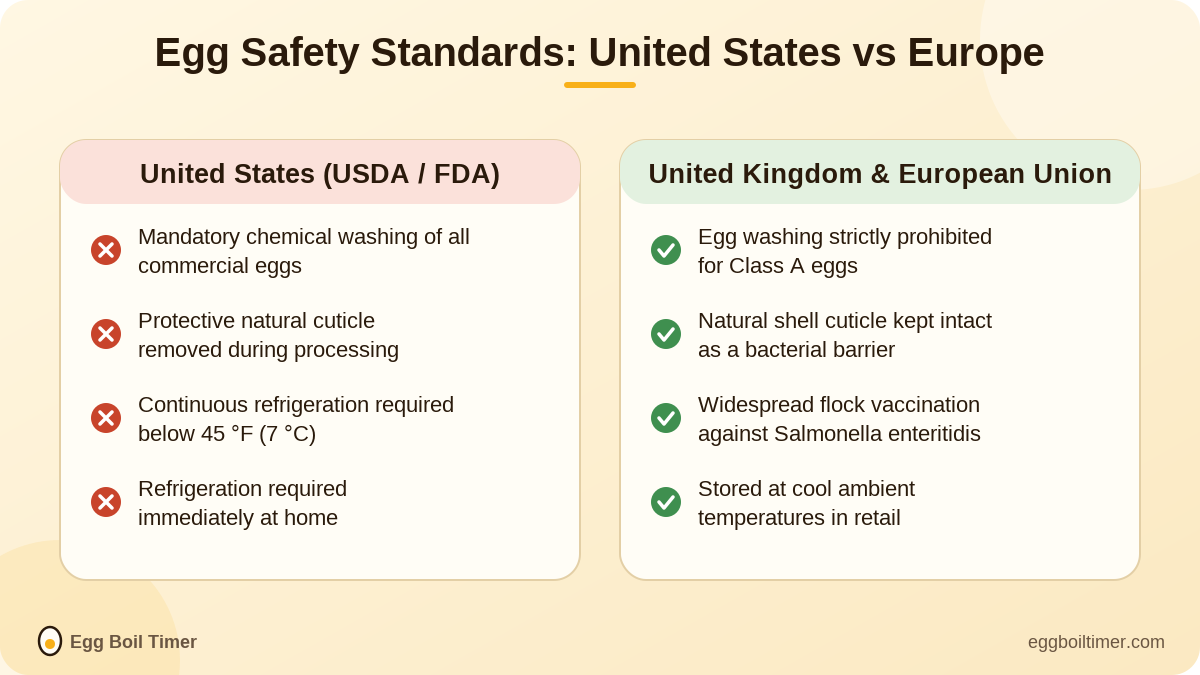
Consumer handling rules differ worldwide because regulators select contrasting points of defense. In the United States, federal standards mandate that commercial producers wash shell eggs in warm sanitizing solutions. This wash eliminates fecal debris and surface pathogens. However, the wash also dissolves the egg cuticle, a thin waxy protein barrier that naturally blocks shell pores. Without this cuticle, American eggs must remain refrigerated below 45 °F (7 °C) throughout transit and retail to prevent moisture condensation and bacterial entry.
The United Kingdom and European Union outlaw egg washing for Class A consumer eggs. European regulators argue that wet washing risks drawing surface contaminants through the shell if wash water temperatures fluctuate. Instead, European authorities mandate strict biosecurity and flock vaccination programs, exemplified by the British Lion scheme. Because the dry natural cuticle stays intact, European grocery stores display eggs on ambient shelves without condensation hazards.
| Region. | Shell Washing. | Flock Vaccination. | Retail Storage. | Primary Safety Defense. |
|---|---|---|---|---|
| United States. | Mandatory sanitized wash. | Voluntary or state programs. | Refrigerated below 45 °F (7 °C). | Surface sanitation and unbroken cold chain. |
| United Kingdom. | Prohibited for Class A eggs. | Mandatory flock vaccination (Lion Mark). | Ambient cool shelf display. | Flock immunity and intact cuticle seal. |
| European Union. | Prohibited for Class A eggs. | Mandatory in high-prevalence areas. | Ambient grocery shelf display. | Intact natural cuticle and on-farm testing. |
| Japan. | Sanitized wash and automated screening. | Widespread flock vaccination. | Refrigerated or short shelf life. | Rapid farm-to-table dates for raw use. |

Temperatures and Times That Kill Salmonella
Salmonella dies instantly when core temperature reaches 160 °F (71 °C). At this thermal threshold, ovalbumin and yolk vitellin denature into an opaque, fully set solid. Cooking eggs until both yolk and white turn firm provides complete pasteurization.
Lower temperatures achieve the same bacterial destruction when held for longer durations. Maintaining an internal temperature of 140 °F (60 °C) for 3.5 to 5 minutes produces a verified 5-log reduction, killing 99.999% of viable organisms. Raising the temperature to 145 °F (63 °C) reduces the required holding time to under one minute.
Commercial egg processors use these exact thermal windows to produce in-shell pasteurized eggs. Submerging whole eggs in regulated warm water baths neutralizes internal bacteria while keeping the yolk silky and runny. For baked casseroles, quiches, and pooled leftovers, food safety agencies recommend reheating portions until a probe thermometer registers 165 °F (74 °C).
Who Needs Fully Cooked Eggs?
Individual health determines whether runny yolks represent an acceptable culinary choice. Healthy adults produce concentrated gastric acid that helps neutralize modest bacterial exposures. For higher-risk demographics, minor exposures cause severe dehydration, invasive bacteremia, and extended hospitalization.
This is general information, not medical advice. Vulnerable groups include children under five, adults over sixty-five, pregnant individuals, and people with compromised immune systems. For these diners, choose pasteurized shell eggs or cook yolks firm. Expectant mothers can review dietary guidelines in our guide to Eggs in Pregnancy: Safety Rules, Choline, and Cooking. For toddler diets, consult our review of Runny Eggs for Toddlers: Why the Answer Depends on Where You Live.
| Preparation Style. | Yolk Core State. | Standard Shell Eggs. | Pasteurized Shell Eggs. |
|---|---|---|---|
| Raw (mayonnaise, aioli, tiramisu). | Unheated liquid yolk. | Healthy adults only (acceptable risk). | Safe for all groups. |
| Soft-boiled and sunny-side up. | Warm liquid core (145 °F / 63 °C). | Healthy adults only. | Safe for all groups. |
| Jammy and medium-boiled. | Custardy, semi-set center (150 °F / 66 °C). | Healthy adults only. | Safe for all groups. |
| Hard-boiled and firm scrambled. | Solid throughout (160 °F / 71 °C). | Safe for all groups. | Safe for all groups. |
| Baked casseroles and frittatas. | Steaming, thoroughly set (160 °F / 71 °C). | Safe for all groups. | Safe for all groups. |
How to Store and Handle Eggs at Home
Safe handling practices halt bacterial growth before food preparation begins. In regions selling washed eggs, store cartons on middle refrigerator shelves maintained at 40 °F (4 °C) or colder. Never store eggs in open refrigerator door bins, where constant opening triggers temperature fluctuations and shell condensation.
Keep eggs in their original carton. The cardboard protects fragile shells from absorbing strong refrigerator odors and limits internal moisture evaporation. Fresh eggs stored properly in cartons maintain culinary quality for 3 to 5 weeks past purchase date.
Do not wash eggs in domestic sinks. Running tap water drives surface microbes inward through open shell pores. If an egg arrives with heavy manure or feather deposits, discard it rather than scrubbing it under running water.
Inspect cartons at purchase and reject any containing hairline cracks. Cracks dismantle the physical defense of the shell, granting external bacteria unrestricted passage into nutrient-rich yolk tissue. When cracking eggs for recipes, tap them against a flat countertop rather than a sharp bowl rim. Sharp edges shove shell fragments directly into raw albumen.
Use our Egg Boil Timer to calculate exact boiling times so your eggs hit your desired yolk texture reliably. If someone experiences non-bacterial reactions like hives or facial swelling, read our guide on Egg Allergy Symptoms, Causes, Diagnosis, and Management to distinguish immune allergies from bacterial food poisoning.
Salmonella Symptoms and When to See a Doctor
Salmonellosis symptoms usually emerge between six hours and six days following consumption of contaminated food. Typical manifestations include watery diarrhea, abdominal cramps, fever between 100 °F and 102 °F (38 °C to 39 °C), nausea, and vomiting. In healthy adults, acute symptoms generally clear within four to seven days without antibiotic intervention.
Fluid loss represents the primary clinical danger during illness. Rehydrate using electrolyte oral solutions or clear broths, and avoid anti-motility drugs that delay bacterial elimination from intestinal passages. Seek immediate medical evaluation if any of these critical warning signs appear:
- Fever exceeding 102 °F (38.8 °C).
- Diarrhea persisting past three days without noticeable improvement.
- Bloody stools or vomiting that prevents retaining oral liquids.
- Signs of severe dehydration including postural dizziness, dry mucous membranes, or minimal urination.


