Telur gulung is a traditional Indonesian street snack. It is made by pouring water-diluted eggs into deep hot oil and wrapping the floating egg threads around a bamboo skewer. Achieving fluffy rolled skewers requires a diluted egg batter, deep oil held at 175 °C, and rapid skewer rotation while the albumen coagulates.
Anatomy of Indonesian Deep-Fried Rolled Eggs
Popular outside Indonesian primary school gates and night markets, this snack turns basic kitchen staples into a light, airy skewer treat. Unlike thick pan-rolled eggs like Japanese Tamagoyaki: How to Roll Japanese Rolled Omelette, telur gulung relies on deep-frying fluid dynamics. When seasoned liquid egg hits deep hot oil, steam pushes expanding proteins outward into a floating web rather than a dense fried patty. Skewering that floating sheet demands continuous rotation before the outer albumen turns rigid.
While boiled eggs rely on exact timing models like our Egg Boil Timer tool, street snacks like telur gulung depend on oil thermal currents and physical technique. As an entry in our Egg Recipes: Breakfast, Lunch, and Dinner Ideas library, this recipe shows how water dilution changes egg structure under high heat.
Water to Egg and Starch Ratios
Undiluted whisked eggs sink to the bottom of a frying vessel. Raw albumen is dense. Without added water, it binds into heavy curds that resist skewer rotation. Adding liquid lowers batter viscosity. This allows the mixture to spread across the oil surface instantly.
- 2 large eggs: Roughly 110 g total liquid egg without shell.
- 4 tablespoons water: Approximately 60 ml room-temperature water. A ratio of 1 tablespoon water per 25 to 30 g of liquid egg yields optimal surface tension release.
- 1 teaspoon tapioca starch or cornstarch: Roughly 3 g. Starch binds free moisture during high-heat expansion. This keeps egg threads flexible so they grip the bamboo skewer.
- 1/2 teaspoon chicken bouillon powder: Provides savory seasoning without adding grainy salt crystals that settle to the pan floor.
- 1/8 teaspoon white pepper: Adds traditional Indonesian flavor warmth.

Whisking Water, Starch, and Albumen into a Fluid Batter
Consistent batter behavior relies on thorough mixing. Whole egg whites contain thick outer albumen and thin inner albumen. Unbroken protein strands drop unevenly into the oil pan.
- Dissolve the starch slurry: Stir 1 teaspoon tapioca starch completely into 4 tablespoons water in a small cup before adding it to the eggs. Liquid starch prevents dry clumps.
- Combine seasonings: Crack 2 large eggs into a narrow measuring jug or mixing bowl. Add the dissolved starch water, chicken bouillon powder, and white pepper.
- Beat until fully liquid: Whisk vigorously with a fork or balloon whisk for 90 to 120 seconds. Aim for complete liquefaction without forming stiff surface foam. Large air bubbles shield batter from direct oil heat, causing soft, un-cooked spots.

Pan Choice, Oil Depth, and Heat Calibration at 175 °C
Frying telur gulung requires deep oil so the egg floats freely while rolling. Shallow oil causes batter to stick directly to the pan floor.
Pan choice alters oil heat stability. A traditional round-bottom metal wok directs oil toward a central deep pool, making it ideal for street frying. A small, deep stainless steel saucepan also works well for home kitchens. Avoid wide, flat frying pans. Flat pans spread oil too thin, reducing depth and causing the egg lace to strike the metal floor.
Fill your vessel with neutral vegetable oil to a depth of at least 6 cm (2.5 inches). High-smoke oils like palm oil, canola oil, or peanut oil perform best under continuous frying conditions. Heat the oil over medium heat until it reaches 170 to 180 °C (340 to 350 °F).
Without a cooking thermometer, test the heat by dropping a single bead of batter into the center. The drop should submerge briefly, burst upward to the surface within 1 second, and sizzle cleanly without immediate browning. Oil below 160 °C forces the egg to sink, absorb excess oil, and remain flat. Oil above 190 °C cooks the egg too fast, hardening proteins so they snap when spun around the skewer.
Ten-Second Skewer Rolling Mechanics
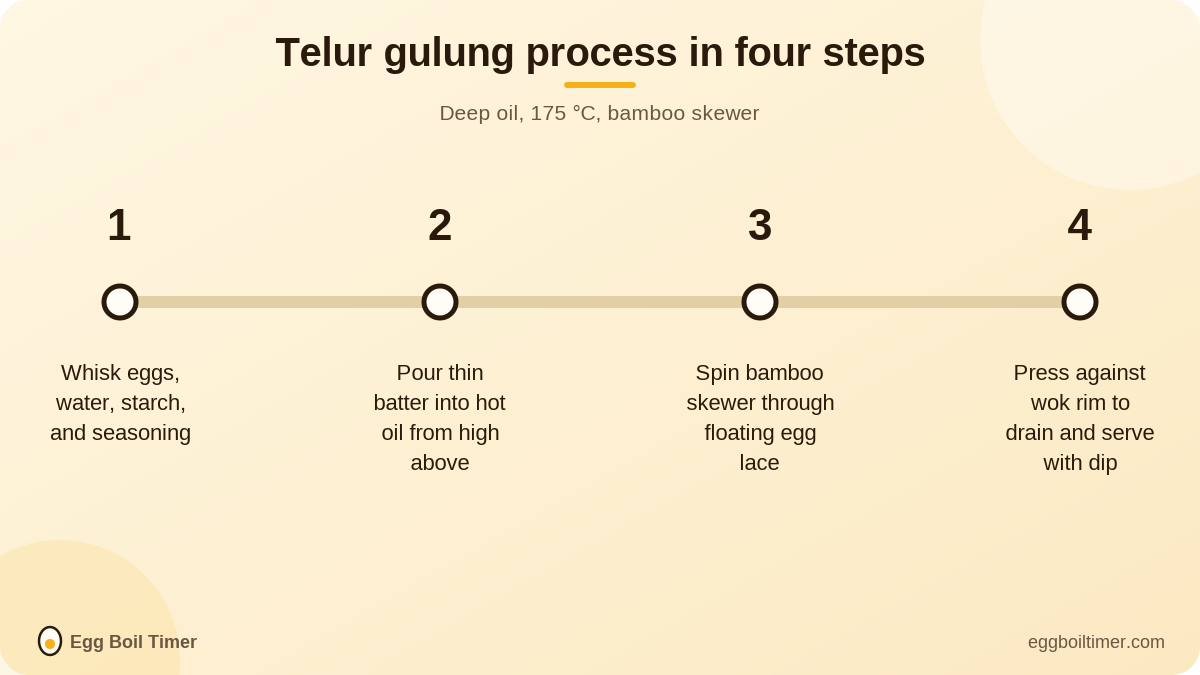
Speed is essential once batter meets hot oil. The entire frying and rolling sequence takes roughly 10 seconds per skewer.
- Pour high and thin: Hold the batter jug roughly 20 cm (8 inches) above the oil surface. Pour 2 to 3 tablespoons of batter in a continuous stream directly into the hot center. Pouring distance breaks the stream into tiny droplets that expand into a floating web.
- Wait 2 seconds: Allow the floating egg lace to spread toward the edges of the pan. The albumen setting phase takes only moments.
- Insert and spin: Place the pointed tip of a long bamboo skewer (20 to 25 cm) into the center of the floating egg layer. Swirl the skewer in tight circular motions toward the outer wall of the wok. Floating egg threads catch onto the wooden tip and wrap around the shaft.
- Press and drain: Press the rolled egg bundle gently against the side wall of the wok for 2 seconds. This compacts the roll and squeezes excess cooking oil back into the pan. Lift the skewer onto a wire rack.
Diagnosing Sinking Batter, Slippage, and Greasiness
Unlike encased fried foods like Filipino Crispy Kwek Kwek: Filipino Fried Orange Quail Eggs or deep-fried Chinese-style Egg Roll Dip: Warm Skillet Recipe and Serving Guide appetizers, unwrapped egg batter leaves zero room for thermal delay. Use this matrix to fix common kitchen issues immediately.
| Symptom. | Primary Cause. | Immediate Fix. |
|---|---|---|
| Batter sinks to the pan bottom without floating. | Oil temperature is below 160 °C, or the egg mixture lacks water. | Heat oil to 175 °C and whisk 1 additional tablespoon water into the batter. |
| Egg wraps briefly, then slips off the bamboo skewer. | Skewer wood is too smooth, or the egg layer cooked too long before spinning. | Soak bamboo skewers in warm water before use, and start spinning within 2 seconds of pouring. |
| Egg tears apart into ragged shreds. | The mixture lacks a starch binder, or the foam layer was over-whisked. | Add 1/2 teaspoon tapioca starch dissolved in 1 teaspoon water to stabilize albumen protein chains. |
| Rolled egg feels greasy and soggy. | Oil heat dropped during batch cooking, or the wall pressing step was omitted. | Fry 1 or 2 skewers at a time to maintain oil temperature, and press every skewer against the wok rim before removal. |
Indonesian Street Dips and Regional Skewer Variations
Telur gulung is rarely served plain. Indonesian street carts serve these hot skewers inside narrow plastic sleeves drizzled with thin, tangy chili sauce.
To make traditional street sauce, whisk together 3 tablespoons sweet chili sauce, 1 tablespoon sambal oelek, 1/2 teaspoon garlic powder, and 2 tablespoons warm water. Drizzle the sauce directly over hot skewers or serve alongside in a small dip bowl.
Popular variations add extra texture inside the egg lace. For telur gulung bihun, drop a small cluster of cooked, drained rice vermicelli into the hot oil first. Immediately pour the egg batter over the noodles, then roll both around the skewer together. For telur gulung sosis, impale a cocktail sausage onto a skewer. Dip the sausage into hot oil for 5 seconds before pouring egg batter around it to form a wrapped core. Similar techniques apply to Asian street snacks like Japanese Omurice: Master Japanese Omelette Rice at Home garnishes or fried savory skewers.


