Egg yolk zabaglione is a classic Italian dessert created by whisking egg yolks, granulated sugar, and fortified wine over gentle steam. The process produces a warm, aerated custard foam served in glassware alongside berries or dry cookies. Success requires holding the pan between 63°C and 68°C so the yolk proteins coagulate around trapped air without curdling.
What Sets Italian Zabaglione Apart From French Sabayon
Zabaglione originated in Northern Italy as a simple restock of energy for workers. While the French call a similar foam sabayon, subtle differences set the two culinary traditions apart. French sabayon frequently relies on dry white wine, champagne, or even savory stocks, serving as an element for fish dishes or poached fruit.
Italian zabaglione remains primarily a dessert sauce or standalone sweet course. The standard mathematical foundation uses equal measures by weight or volume: for every large yolk (about 17 grams), use one tablespoon of sugar (12 grams) and one tablespoon of sweet Marsala wine (15 milliliters). Unlike a dense baked Custard Recipe and Science: Perfecting Egg-Thickened Creams or rich Classic Flan: Caramel, Custard Ratios, and Water Bath Baking, no dairy or flour stabilizes the structure.
Molecular Expansion: How Protein Denaturation Holds Air
Creating this foam depends on controlling protein strands inside Egg Yolk Science: Composition, Nutrition, and Culinary Mechanics. Fresh yolks contain roughly 50% water, 16% protein, and 30% emulsified fats. When you whisk yolks with sugar at room temperature, the sugar crystals dissolve into the water phase, increasing viscosity and helping to trap mechanical air bubbles.
When you apply heat using a double boiler, yolk proteins like vitellin begin to uncoil from their tight native shapes. This unfolding, known as denaturation, allows the protein chains to link together in a continuous matrix around tiny trapped air pockets. Ethanol from the wine alters this process by lowering the temperature at which egg proteins bond. This expanded thermal range gives you time to build volume before full coagulation occurs.

Evaluating Fortified Bases: Marsala, Vin Santo, and Dry Whites
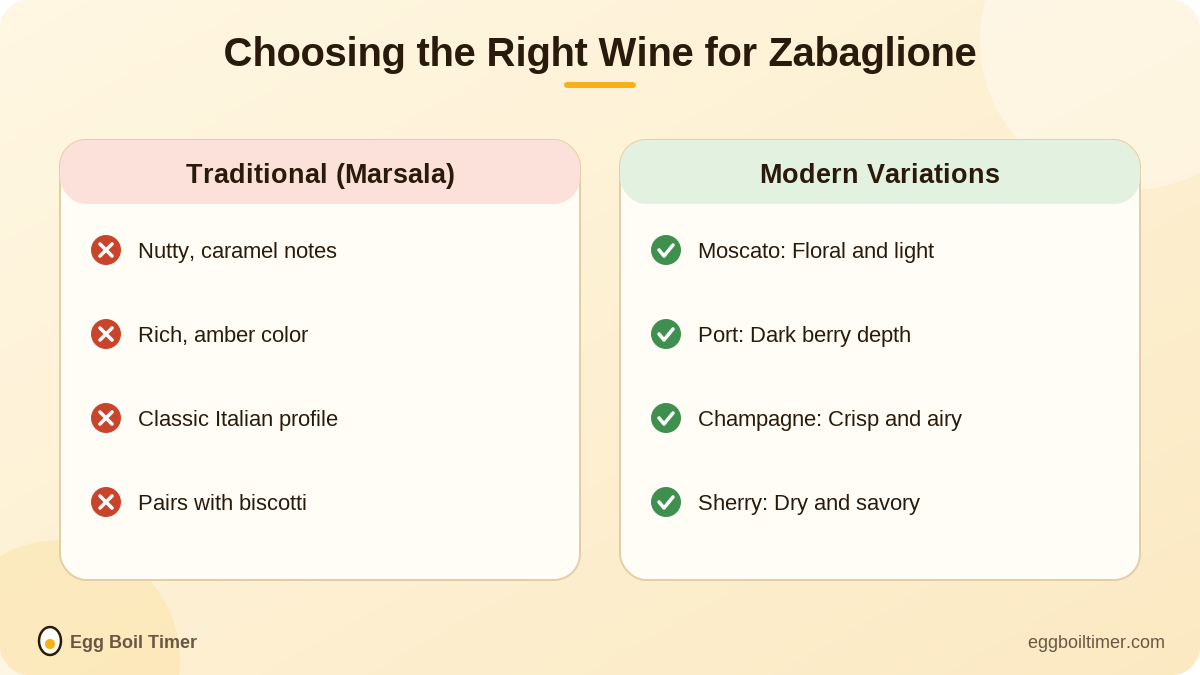
Marsala Superiore or Fine remains the historical standard for this dish. Amber Marsala delivers distinct caramel and dried fruit notes that complement the rich lipids in the yolk. However, switching the liquid transforms the character of the custard entirely without altering the chemical reaction.
Dry wines create a lighter, tarter foam, whereas fortified dessert wines increase body and sweetness. Match your wine selection to the intended accompaniment using these proven flavor profiles:
| Wine Selection | Alcohol by Volume | Flavor Profile | Ideal Dessert Companion |
|---|---|---|---|
| Marsala (Ambra Semi-Secco) | 18% ABV | Toasted hazelnut, vanilla, dark caramel | Almond cantucci or fresh figs |
| Vin Santo | 16% ABV | Dried apricot, honey, toasted walnut | Crisp amaretti cookies |
| Tawny Port | 20% ABV | Raisin, fig, dark chocolate undertones | Fresh blackberries or warm plum tart |
| Moscato d'Asti | 5.5% ABV | Peach blossom, pear, light effervescence | Macerated summer strawberries |

Whisking Over Steam: The Method for a Stable Custard Foam
Preparation demands active attention and physical effort. Before starting, carefully How to Separate Eggs Cleanly: Methods, Tools, and Storage so zero egg white enters the mixture. Ovalbumin in the whites changes the foam texture, making it rubbery rather than silky. Select a rounded stainless steel or copper bowl that sits neatly over your saucepan.
- Set Up the Water Bath: Fill a medium saucepan with 5 centimeters of water. Bring it to a bare simmer over low heat. The base of your mixing bowl must hover 3 centimeters above the water level without touching it.
- Aerate the Yolks and Sugar: Combine 3 large egg yolks and 36 grams (3 tablespoons) of sugar in your bowl off the heat. Whisk vigorously for 2 minutes until the yellow color lightens noticeably.
- Incorporate the Wine Base: Pour in 45 milliliters (3 tablespoons) of Marsala in a thin stream, whisking constantly to integrate the liquid smoothly.
- Apply Steam Heat: Set the bowl over the simmering water. Whisk continuously in a steady figure-eight pattern, scraping the bottom and sides of the bowl to avoid hot spots.
- Build the Structure: Continue whisking over gentle steam for 6 to 8 minutes. The dark liquid will transform into a thick, pale yellow foam that triples its original volume.
- Verify the Ribbon Stage: Lift your whisk out of the custard. The falling trail should form a visible ribbon on the surface that remains distinct for 3 seconds before sinking.
Thermal Milestones: Visual Cues Between 63°C and 68°C
Heat management dictates whether you achieve a silky foam or scrambled eggs. The ideal target internal temperature for egg yolk zabaglione falls strictly between 63°C and 68°C (145°F–155°F). An instant-read digital thermometer provides the highest accuracy, but physical visual indicators also signal progress.
At 50°C, large soapy bubbles cover the surface. By 60°C, these bubbles break down into a fine, uniform micro-foam that clings to the wire whisk. Once the mixture hits 65°C, the custard swells dramatically and takes on a glossy sheen. If you see tiny solid specs or steam rising rapidly from the bowl surface, immediately transfer the bowl to a cool kitchen towel and whisk furiously for 30 seconds to drop the core temperature.
Correction Matrix for Overheated or Separated Custards
Even seasoned pastry cooks occasionally encounter texture flaws due to erratic burner output. The table below outlines how to identify and correct common errors during preparation.
| Observed Defect | Root Cause | Corrective Action |
|---|---|---|
| Liquid Remains Thin | Insufficient heat or cooking time below 60°C | Maintain steam heat and continue figure-eight whisking for 3 more minutes. |
| Curdling or Grainy Texture | Pan temperature exceeded 72°C | Immediately pass through a fine mesh strainer into a chilled bowl; whisk in 1 raw yolk off heat. |
| Foam Collapses Quickly | Inadequate whisking speed during expansion phase | Whisk cold over an ice bath for 2 minutes to cool and stabilize remaining structure. |
| Harsh Alcohol Aftertaste | Cooking time was too short to evaporate ethanol | Extend time over steam by 90 seconds while continuing vigorous agitation. |
Plating Ratios and Flavor Pairings for Warm Foam
Serve this delicate dish within 5 minutes of cooking to present the maximum volume to your guests. Spoon 80 to 100 grams of warm foam into wide champagne coupes or glass dessert bowls. The transparent glass displays the golden hue and airy texture effectively.
Tart fruits provide the ultimate contrast to rich yolk fats. Macerate raspberries, blackberries, or sliced plums with a splash of lemon juice to balance the sweet dessert. For textural variety, serve alongside dry Italian baked goods like savoiardi ladyfingers or hazelnut biscotti. Alternatively, spoon the warm foam over baked fruit tarts, rich chocolate cake, or warm panettone during winter holidays.
Thermal Safety vs. Aeration: Pasteurization Trade-Offs
Traditional culinary methods cook this custard to 65°C to protect its airy volume. However, official safety standards from agencies like the USDA specify heating egg dishes to 71°C (160°F) to completely eliminate Salmonella bacteria. This page provides general culinary information, not formal medical advice.
Cooking past 70°C causes egg proteins to cross-link tightly, resulting in a noticeably denser custard akin to Classic Crème Brûlée: The Science of Silky Custard or traditional pastry cream. When serving vulnerable individuals, such as young children, older adults, or pregnant women, use commercially pasteurized in-shell eggs. Pasteurized eggs allow you to cook at the traditional 65°C window for maximum volume while ensuring complete biological safety. Freshly prepared warm foam begins separating into liquid after 20 minutes at room temperature. Check Egg Boil Timer to refine timing across all your egg recipes.


