A fertilized egg contains genetic material from both a hen and a rooster. It develops a faint white ring called a blastoderm on the yolk surface rather than the solid white dot seen on unfertilized eggs. Fresh fertilized eggs are completely safe to eat and taste identical to unfertilized eggs. Their nutritional content remains identical when gathered promptly and stored cold below 20 °C (68 °F).
How Hen and Rooster Sperm Form a Blastoderm
Egg formation begins inside the hen whether or not a rooster lives in the flock. A hen releases an ovum from her ovary into the oviduct roughly every 24 to 26 hours. If the hen has mated, viable sperm resides in small storage glands within the utero-vaginal junction of the oviduct. Fertilization takes place high in the infundibulum within 15 minutes of ovum release, long before albumen and shell layers enclose the yolk.
Sperm penetrates the germinal disc on the yolk surface. Cell division begins immediately during the 24-hour passage down the reproductive tract. By the time the egg is laid, a single cell has divided into roughly 40,000 cells. This process changes the germinal disc from an unfertilized blastodisc into a fertilized blastoderm. Backyard flocks with a rooster produce fertilized eggs almost daily. Embryonic development pauses completely once the egg cools below the physiological zero temperature of 20 °C (68 °F).
Visual Markers: Blastodisc Spot versus Blastoderm Ring
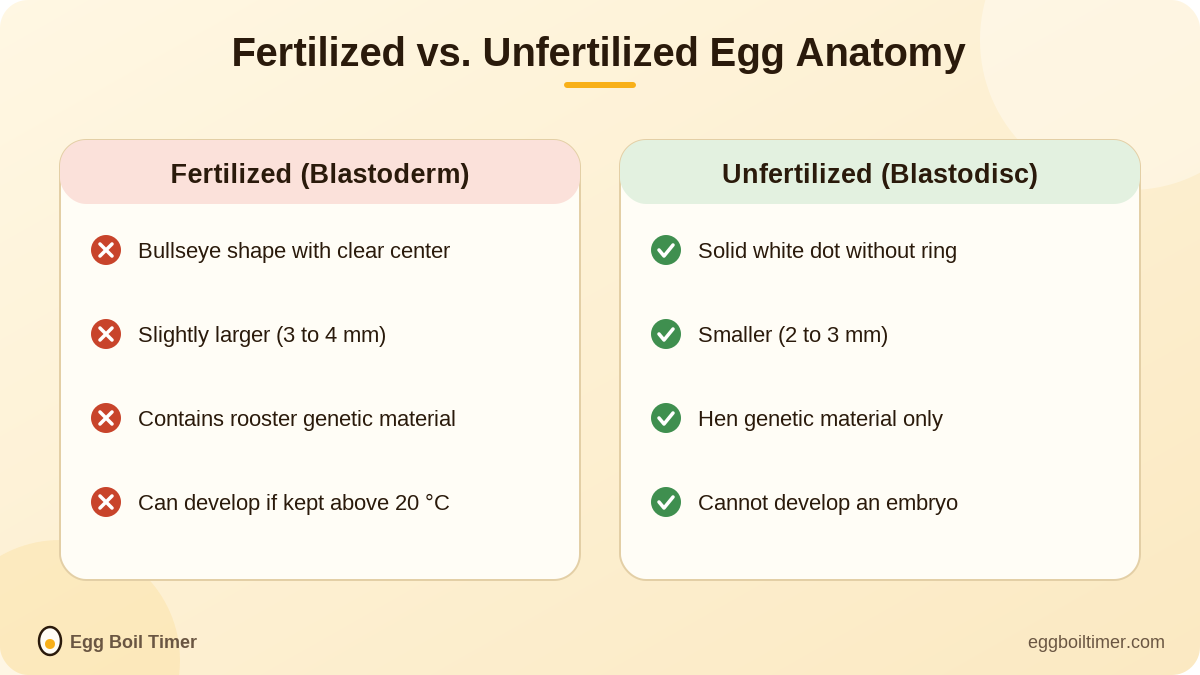
You can identify a fertilized egg after cracking it onto a flat plate. Look closely at the surface of the yolk for the tiny white germinal disc. In an unfertilized egg, this disc is called a blastodisc. It appears as a solid, opaque white dot about 2 to 3 millimeters across with slightly irregular edges.
In a fertilized egg, the disc is a blastoderm. It expands to 3 or 4 millimeters and forms a distinct ring pattern. The outer border stays bright white while the center remains pale and translucent, creating a doughnut or bullseye shape. When preparing eggs or monitoring yolk firmness, use our Egg Boil Timer to calculate exact boiling times regardless of fertilization status. You can also inspect uncracked shells over a bright light using a technique called candling in a dark room.
| Visual Marker | Unfertilized Egg (Blastodisc) | Fertilized Egg (Blastoderm) |
|---|---|---|
| Shape on Yolk | Solid white pinprick dot. | Ring pattern with a clear center (bullseye). |
| Average Size | 2 to 3 mm. | 3 to 4 mm. |
| Genetic Source | Hen only. | Hen and rooster combined. |
| Development Potential | None. | Embryonic growth if incubated above 20 °C. |
| Candling Appearance | Clear yolk shadow, single air cell. | Clear yolk shadow unless incubated past 48 hours. |

Safety Standards and Edibility of Fertile Shell Eggs
Fertilized eggs carry no higher food safety risk than unfertilized eggs when gathered and stored under cold temperatures. Food safety authorities like the USDA evaluate shell eggs based on bacterial risks such as Salmonella enteritidis rather than mating status. A freshly laid, unincubated fertilized egg contains no blood vessels or chick tissue. It acts identically to any unfertilized kitchen egg.
Temperature control remains the decisive safety factor. Storing eggs at 4 °C (40 °F) halts cell division completely. Without continuous warmth between 37 °C and 39 °C (99 °F to 102 °F) alongside proper humidity, an embryo cannot grow. The single-celled blastoderm stays dormant. Treat farm-fresh fertile shells like standard raw eggs. Refrigerate them promptly and cook thoroughly when preparing meals for vulnerable groups. For raw food preparations requiring reduced pathogen risk, consider using Pasteurized Eggs: Safety, Pasteurization Temp, and Cooking Uses.

Flavor and Yolk Density Myths Examined
Many backyard chicken keepers believe fertilized eggs taste richer or yield firmer yolks. Controlled sensory panel tests show that fertilization causes no measurable change in flavor, yolk viscosity, or whipped white volume. The belief stems from culinary context: fertilized eggs usually come from small pasture-raised flocks rather than commercial battery cages.
Flock diet and egg freshness dictate flavor profile and yolk color. A hen foraging on open pasture, grasses, insects, and seeds produces yolks rich in xanthophylls and carotenoids. This diet yields a deep orange yolk and pronounced flavor. An unfertilized egg from that same pasture-fed hen tastes identical to her fertilized egg.
Commercial grain feed yields paler, milder yolks regardless of whether a rooster is present. Whether preparing pasture-raised shells or standard Chicken Eggs: Anatomy, Formation, Nutrition, and Cooking, culinary performance depends on feed quality and egg age rather than genetics. Shell color also reflects breed rather than fertility, as seen when comparing Brown or White: Does the Colour of the Shell Change the Boiling Time? or Blue Eggs: Genetics, Chicken Breeds, and Shell Colors.
Nutritional Breakdown: Comparing Fertile and Infertile Eggs
Claims that fertilized eggs hold higher hormone levels or superior protein density lack scientific backing. Laboratory testing confirms that nutritional values in unincubated fertilized eggs match unfertilized eggs. A large egg weighing 50 grams delivers approximately 6.3 grams of protein, 4.8 grams of fat, and essential micronutrients like choline, lutein, and vitamin B12.
Because cold storage stops cellular activity, the dormant cell cluster does not synthesize new vitamins or consume yolk energy reserves. Hormone levels such as estrogen and progesterone exist only in trace picogram amounts, identical across fertile and infertile unincubated eggs. Microscopic cell structures inside the blastoderm are far too tiny to alter USDA nutrition figures. The table below lists baseline nutrients for a 50-gram egg across both types.
| Nutrient (per 50 g egg) | Unfertilized Shell | Fertilized Shell (Unincubated) |
|---|---|---|
| Calories | 72 kcal. | 72 kcal. |
| Protein | 6.3 g. | 6.3 g. |
| Total Fat | 4.8 g. | 4.8 g. |
| Choline | 147 mg. | 147 mg. |
| Cholesterol | 186 mg. | 186 mg. |
Sourcing Fertile Shells and Managing Fridge Temps
Commercial supermarkets rarely stock fertilized eggs. Large-scale commercial egg facilities keep laying hens isolated from roosters to prevent flock stress and maintain uniform shelf life. Eggs sold in standard retail cartons are universally unfertilized. Specialty grocers sometimes stock certified fertile eggs at a premium price, clearly labeled on the carton.
When buying fertile eggs at farm stands or collecting them from a home flock, follow these storage practices:
- Gather nests twice daily: Prevents broody hens from sitting on eggs and initiating thermal incubation.
- Chill quickly below 4 °C (40 °F): Locks in structural freshness and maintains blastoderm dormancy.
- Leave unsoiled shells unwashed: The natural cuticle or bloom seals shell pores against bacterial entry. Wash dirty shells with warm water right before cooking.
- Store small end down: Keeps the yolk centered and protects the air cell inside the large end from rupture.
- Maintain stable humidity: Storing eggs at 75% relative humidity prevents moisture loss through porous shells.
Blood Spots, Veins, and Early Embryo Troubleshooting
Cracking an egg to reveal a bright red spot often causes concern, but it does not indicate fertilization. A blood spot results from a tiny follicle vessel breaking on the hen's ovary during ovulation. Blood spots appear in both fertilized and unfertilized eggs, posing no health or safety hazard.
A developing embryo appears only if a fertilized egg remains above 20 °C (68 °F) for several consecutive days. After 48 hours of warm incubation, a thin red ring of blood vessels forms across the yolk. If warm conditions continue past 72 hours, visible vascular networks and embryo tissue emerge. If an egg shows red vessel lines or embryo tissue, discard it. Those signs indicate warm storage and potential bacterial growth.
Culinary Uses of Incubated Eggs Across Cultures
While Western kitchens cook unincubated eggs, several global traditions intentionally incubate fertilized eggs before preparing them. The most prominent example is What Is Balut? Incubation, Flavor, Safety, and Culture, a street food staple in the Philippines and Vietnam. Balut uses fertilized duck or chicken eggs incubated for 14 to 18 days, allowing partial embryo formation before boiling.
The savory broth inside a balut shell offers deep umami flavor, while the yolk turns dense and rich. Beyond balut, regional recipes across Southeast Asia use incubated eggs in slow-simmered herbal soups. Understanding cooking mechanics for distinct poultry species, such as How to Boil Duck Eggs: Precise Times, Peeling, and Safety or How to Boil Quail Eggs for Runny, Jammy, or Firm Yolks, helps when handling varied shell sizes. You may also encounter natural shell variations like a Where to Buy Double-Yolk Eggs and How They Affect Cooking when sourcing eggs from young breeding flocks.
Culinary Decisions: When to Choose Fertile over Standard Shells
For everyday boiling, frying, and baking, fertilized eggs offer no culinary advantage over standard eggs. They perform identically when whipped into meringues, fried in butter, or poached in simmering water. Selecting fertile eggs depends on farm sourcing preferences and animal husbandry practices rather than cooking results.
If you plan to hatch chicks or wish to support pasture-based farms where roosters roam with hens, purchasing fertile eggs makes sense. For general meal preparation, choose eggs based on farm freshness and laying dates. Shell freshness and flock diet shape your dish far more than a microscopic blastoderm ring.


