A classic soufflé rises when trapped air and moisture in the batter heat up, expand, and generate steam that forces whipped egg whites toward the rim of a buttered ramekin. Achieving a tall, golden crown with a delicate, creamy center requires an emulsion base, properly aerated albumen, and steady oven heat without premature door openings.
The Physics of Thermal Expansion in Egg Foam
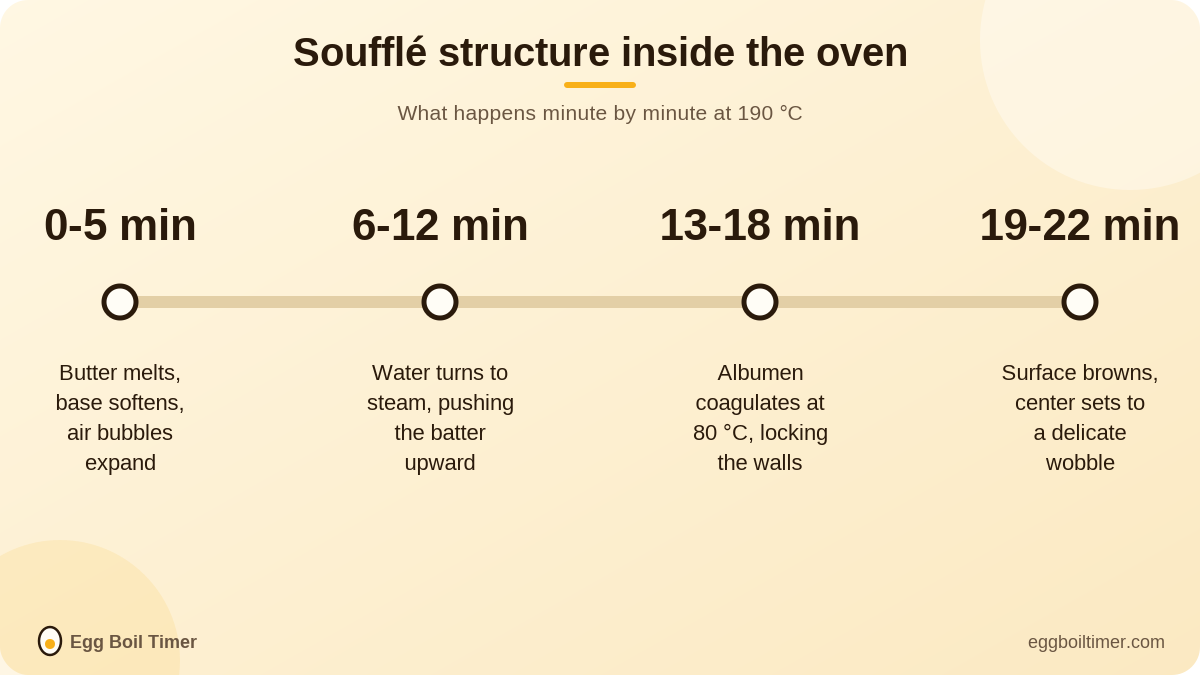
Soufflé rise is pure thermodynamics. When the ramekin enters an oven preheated to 190 °C (375 °F), heat penetrates the batter through the ceramic walls. As internal heat climbs past 60 °C (140 °F), millions of trapped air pockets expand. Water in the milk, butter, and eggs then vaporizes into steam, which expands to over 1,600 times its liquid volume. With minimal friction along the buttered ramekin walls, this expanding gas pushes the entire mass upward.
Meanwhile, egg white proteins undergo denaturation and coagulation. Ovalbumin and ovotransferrin uncoil under heat and bond into a semi-rigid network around the expanding bubbles. A standard large egg provides roughly 6.3 g protein, supplying the structural scaffold necessary to hold that volume aloft. Once the internal temperature reaches approximately 75 °C to 80 °C (167 °F to 176 °F), the protein walls solidify. The structure sets, capturing the inflated height before the pockets can pop.
Ramekin Physics and Ingredient Standards
Equipment geometry directly governs the vertical travel of your batter. Slanted ceramic bowls cause expanding foam to spread laterally, producing a flat, squat bake. Straight-sided, unglazed-rim porcelain ramekins measuring 9 cm (3.5 inches) across and 5 cm (2 inches) deep provide the vertical path required for a clean lift.
The choice of ingredients establishes the balance between rich flavor and physical lift:
- Eggs: Fresh large eggs separate cleanly without yolk contamination. Cold eggs separate easily, but the whites must warm to room temperature (about 20 °C or 68 °F) before whipping to maximize air bubble volume. Separate yolks for richness from Flax Egg White Guide: Ratios, Baking Uses, and Whipping Limits that build the lift.
- Fat and Starch: Unsalted butter and all-purpose flour create a roux for savory bases, or blend with milk into a light starch suspension that stabilizes sweet bases without weighting down the foam.
- Flavor Mediums: Sharp cheeses such as Gruyère, Comté, or aged cheddar must be finely grated so their weight does not anchor the base. For sweet versions, melted bittersweet chocolate (60% to 70% cacao) provides intense taste without surplus sugar dragging down the proteins.
- Ramekin Coating: Softened whole butter brushed vertically up the ceramic interior, coated with finely grated Parmesan for savory versions or granulated sugar for sweet ones, provides physical footholds for the climbing foam.

Building the Base: Béchamel and Crème Pâtissière
Every traditional soufflé begins with a thickened foundation that carries flavor, seasoning, and fat. Savory versions rely on a thick béchamel sauce, while dessert versions use a flavored pastry cream base similar to what you prepare for a rich Custard Recipe and Science: Perfecting Egg-Thickened Creams.
For a savory cheese foundation, melt 30 g (2 tablespoons) of butter in a saucepan over medium-low heat. Whisk in 30 g (1/4 cup) of all-purpose flour and cook for two minutes without browning to eliminate raw starch flavor. Gradually pour in 180 ml (3/4 cup) of warm whole milk while whisking constantly.
Simmer until the sauce thickens into a heavy paste that leaves clean trails behind the whisk. Remove the pan from heat, let it cool for three minutes, then beat in three large Egg Yolk Science: Composition, Nutrition, and Culinary Mechanics one by one. Stir in 80 g of finely shredded cheese and a pinch of ground nutmeg until fully emulsified.
For a chocolate dessert base, heat 120 ml (1/2 cup) of whole milk with 20 g of sugar until steaming. Whisk two egg yolks with 15 g of cornstarch, temper with the warm milk, and return to the pan until thickened. Melt 100 g of chopped dark chocolate directly into the warm mixture until smooth and glossy. Cover the surface directly with parchment paper so a skin does not form while cooling to room temperature.

Whipping the Albumen to Medium-Stiff Peaks
Aerated foam provides the sole leavening in this recipe. Any trace of fat from stray yolk particles or oily residue on the mixing bowl prevents albumen proteins from bonding around air bubbles. Use a clean glass, copper, or stainless steel bowl wiped with a paper towel dampened with lemon juice or white vinegar.
Whip four large egg whites on medium-low speed until foamy. Add a pinch of salt or 1/8 teaspoon of cream of tartar. The acid lowers the pH of the albumen, stabilizing the bond between conalbumin and ovalbumin molecules so the foam resists weeping. Increase the mixer speed to medium-high once fine, uniform bubbles appear throughout the liquid.
Aim for glossy peaks that hold their shape with a gentle, curved tip when you lift the whisk. Avoid over-whipping into dry, clumpy cotton-like tufts. Over-coagulated whites lose their elasticity and tear apart during baking instead of stretching alongside the expanding steam. If you make sweet Mastering Meringue: French, Swiss, and Italian Techniques often, remember that soufflé whites need slightly less sugar and marginally softer peaks than crisp piped shells.
Incorporating the Foam and Prepping the Ramekins
Combining a dense, viscous base with fragile foam requires a staged approach to protect bubble volume. Cold bases will seize the whipped whites, so ensure your flavored foundation rests lukewarm to the touch (around 30 °C to 35 °C).
Scoop one-quarter of the whipped whites directly into the flavored base. Stir this portion thoroughly with a silicone spatula. This sacrificial addition thins the heavy base, equalizing its density so subsequent folds do not crush the remaining foam.
Pour the lightened base over the remaining whites. Cut straight down through the center of the bowl with the edge of your spatula, sweep along the curved bottom, and bring the batter up the side, rotating the bowl 90 degrees with each stroke. Stop the moment streaks of white vanish. Over-mixing deflates the volume by breaking the cellular gas pockets.
Prepare four 180 ml (6 oz) ramekins by brushing softened butter in deliberate upward vertical strokes along the inner walls. Coat the butter thoroughly with grated cheese or sugar, tapping out all excess. Fill each ramekin to the top rim and level flush with an offset spatula. Run your thumb around the top inner rim to create a 2 mm channel. This groove prevents batter from catching on the rim, ensuring an even, vertical rise.
Baking Protocols, Heat Curves, and Visual Indicators
Place a heavy baking sheet on the lower-middle rack of the oven and preheat to 190 °C (375 °F). Placing cool ramekins directly onto a preheated metal surface drives immediate bottom heat into the batter, kicking off steam generation within the first four minutes.
Set the filled ramekins onto the hot sheet, leaving at least 5 cm (2 inches) of clearance between dishes for radiant heat circulation. Close the oven door immediately. Do not open the door during the first 16 minutes of baking. Opening the door lets cool air rush inside, which drops the ambient temperature rapidly and causes expanding steam pockets to contract before the protein walls have set.
A standard 180 ml ramekin requires 18 to 22 minutes to bake. Look through the oven glass to monitor physical changes:
- At 8 minutes: The batter climbs past the ramekin rim, displaying straight, vertical walls.
- At 15 minutes: The top develops a rich golden crust while the structure reaches maximum height (typically 3 to 5 cm above the rim).
- At 20 minutes: The exterior appears dry and set. A gentle nudge of the oven rack produces a subtle, synchronized wobble across the center rather than a sloshing liquid ripple.
If you prefer an egg dish with a dense, creamy, unbaked consistency throughout, a classic baked Classic Flan: Caramel, Custard Ratios, and Water Bath Baking or rich Classic Crème Brûlée: The Science of Silky Custard offers that custard texture without the vertical structural demands of whipped albumen.
Solving Common Structural Failures
Because the dish balances delicate mechanics, even small deviations in oven heat, egg freshness, or folding motion produce visible flaws. Use this diagnostic matrix to match structural symptoms with corrective kitchen actions.
| Visible Symptom | Physical Cause | Corrective Action |
|---|---|---|
| Lopsided or crooked rise | Uneven buttering or batter sticking to the ramekin rim | Brush butter in strictly vertical strokes; clear a 2 mm channel around the inner rim with your thumb. |
| Dense, squat height (under 2 cm) | Over-folded batter or whites whipped past stiff peaks into dry curds | Stop whipping at glossy medium-stiff peaks; sacrifice 25% of whites first to loosen the base. |
| Deep surface fissures and cracks | Oven temperature too high; exterior baked rigid before interior finished expanding | Lower oven temperature by 15 °C; verify actual temperature with an internal oven thermometer. |
| Collapsing within 60 seconds of exit | Severely underbaked center; albumen network never reached 75 °C set point | Bake 2 to 3 minutes longer until the center shows a gentle wobble rather than liquid ripple. |
| Watery separation at the ramekin base | Egg whites wept due to prolonged delay between whipping and baking | Fold and bake immediately once whites reach peak volume; do not let filled ramekins sit on the counter. |
| Rubbery, tough crumb | Overbaking, causing proteins to over-tighten and expel all moisture | Pull the dish when the top is golden and center retains a soft, creamy core. |
Every soufflé begins deflating roughly two to three minutes after leaving the oven. As ambient room air cools the gas pockets inside, internal steam condenses back into liquid water droplets. Atmospheric pressure gently presses the unsupported crown downward. This gradual descent is normal physics, not culinary error. Serve the dish immediately from oven to table while the steam remains fully expanded.
For everyday cooking outside of baking projects, accurate timing remains the single most important variable for poultry eggs. Whether boiling dippy eggs for breakfast or soft-boiling eggs for broth, consult our calibrated Egg Boil Timer to calculate exact heat times based on egg mass, starting temperature, and local elevation.


