A classic sponge cake relies entirely on beaten whole eggs and sugar for its rise, using zero baking powder or baking soda. The method traps air within egg proteins to create a springy, tender crumb. Whipping eggs to the ribbon stage forms elastic membranes around micro-bubbles. Oven heat expands these pockets while flour starches set into a delicate lattice.
How Egg Proteins Trap Air and Set the Crumb
Whole eggs supply water and structure. A standard large egg contains about 6.3 grams of protein distributed between the yolk and albumen. During vigorous whipping, mechanical shearing uncoils tightly folded ovalbumin and vitellin molecules so they migrate to bubble boundaries, forming elastic protective films that trap expanding air.
Temperature controls foam stability. Cold eggs straight from the refrigerator possess high viscosity that resists bubble expansion. Warming intact eggs to roughly 37 °C (99 °F) in warm water lowers surface tension, which allows the beating whisk to trap millions of tiny, uniform micro-bubbles that expand reliably during the bake. Sugar acts as a structural stabilizer. Added gradually, it dissolves into egg moisture and thickens bubble walls to prevent collapse before heat sets the foam.
Thermal setting occurs in two distinct phases between 60 °C and 85 °C (140 °F to 185 °F). First, yolk and white proteins coagulate into a firm scaffold. Next, flour starches absorb moisture, swell, and gelatinize. Steam trapped inside the air cells forces the crumb outward, producing tall lift.
Ingredients and Method for a 20-Centimeter Sponge
This formula produces two tender 20 cm (8-inch) sponge cake rounds designed for layered fillings, requiring zero chemical leaveners.
- Eggs: 4 large eggs (220 g shelled weight), warmed in their shells in warm water for 10 minutes.
- Granulated sugar: 120 g, superfine or castor sugar dissolves fastest.
- Cake flour: 120 g, low-protein (8% to 9% protein content), sifted twice before combining.
- Unsalted butter: 30 g, melted and cooled to lukewarm (optional, for enriched Genoise crumb).
- Vanilla extract: 5 ml (1 teaspoon) pure vanilla extract.
- Fine salt: 1 g (pinch) to sharpen egg sweetness.
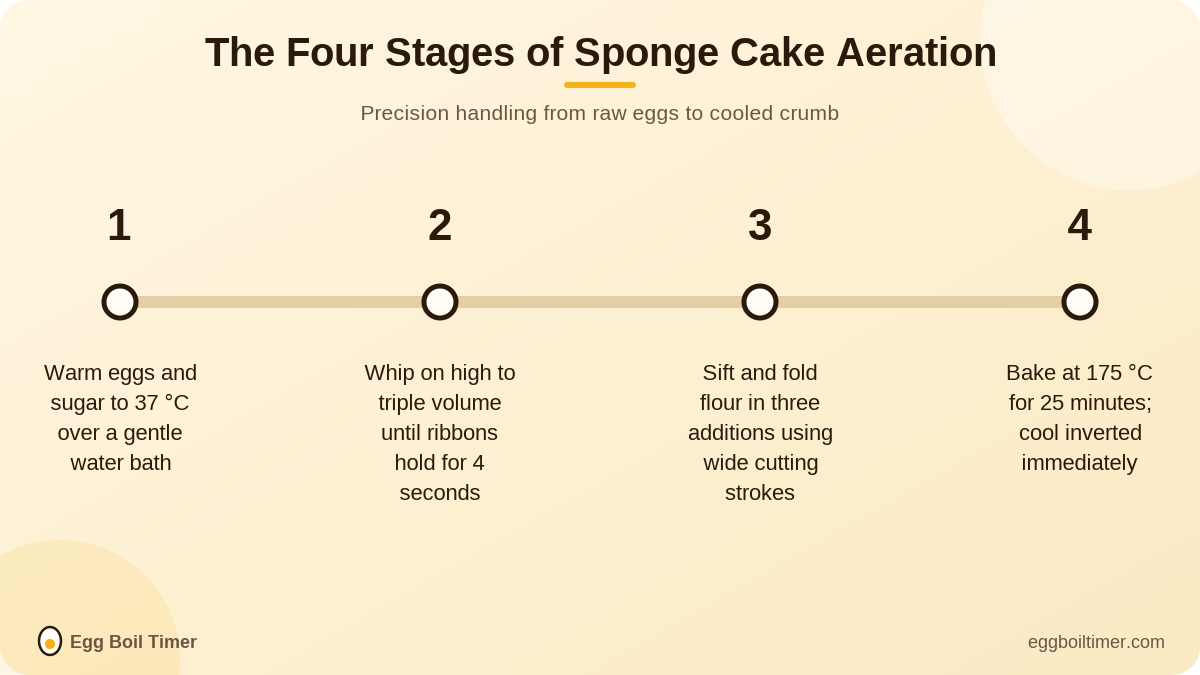
- Prepare the pans: Grease two 20 cm straight-sided cake tins and line the bases with parchment paper. Leave tin sides ungreased so rising batter can cling to the walls. Heat the oven to 175 °C (350 °F) conventional, or 160 °C (320 °F) fan-forced.
- Whip to ribbon stage: Combine eggs, sugar, salt, and vanilla in a mixing bowl. Beat on medium-high speed for 7 to 9 minutes. The mixture must triple in volume and turn pale ivory. When the whisk is lifted, the batter should form a ribbon that stays visible for four seconds.
- Sift and fold the flour: Sift one-third of the flour over the egg foam. Cut down through the center with a silicone spatula, sweep the bottom, and fold upward. Repeat until dry spots vanish. Fold in the remaining flour in two additions, using 15 to 20 strokes total.
- Incorporate optional fat: To add melted butter, scoop 100 ml of batter into the butter bowl and stir smooth. Gently fold this tempered mixture back into the main batter in three broad strokes.
- Bake and cool: Divide batter between the pans. Drop each pan onto the counter from 5 cm height to pop large air pockets. Bake for 23 to 25 minutes until the center springs back. Invert pans immediately onto wire racks so steam escapes without compressing the crumb.

Whipping to Ribbon Stage and Folding Mechanics
Under-whipped eggs produce flat, rubbery cakes, while over-whipped whole eggs turn dry and crumbly. Watch visual cues rather than the clock to judge the ribbon stage. The batter should cascade from the beater like folded silk ribbons. If trails sink immediately, whip for another two minutes on medium speed.
Adding flour risks deflating the foam and overworking gluten. Flour starches contain glutenin and gliadin, which form tough strands if stirred vigorously with liquid. Sifting distributes starch evenly across the foam without heavy mixing. If your recipe uses egg whites whipped into Mastering Meringue: French, Swiss, and Italian Techniques, fold with even lighter strokes to protect delicate cell walls.

Comparing Genoise, Chiffon, Biscuit, and Angel Food
The sponge family varies by fat source, egg handling, and elasticity. Select the right style to match your planned filling and moisture level.
| Style | Fat Source | Egg Technique | Crumb Profile | Best Culinary Application |
|---|---|---|---|---|
| Classic Genoise. | Melted butter. | Whole eggs and sugar whipped warm. | Dry, tight, highly absorbent. | Layer cakes soaked with fruit syrups, French entremets. |
| Chiffon Cake. | Vegetable oil. | Whites whipped to meringue, yolks mixed with oil and flour. | Extremely tender, stays soft when refrigerated. | Chilled cream cakes, fruit shortcakes, tube pans. |
| Angel Food. | Zero fat. | Egg whites only whipped with sugar and cream of tartar. | Snow-white, chewy, ultra-light. | Fresh berry compotes, light summer desserts. |
| Biscuit Sponge. | None or minimal. | Yolks and whites whipped separately, then folded. | Flexible, sturdy, tear-resistant. | Swiss rolls, jelly rolls, Ladyfingers (Savoiardi). |
Diagnosing Sunken Centers, Tough Crumbs, and Eggy Notes
Precision baking leaves little margin for inaccurate oven dials or careless folding. Use this matrix to identify and fix common structural defects.
| Defect Symptom | Underlying Cause | Corrective Action |
|---|---|---|
| Sunken crater in center. | Opening oven door too early, underbaking, or excess sugar weakening starch bonds. | Keep the oven door shut for the first 20 minutes; test crumb resistance before removing. |
| Dense, rubbery texture. | Flour overmixed into gluten development, or deflated egg foam. | Sift flour three times; fold using wide bottom-sweeping cuts in under 20 strokes. |
| Dry, choking crumb. | Baking past target doneness, or oven running hotter than dial setting. | Verify oven with an internal thermometer; soak layers with 1:1 simple syrup. |
| Strong sulfuric smell. | Overcooked egg proteins or using eggs past their prime freshness. | Bake immediately after mixing; add pure vanilla bean paste or citrus zest. |
| Wrinkled, peeling top crust. | Excess moisture during cooling, or undissolved sugar. | Whip until sugar dissolves completely; cool upside down on a raised wire rack. |
Scaling Pan Volumes and Altitude Adjustments
Pan geometry controls how heat penetrates the batter. A 20 cm round tin with 5 cm sides holds roughly 1.5 liters of batter. In a wider 23 cm pan, batter depth drops by nearly a quarter. Reduce baking time by 4 to 6 minutes for wider tins to prevent dry edges. Never fill tins past two-thirds full, or rising foam will spill over the rim and collapse.
At higher altitudes above 1,000 meters, low air pressure makes gas cells expand faster. Reduce sugar by 15 g per 100 g to strengthen moisture retention. Increase baking temperature by 10 °C to set protein walls before air cells burst. Add one extra tablespoon of flour per cup to support the rapid rise.
Handling, Freezing, and Flavor Infusions
Without added shortening, sponge cake dries out quickly once sliced. If baking ahead, wrap fully cooled rounds in plastic wrap. Store them at cool room temperature for up to two days. You can also freeze wrapped cakes for up to three months. Avoid storing unfrosted sponge in the refrigerator, which causes rapid starch staling.
Genoise and other lean sponges absorb liquid toppings without turning mushy. Brush sliced layers with 1:1 simple syrup flavored with citrus peel, rum, or espresso. Top with chantilly cream, fruit preserves, or rich Custard Recipe and Science: Perfecting Egg-Thickened Creams. Fresh eggs are the anchor for aerated cakes, just as they are for boiled eggs tracked on our Egg Boil Timer timer.


