When shopping for eggs free range labels sit next to cage-free, pasture-raised, and organic claims in the supermarket aisle. The USDA defines free-range eggs as those produced by hens given continuous access to the outdoors during their laying cycle. Federal standards specify neither a minimum outdoor acreage per bird nor living vegetation on the ground. Because housing conditions range from industrial screened porches to sprawling pastures, understanding third-party certification stamps helps you make informed choices about animal welfare, nutrition, and cost.
What "Free-Range" Access Means in Practice
Federal regulations managed by the USDA require that commercial poultry houses provide continuous outdoor access through opening doors, often called pop-holes. However, the law leaves outdoor duration, space dimensions, and ground surface type up to producers. On large commercial farms housing over twenty thousand hens, outdoor space may consist of a narrow concrete patio or an enclosed screened porch attached to a metal building.
Hens are naturally cautious flock animals that fear open skies and predators. If exit doors sit far from nesting perches or lead onto barren gravel, few birds choose to step outside. Independent third-party certifications step in to fill these regulatory gaps. Certified Humane requires at least two square feet of outdoor space per bird, alongside at least six hours of daily outdoor access when weather permits. Without a third-party audit seal on the carton, an uncertified free-range label can represent housing conditions barely distinguishable from standard indoor barn production.
Cage-Free, Pasture-Raised, and Organic Standards Compared
Egg carton labels describe three main variables: bird housing systems, feed composition, and external oversight. Battery cages, which restricted each hen to less floor space than a standard sheet of paper, are largely phased out in major retail markets. Modern production methods vary widely in flock density and foraging opportunities.
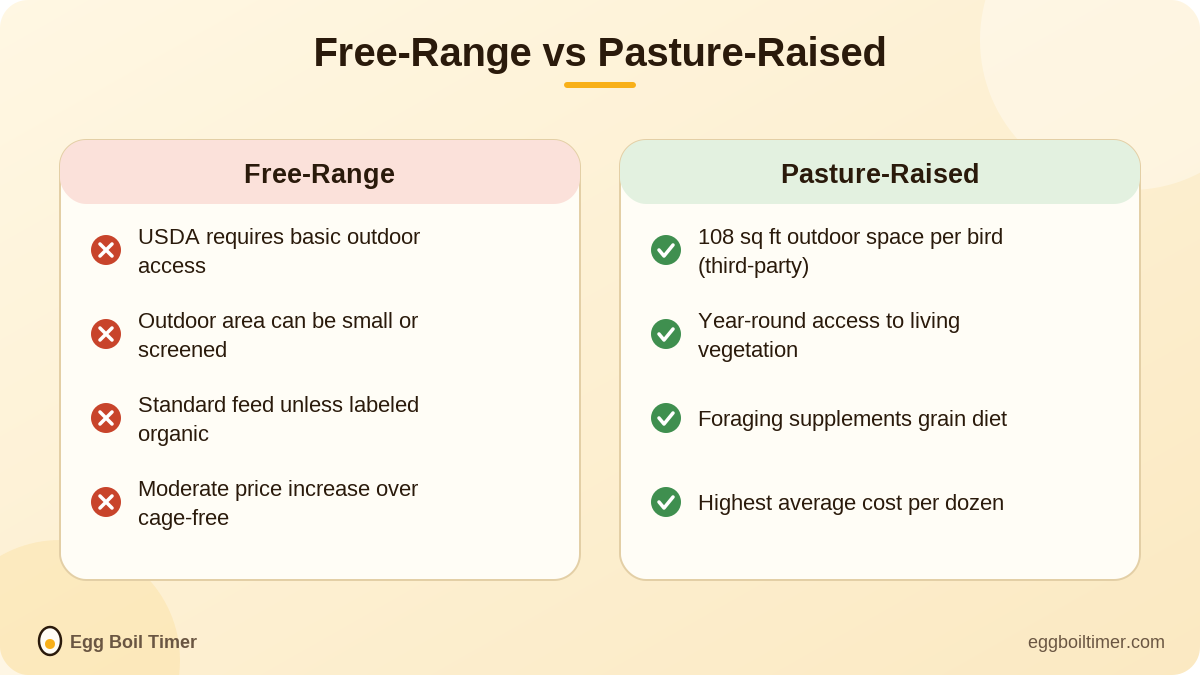
Cage-free hens inhabit large open indoor barns or multi-tiered aviary systems. They can walk, roost on perches, lay in designated nest boxes, and scratch in floor litter, but they never receive outdoor exposure. Pasture-raised systems require extensive outdoor foraging grounds. Major independent certifiers mandate 108 square feet of pasture per bird, managed through rotated fields so living vegetation continually recovers.
| Carton Label | Outdoor Access Requirements | Minimum Space Per Bird | Feed and Medication Rules |
|---|---|---|---|
| Cage-Free | None. Birds remain fully indoors. | 1.0 to 1.5 sq ft (indoors) | Standard grain feed; hormones prohibited by federal law. |
| Free-Range | Required by USDA; duration and ground unspecified. | 2.0 sq ft outdoors (if Certified Humane) | Standard grain feed unless combined with organic cert. |
| Pasture-Raised | Continuous daily outdoor pasture access required. | 108 sq ft outdoors (third-party audited) | Grain feed supplemented by natural plants and insects. |
| Organic | Required outdoor access under USDA NOP rules. | Varies by certifying agency (typically 2+ sq ft) | 100% organic, non-GMO feed; no synthetic pesticides. |
USDA Organic certification overlaying these housing systems adds strict feed and chemical rules. Organic hens consume feed grown without synthetic fertilizers, chemical pesticides, or genetically modified organisms. Routine antibiotic use is prohibited. Housing must offer natural light, shade, and fresh air. Higher feed supply costs and land requirements make organic eggs the highest priced standard option on grocery shelves.

European Union Versus United States Free-Range Rules
Regulatory definitions for free-range poultry differ sharply between North America and Europe. In the European Union and the United Kingdom, free-range egg production is governed by strict statutory standards. European regulations dictate that hens must have continuous daytime access to open-air runs covered primarily with living vegetation, providing a minimum of 4 square meters (43 square feet) of outdoor space per bird.
European law also sets strict limits on indoor flock density, capping housing at nine birds per square meter of usable floor space. Pop-hole doors must extend along the entire length of the building to encourage all hens to exit freely. In contrast, US federal USDA regulations do not mandate plant coverage, specific square footage, or door width ratios. As a result, European free-range standards enforce living space baselines that align more closely with American pasture-raised operations than standard USDA free-range farms.

USDA Grades AA, A, and B: Yolk Height and Albumen Firmness
Egg grading evaluates physical structural freshness and shell condition rather than farm housing type or nutritional value. USDA inspectors grade eggs by candling, projecting a bright light through the egg to examine internal air cell depth, yolk position, and white consistency.
Grade AA eggs display thick, firm whites and a high, round yolk. When cracked into a pan or poaching pot, Grade AA eggs remain tall and compact. Grade A eggs, the most common supermarket grade, possess slightly thinner whites that spread moderately across cooked surfaces. Grade B eggs feature flat yolks and thin, watery whites, alongside minor shell shape irregularities. Commercial food processors use Grade B eggs in liquid, frozen, or baked products rather than whole retail cartons.
Eggs naturally lose grade quality over time as carbon dioxide and moisture escape through thousands of microscopic shell pores. As internal moisture evaporates, the air cell expands and albumen proteins break down into a watery liquid. Performing an Does the Egg Float? What the Water Test Really Tells You in cold water quickly reveals how much internal air volume has developed before cracking older eggs into boiling water.
Shell Colors, Yolk Pigments, and Omega-3 Fortification
Eggshell color is determined exclusively by hen genetics and breed characteristics. White Leghorn chickens lay white eggs, Rhode Island Reds lay brown eggs, and Ameraucana breeds lay soft blue or green eggs. Shell color has no impact on nutritional content, shell strength, flavor, or cooking properties. Brown eggs often carry a higher price point simply because brown-laying breeds are physically larger and eat more grain per egg produced.
Yolk color indicates dietary intake rather than overall vitamin density. Feeds containing high levels of natural carotenoid pigments, such as marigold flower petals, alfalfa meal, yellow corn, or fresh pasture plants, yield deep orange yolks rich in lutein. Wheat-based or barley-based feeds produce pale yellow yolks. Poultry farmers adjust yolk shade by changing feed mixes without altering overall protein or fat content.
Omega-3 fortified eggs come from hens whose diet is supplemented with flaxseed, chia seeds, or marine algae oil. Hens digest these polyunsaturated fats and deposit alpha-linolenic acid (ALA) into their yolks, raising Omega-3 content from roughly 30 mg in a standard egg to between 100 mg and 250 mg per serving. Monitoring local Buy Eggs Smarter: Labels, Prices, and Real Freshness shows that specialized fortified eggs maintain consistent pricing even when standard commodity egg markets experience swings.
Matching Carton Labels to Cooking Methods and Budget
Selecting the right egg carton depends on your kitchen requirements, culinary techniques, and household budget:
- For poaching and frying: Purchase Grade AA eggs. Firm albumen retains a clean, rounded shape in simmering water and prevents spreading across flat skillets.
- For raw or lightly cooked dressings: Choose pasteurized or organic eggs when making homemade mayonnaise, hollandaise, or Caesar dressing to protect vulnerable household members.
- For animal welfare priorities: Look for dual certification seals, such as USDA Organic paired with Certified Humane or Pasture-Raised stamps. These guarantees ensure audited outdoor access alongside chemical-free feed.
- For everyday baking and prep: Grade A cage-free eggs provide dependable structural binding and emulsification in batters and custards at an economical cost. Standardized Small, Large or Jumbo: Egg Sizes Explained, and Why They Change Your Timer ensure recipe liquid ratios remain accurate.
Keep fresh eggs on an interior refrigerator shelf held at 40 °F (4 °C) or lower rather than inside the door storage rack, where ambient temperature shifts thin the albumen layer. Understanding When Do Eggs Expire? True Shelf Life and Spoilage Signs prevents unnecessary waste and maintains reliable cooking results. If you prepare batches ahead for busy mornings, like an A Dozen Eggs on Sunday: The Meal-Prep Habit That Feeds You All Week routine, check How Long Do Hard-Boiled Eggs Last in the Fridge? to store cooked eggs safely. For exact boiling times tailored to egg size and starting temperature, use Egg Boil Timer to calculate your timer settings.


