Raw shell eggs in fridge storage stay fresh for 3 to 5 weeks when kept at or below 4 °C (40 °F). Commercial washing in North America and Japan removes the egg's protective outer cuticle, making continuous refrigeration necessary to prevent bacterial growth. Storing eggs in their original paperboard carton on a middle shelf protects them from temperature swings and odor absorption.
Why Commercial Egg Washing Demands Cold Storage
Eggshells contain 7,000 to 17,000 microscopic pores that allow oxygen and moisture to pass through during embryonic development. Freshly laid eggs carry a natural protein coating called the cuticle, or bloom, composed of mucin glycoproteins. This barrier seals the pores against environmental bacteria like Salmonella enteritidis and slows interior moisture loss. Commercial egg processors in North America and Japan wash harvested eggs with warm water (at least 32.2 °C) and mild sanitizer to clean the outer shell, stripping away this natural cuticle completely.
Without its protective cuticle, an egg shell becomes permeable. Moisture escapes faster and surface micro-organisms reach the internal membranes easily. Keeping washed eggs at a constant 4 °C (40 °F) halts bacterial multiplication. Moving a chilled egg to room temperature causes moisture from ambient air to condense on the cool shell. This surface water creates a liquid pathway for bacteria to swim through the open pores straight into the albumen.
Door Storage vs. Main Shelf Placement
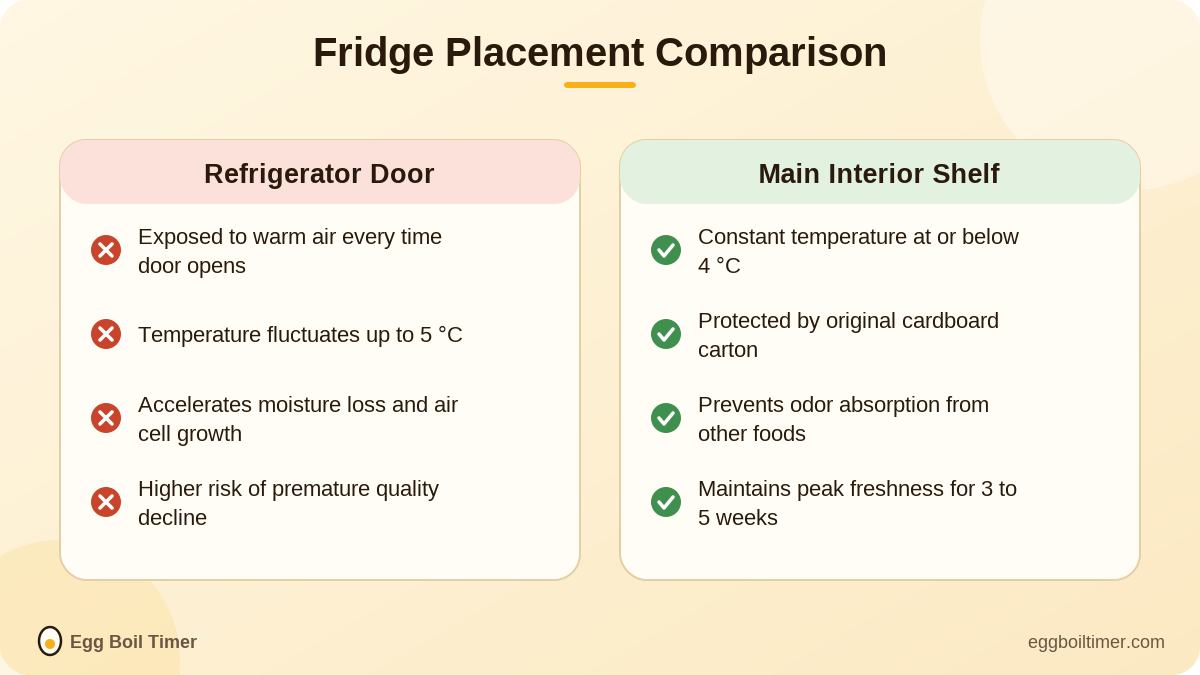
Built-in egg trays on refrigerator doors look convenient, but the door is the warmest and most thermally volatile location in the appliance. Opening the refrigerator door sweeps ambient kitchen air across the door racks several times each day. These recurring warmth spikes cause temperature swings of 3 °C to 5 °C, which accelerate the breakdown of structural egg proteins.
Fluctuating temperatures weaken the vitelline membrane holding the yolk intact, causing aged yolks to break easily when cracked. Warm storage also thins the thick albumen, turning egg whites watery. The best location for egg storage is a middle or lower main shelf where cold air circulation remains stable. Keeping eggs inside their original cardboard carton shields them against light, cushions physical impacts, and stops eggshells from absorbing volatile sulfur and nitrogen compounds from sliced onions, garlic, or brassicas stored nearby.
| Storage Location | Average Temperature | Temperature Stability | Odor Protection | Recommended Purpose |
|---|---|---|---|---|
| Refrigerator Door | 5 °C to 8 °C | Poor (Frequent warmth spikes) | Low (Exposed plastic trays) | Not recommended for fresh eggs |
| Middle Main Shelf | 2 °C to 4 °C | High (Consistent cold air) | High (Kept inside paper carton) | Ideal for raw shell eggs |
| Crisper Drawer | 1 °C to 3 °C | High (High humidity zone) | Moderate (Risk of vegetable moisture) | Acceptable backup location |

Cold Storage Timelines for Raw and Cooked Eggs
Egg longevity varies depending on whether the shell remains intact and whether the proteins are raw or cooked:
- Raw whole eggs in shell: Remain fresh for 3 to 5 weeks past the packaging date when chilled at 4 °C. The three-digit Julian pack date printed on carton side panels (001 for January 1, 365 for December 31) indicates when the eggs were packed. Find more details in our complete guide on When Do Eggs Expire? True Shelf Life and Spoilage Signs">how long eggs last in the fridge.
- Separated egg whites: Keep for 2 to 4 days in an airtight container. Raw albumen lacks its protective shell once opened, making sealed glass jars ideal for storage.
- Separated egg yolks: Dry out within hours if left exposed to cold air currents. Store raw yolks in a sealed vessel submerged under a thin layer of cold water for 2 to 4 days, pouring off the liquid before cooking. Balancing recipes is simpler when you understand standard Small, Large or Jumbo: Egg Sizes Explained, and Why They Change Your Timer">egg sizes and weights.
- Hard-boiled eggs: Stay safe for up to 7 days in their shells. Boiling removes any synthetic wax or natural coatings applied during packing, leaving the shell porous. Read specific storage windows in our reference on How Long Do Hard-Boiled Eggs Last in the Fridge?">boiled egg shelf life.
- Jammy and soft-boiled eggs: Keep for 3 to 4 days in shell. Liquid yolk centers contain active water that degrades slightly faster than fully coagulated proteins.

Safe Cooling Procedures for Cooked Eggs
Cooked egg dishes, frittatas, and boiled eggs must enter the refrigerator within two hours of preparation. Between 4 °C and 60 °C (40 °F to 140 °F), dangerous foodborne pathogens like Staphylococcus aureus double in population every 20 minutes.
When cooking eggs ahead for meal prep, set precise heat times using our Egg Boil Timer so yolks hit your preferred texture before chilling. Submerging freshly boiled eggs in an ice water slurry for 10 to 15 minutes halts residual thermal carryover. This rapid chilling shrinks the egg albumen slightly away from the inner shell membrane, making peeling easier while preventing a green ferrous sulfide ring from forming.
Store unpeeled boiled eggs in an airtight glass container. If you peel them early, cover them with cold water or line the container with a damp paper towel. For batch cooking ideas, view our A Dozen Eggs on Sunday: The Meal-Prep Habit That Feeds You All Week">oven egg meal prep guide.
Washing Rules and Freezing Protocols
International poultry standards explain why egg storage practices differ across regions. European Union regulations prohibit commercial washing of Class A eggs to preserve the natural cuticle. European farms rely on hen flock vaccination against Salmonella, allowing unwashed eggs to sit safely on unchilled grocery store shelves. However, once an egg is chilled in a home refrigerator, it must remain refrigerated to prevent surface condensation.
Never freeze intact raw eggs in their shells. As internal water freezes, it expands by approximately 9 percent, fracturing the rigid calcium carbonate shell and opening the egg to freezer burn. To freeze raw eggs safely, whisk whites and yolks together thoroughly, adding 0.5 grams of salt per 100 grams of egg liquid to stabilize proteins.
Separate whites freeze well plain and retain full whipping power for meringues. Separate yolks require 1.5 grams of salt or 2.5 grams of sugar per 4 yolks (70 grams of yolk) to prevent irreversible lipo-protein gelation during freezing. Thaw frozen egg products overnight at 4 °C before use.
Detecting Spoilage and the Water Float Test
Determining egg quality requires simple physical and visual checks. Over time, moisture and carbon dioxide escape through shell pores, causing the internal air cell at the wide end to enlarge gradually.
The float test measures egg density changes caused by air cell expansion. Fill a deep glass vessel with cold water and submerge the raw egg:
- Fresh egg: Sinks flat to the bottom on its side. Its internal air pocket is tiny, and its overall density exceeds that of water (roughly 1.08 g/cm³).
- Older egg: Stands upright on its pointed tip at the container floor. The enlarged air pocket adds buoyant lift, though the egg remains completely safe for baking or hard boiling.
- Floating egg: Buoys to the top surface. A floating egg has lost substantial moisture through evaporation. Crack any floating egg into a separate bowl to inspect its aroma and clarity before cooking. Follow complete testing steps in our Does the Egg Float? What the Water Test Really Tells You">egg float test guide.
A spoiled egg emits a sharp hydrogen sulfide odor immediately upon cracking. Discard any egg displaying pink, blue, or green iridescent discoloration in the albumen, dark fungal spots inside the shell, or a slimy yolk membrane. Learn to decode carton date stamps with our guide to Egg Labels Explained: Free-Range, Organic, and Pasture-Raised">egg carton labels.


