Order eggs in an American diner and you will be asked: over easy, over medium or over hard? All three are fried eggs flipped once, so both sides of the white touch the pan. The only difference is how long they stay there after the flip, and that decides the yolk.
The three doneness levels
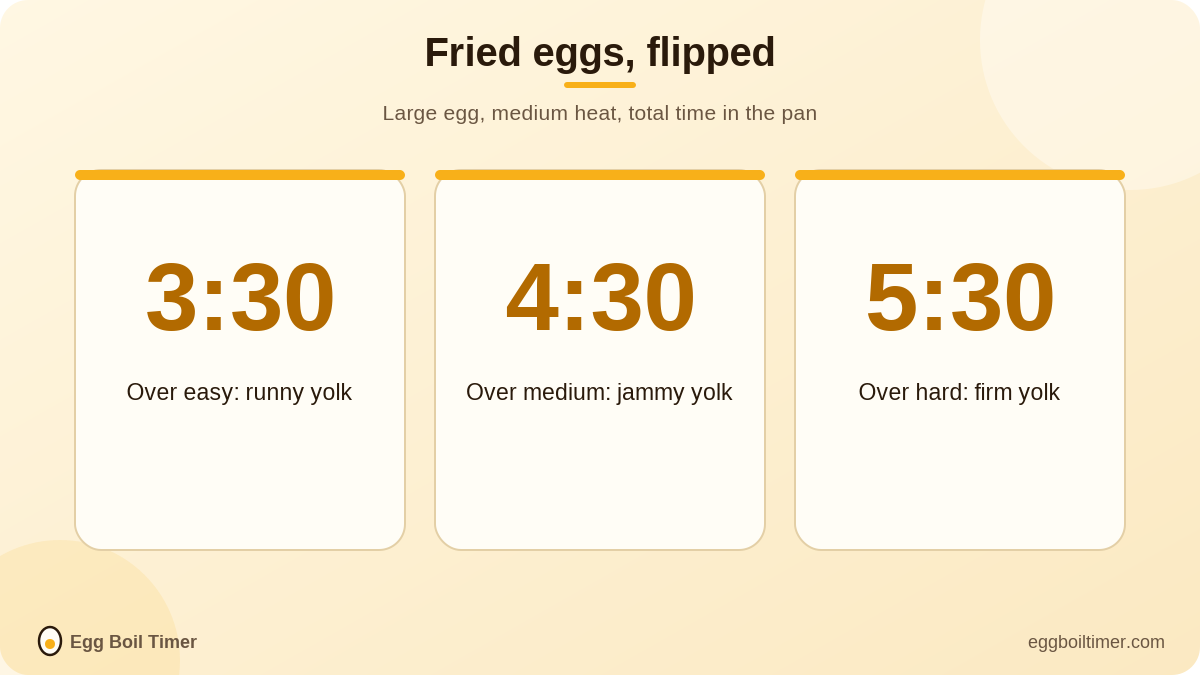
- Over easy: flipped for about 20 to 30 seconds. The white is set, the yolk is fully runny. About 3½ minutes in total.
- Over medium: flipped for about a minute. The yolk is thick and jammy at the edge, still soft in the middle. About 4½ minutes.
- Over hard: flipped for 2 minutes or more, often with the yolk broken. Fully firm, good in sandwiches. About 5½ minutes.
The timer at the top of this page is set to over easy and tells you when to flip. Choose over medium or over hard in the doneness options.
How to flip a fried egg without breaking the yolk
- Use enough fat and a non-stick or well-seasoned pan, over medium heat.
- Wait until the white is mostly set before flipping; a runny white tears.
- Slide a thin spatula fully under the egg, lift it just a little and turn it over close to the pan, so it does not drop.
- Do not press down on the egg after flipping, unless you want it over hard.
Over easy vs sunny-side up
Sunny-side up is never flipped; the top of the white is set with a lid instead, and the yolk stays bright and uncovered: Sunny-Side Up Eggs: Set Whites, Runny Yolks, No Flipping. Over easy has a thin film of white over the yolk.
A note on runny yolks
For young children, pregnant women, older adults and people with weakened immune systems, food safety agencies such as the US FDA advise cooking eggs until the yolk is firm, so choose over hard, or use pasteurized eggs.
For all the other ways to cook an egg, see 15 Ways to Cook Eggs, From Boiled to Sous Vide (With Times for Each). The Egg Boil Timer times fried, boiled, poached and scrambled eggs.