Authentic kwek kwek consists of hard-boiled quail eggs coated in a vibrant orange annatto batter and deep-fried at 180 °C (350 °F to 375 °F) until blistered and crisp. Served on bamboo skewers with spiced vinegar or thick sweet brown sauce, this quintessential Philippine street snack balances rich egg yolks against a crunchy starch crust.
Street Heritage: Quail Eggs Versus Tokneneng
Walk past any transport terminal or school gate in the Philippines during late afternoon, and orange batter sizzles in hot oil along the pavement. Street carts display glowing orbs inside glass warmers, sold in paper bags or pierced onto blunt bamboo skewers. Diners stand around metal tubs, dipping each bite into sour chili vinegar or thick brown gravy.
While western cooking often treats eggs as breakfast staples, Southeast Asian street food turns them into savory finger snacks. Kwek kwek holds a distinct place among world Egg Recipes: Breakfast, Lunch, and Dinner Ideas through its balance of light starch and creamy yolk.
Casual menus frequently interchange kwek kwek with tokneneng, confusing newcomers. The boundary between both dishes lies entirely in the egg choice. Kwek kwek uses quail eggs. Tokneneng uses chicken or duck eggs coated in the identical orange batter.
Because quail eggs weigh 9 to 11 grams, they offer a high yolk-to-white ratio. Each quail egg supplies about 1.2 grams of protein within a delicate white. The bite yields completely without feeling heavy or rubbery.
The fiery orange hue comes from achuete, the seeds of the annatto tree (Bixa orellana), soaked in warm water to extract natural bixin pigments. Street vendors sometimes substitute commercial red and yellow powder dyes, but traditional preparations rely on annatto powder or steeped seeds for an earthy, subtle pepper note.
Other traditions wrap eggs in hearty layers, like the sausage casing of a British Scotch Egg Recipe: Runny Yolks and Crisp Sausage Shells or the brine of American Pickled Eggs Recipe: Brine Ratios, Peeling, and Safe Storage. The Filipino street version stands apart through its light, tempura-style starch shell.
Precision Quail Egg Boiling and Fast Shell Removal
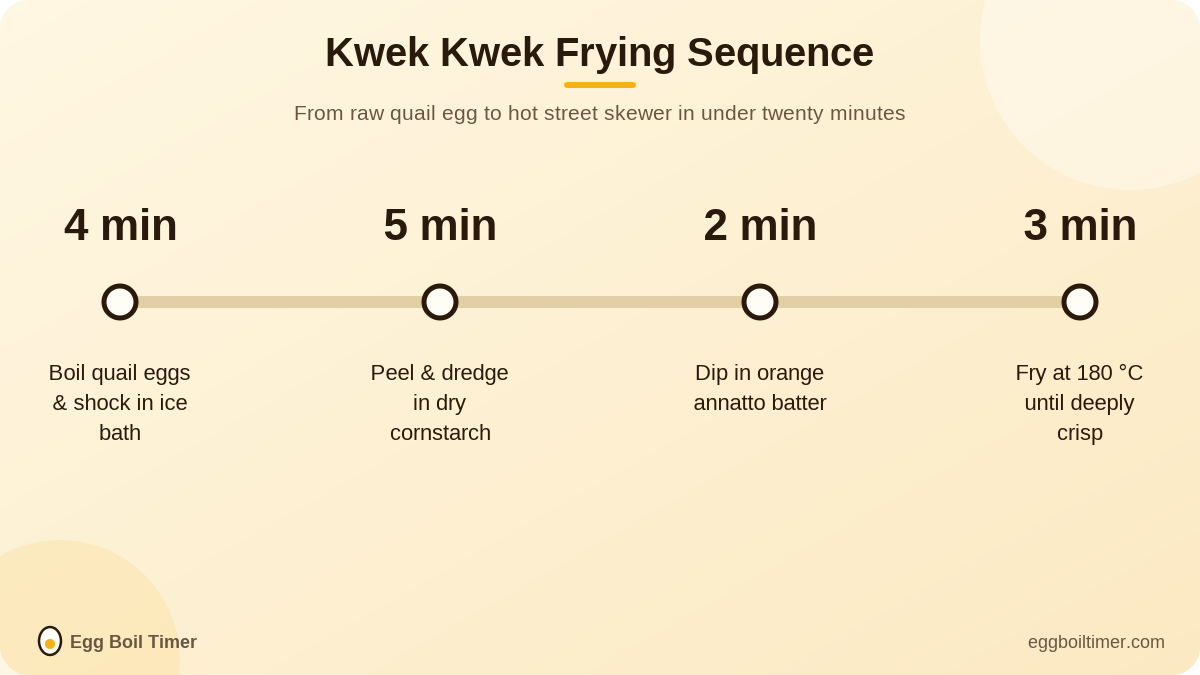
Because quail eggs are tiny, cooking them requires strict timing down to the second. A rolling boil cooks a quail egg yolk firm in four minutes flat. Overcooking quail eggs produces gray ferrous sulfide rings around the yolks and turns the albumen rubbery, ruining the texture beneath the light batter.
Fill a saucepan with enough water to submerge the eggs by 2 centimeters. Bring the water to a rolling boil over high heat before adding the eggs. Lowering fridge-cold quail eggs into boiling water creates thermal shock. This prevents the inner membrane from fusing to the white.
Boil for exactly 240 seconds (4 minutes) for a firm yolk that holds its structure on skewers. If you prefer a jammy core, cook for 150 seconds (2.5 minutes). You can check exact timings across egg sizes with our Egg Boil Timer.
Transfer the eggs with a slotted spoon into an ice bath of equal parts ice and cold water. Let them chill for three minutes. Rapid cooling contracts the egg proteins, separating the albumen from the outer membrane.
To peel dozens quickly without tearing the tender whites, place chilled eggs inside a small plastic container. Secure the lid and shake gently. The shells crack all over at once. Submerge the eggs in water, and the shells slide off in single strips.
Whisking the Annatto Starch Batter for High Adhesion
The primary hurdle home cooks face with kwek kwek is batter separation. An egg white is naturally smooth and slightly slick, causing watery batters to slip off during frying and leaving bald, uncoated patches. Reliable street-cart adhesion relies on two simple elements: a dry pre-dredge and a balanced starch-to-flour ratio.
Combine all-purpose flour and cornstarch in a 2:1 ratio. Pure all-purpose flour creates a batter that turns soft and bread-like within minutes of leaving the hot oil. Cornstarch contains high levels of amylose, which forms an intensely rigid, glass-like network when fried, preserving crispness even after cooling. Adding a half teaspoon of baking powder aerates the wet mixture, creating micro-bubbles across the surface that blister into a crackling exterior.
Dissolve one tablespoon of annatto powder in three-quarters of a cup of lukewarm water before incorporating it into the bowl of dry ingredients. Whisk until smooth; the consistency must resemble thick pancake batter or heavy cream. If the batter runs like milk, add a tablespoon of flour. If it clumps like bread dough, whisk in cold water a teaspoon at a time. Season the batter generously with fine sea salt, ground white pepper, and a pinch of garlic powder to build flavor from within the shell.
Frying Dynamics: Regulating 180 °C Oil and Skewer Handling
Deep-frying eggs safely requires careful temperature monitoring. Heat at least 5 to 7 centimeters of neutral cooking oil with a high smoke point, such as peanut, canola, or sunflower oil, in a heavy Dutch oven or deep skillet. Bring the oil to 180 °C (350 °F to 375 °F). If the oil drops below 170 °C, the starch absorbs excessive fat before crisping, yielding greasy fritters. If the oil spikes above 195 °C, the orange exterior chars before the inner batter sets.
Moisture is the primary enemy of hot frying oil. Pat each peeled quail egg completely dry with paper towels. Roll the dry eggs in a shallow dish containing pure cornstarch until lightly frosted. This dry layer acts as a primer, absorbing residual albumen moisture and giving the wet orange batter a porous surface to grip. Drop the floured eggs into the batter bowl, rolling them gently with a spoon until evenly masked.
Lift each coated egg with a slotted spoon or skewer, letting excess batter drip back, then slide it into hot oil. Fry six to eight eggs per batch so oil temperature stays stable. Stir gently with a spider skimmer after fifteen seconds so the eggs do not stick together.
Fry for 2.5 to 3 minutes until tapping the shell produces a dry, hollow sound. Transfer the kwek kwek onto a stainless steel wire rack to drain. Never rest fried eggs on flat paper towels, because trapped steam softens the crisp bottom crust.
Vinegar Dips and Sweet-Spicy Glazes: Flavor Profile Matrix
A skewer of kwek kwek depends on the sauce in which it bathes. Philippine street gastronomy features two primary condiments for battered snacks: a sharp, fermented spiced vinegar that cuts through hot frying oil, and a thick, sweet-savory brown sauce thickened with cornstarch slurry. Starch-thickened sauces anchor savory eggs across Asia, including Cantonese Egg Foo Young: Golden Patties and Savory Brown Gravy and Japanese Onsen Egg Sauce: Classic Dashi Broth and Bold Modern Twists, but kwek kwek pairs its crunchy crust with sour sugarcane acidity and rich caramel sweetness.
| Sauce Style | Primary Ingredients | Flavor Profile | Best Suited For |
|---|---|---|---|
| Classic Spiced Sinamak | Cane vinegar, red onion, garlic, bird's eye chili, black pepper, sea salt | Pungent, sharply acidic, sharp heat | Cutting oil richness; hot-weather street eating |
| Manila Brown Street Glaze | Water, brown sugar, soy sauce, garlic, shallot, cornstarch slurry | Sweet, salty, glossy, mild umami | Dipping with children or sweet-flavor fans |
| Sweet & Sour Chili Glaze | Cane vinegar, brown sugar, banana ketchup, garlic, chili | Tangy, sweet, fruity, mild pepper heat | Balancing richness with bright fruity acidity |
| Mixed Street Cart "Manong" Style | Equal splash of Spiced Vinegar combined with Brown Street Glaze | Complex, sweet, fiery, sour, thick | Authentic vendor flavor matching all palate notes |
For the spiced vinegar, combine minced shallots, crushed garlic, sliced labuyo chilies, black pepper, and sugar in cane vinegar. Let the mixture steep for thirty minutes before serving to infuse the acid.
For the brown sauce, simmer water, brown sugar, soy sauce, and aromatics in a small pan. Whisk in a quick cornstarch slurry and cook until thick and glossy.
Diagnosing Batter Slippage, Greasiness, and Leaking Shells
When kwek kwek fails, the issue usually stems from oil temperature variance, poor pre-dredging, or moisture retention during assembly.
Problem: The orange batter slides off the egg in sheets during frying. This happens when wet boiled eggs go straight into liquid batter without a dry starch intermediate. Albumen repels water-based batters once heated. Dry the peeled eggs thoroughly and coat them in dry cornstarch or all-purpose flour before dropping them into the orange batter. Ensure your batter contains enough flour; if the batter is too thin, it runs off the egg curvature before the oil can set it.
Problem: The shell is dense, hard, and excessively oily. Cold frying oil is the culprit. When oil drops below 165 °C, the starch absorbs fat rather than instantly vaporizing its surface moisture. Always check the oil with a digital kitchen thermometer between batches. Keep your batch sizes under eight eggs to avoid thermal collapse.
Problem: Quail eggs burst or pop violently in the pan. If boiled quail eggs contain trapped air pockets beneath the inner membrane or micro-fissures in the white, steam builds inside the egg during high-heat frying. Poking two tiny pinpricks into the blunt end of each peeled quail egg before dredging allows internal air expansion without bursting the outer batter crust.
Street-Cart Skewering, Crisp Storage, and Air Fryer Revival
Serve freshly fried kwek kwek within five minutes of leaving the oil. Thread four or five eggs onto 15-centimeter bamboo skewers, providing guests with individual deep jars or ramekins of spiced vinegar and sweet brown sauce. Encourage diners to dip each bite freshly, mirroring Manila's street cart ritual.
Kwek kwek is designed for immediate consumption. Store leftover fried eggs in a single layer inside a paper-towel-lined container in the refrigerator for up to two days. Avoid reheating kwek kwek in a microwave; the radiation superheats steam inside the dense yolk, softening the starch coating into a rubbery sponge and risking an egg explosion.
To restore blistered crispness to chilled kwek kwek, preheat an air fryer or convection oven to 190 °C (375 °F). Place the refrigerated eggs inside the basket with space between each unit, and heat for 3 to 4 minutes. The circulating dry heat draws surface oils out of the crust, reviving the glass-like crunch of the cornstarch without overcooking the central quail yolk.


