Making fried green tomato eggs benedict requires balancing crisp crusts, hot runny yolks, and a stable butter emulsion. Firm, unripe green tomatoes take the place of standard toasted muffins, offering an acidic crunch that cuts through rich egg yolks and creamy sauce. The complete dish comes together in thirty-five minutes when you sequence the frying, poaching, and whisking deliberately.
Architectural balance of the Southern Benedict
Traditional eggs benedict pairs toasted bread with cured pork, poached eggs, and hollandaise sauce. Replacing the bread with sliced green fruit changes both the physics and flavor profile of the plate. Unripe green tomatoes contain dense insoluble pectin. Half-inch slabs retain structural firmness under hot oil instead of collapsing into mush.
Each large egg supplies roughly 6.3 grams of protein, concentrated primarily within the dense white and yolk sphere. When the warm yolk breaks, it cascades over the acidic tomato pulp. This softens the sharpness of the green fruit while the coarse cornmeal crust stays crunchy. You can view classic foundations on Egg Recipes: Breakfast, Lunch, and Dinner Ideas or compare this construction against traditional Canadian bacon builds at Classic Eggs Benedict Recipe: Poached Eggs and Silky Hollandaise.
Slicing, salting, and frying the green tomatoes
Moisture is the primary barrier to a crisp crust. Slicing unripe tomatoes to a thickness of twelve millimeters produces sturdy rounds that survive the dredging line without turning soggy in the skillet.
- Slice three medium green tomatoes into uniform rounds, discarding the stem and blossom ends.
- Lay the slices across a paper towel-lined rimmed sheet pan and sprinkle two grams of kosher salt over both sides. Let them drain for ten minutes so osmotic pressure extracts surface water.
- Set up three wide shallow bowls. Fill the first with sixty grams of all-purpose flour, half a teaspoon of kosher salt, and black pepper. Fill the second with one large egg beaten into one hundred milliliters of whole buttermilk. Fill the third with eighty grams of coarse stone-ground yellow cornmeal mixed with thirty grams of fine breadcrumbs.
- Pat each salted slice thoroughly dry with fresh paper towels. Press the tomato into seasoned flour and shake off excess dust. Submerge it in buttermilk, then coat it firmly in the cornmeal blend.
- Pour neutral peanut or canola oil into a heavy cast-iron skillet to a depth of six millimeters. Heat the oil to 180 °C (356 °F).
- Lower three slices at a time into the bubbling oil. Fry for three minutes per side until the exterior turns deep golden brown. Transfer the fried rounds to a wire rack over a baking sheet. Keep them warm inside a 95 °C (200 °F) holding oven.
Poaching eggs to exact yolk consistencies
A soft poached egg requires gentle, uniform water circulation without aggressive boiling bubbles that tear fragile whites apart. Maintain a wide saucepan of water between 80 °C and 85 °C (176 °F to 185 °F). Tiny bubbles should cling to the pot base without breaking the surface. Adding fifteen milliliters of distilled white vinegar helps consolidate the loose outer albumen around the yolk nucleus.
Cooking times depend strictly on egg mass and water temperature. Using the Egg Boil Timer timer model, these baseline durations apply to fridge-cold, large eggs (55 grams) dropped into controlled water at sea level.
| Doneness level. | Target yolk texture. | Target core temp. | Timer duration. |
|---|---|---|---|
| Soft (runny). | Warm liquid yolk, fully opaque white. | 63 °C (145 °F). | 3 minutes 00 seconds. |
| Medium. | Jammy center with viscous edges. | 67 °C (153 °F). | 4 minutes 00 seconds. |
| Firm. | Solid yolk throughout, tender white. | 72 °C (162 °F). | 5 minutes 00 seconds. |
For Eggs Benedict, the soft level provides the classic fluid yolk required to glaze the tomato crust. Crack each cold egg into a fine-mesh tea strainer first to drain away watery peripheral albumen before sliding it into the simmering water. Retrieve finished eggs using a perforated spoon, blotting the wet underside gently on a folded lint-free kitchen towel before plating.
Whisking a warm, stable lemon hollandaise
Hollandaise is a warm suspension of clarified or melted butterfat dispersed throughout egg yolks stabilized by lecithin. The sauce demands steady warmth; excessive heat curdles yolk proteins at 68 °C, while cold butter fails to incorporate and causes greasy separation. Master standard proportions at Hollandaise Sauce: Classic Stovetop and Blender Methods to understand baseline emulsion ratios.
Place two large egg yolks and fifteen milliliters of fresh lemon juice into a curved stainless steel bowl set over a small saucepan of barely steaming water. Whisk continuously until the mixture pales in color and doubles in volume. Remove the bowl from indirect heat periodically to prevent the bottom perimeter from cooking into solid flakes.
Slowly drizzle one hundred and fifteen grams of warm melted butter into the yolk base. Whisk vigorously in a thin stream until emulsified. Once the emulsion thickens to ribbon consistency, season the sauce with a pinch of cayenne pepper and a quarter teaspoon of salt. Keep the bowl resting over lukewarm water until assembly.
Coordinating the kitchen line for hot service
Home cooks struggle with eggs benedict because the individual components cool rapidly. Cold hollandaise congeals into paste, cold fried tomatoes lose crispness, and cold poached eggs turn unpalatably rubbery.
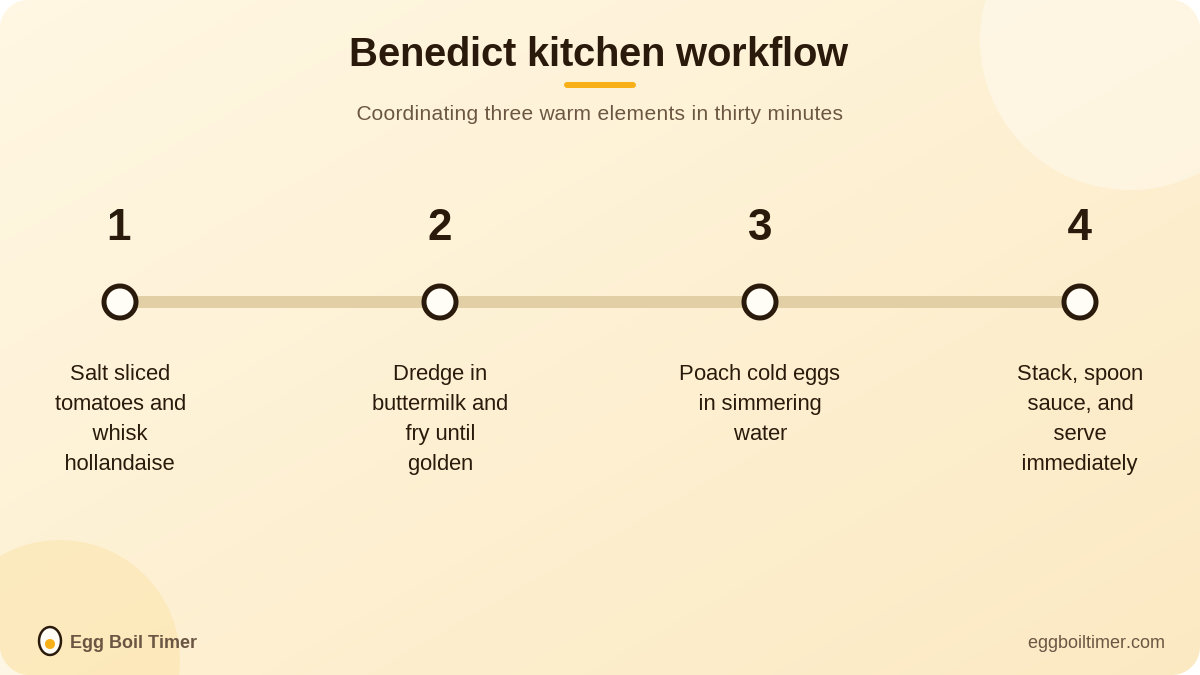
Execute the dish by preparing the sauce first, resting the whisked bowl over a pan of warm water off the burner. Fry the coated green tomatoes second, moving the browned rounds to the wire rack in your low warming oven. Poach the eggs last. Because poaching takes exactly three minutes, you can lay warm tomato slices onto preheated ceramic plates during the final minute of egg cooking.
Top each crispy green tomato slab with a drained poached egg. Spoon thirty milliliters of warm hollandaise directly over the crown. Let the emulsion drape over the white without completely smothering the crunchy cornmeal rim. Garnish with minced fresh chives and cracked black pepper, serving immediately.
Diagnosing texture and sauce failures
When brunch components misbehave, the cause almost always traces back to moisture control, heat excess, or unstable fat ratios.
| Observed symptom. | Underlying cause. | Immediate kitchen fix. |
|---|---|---|
| Breading slides off tomato during frying. | Surface moisture created a steam barrier beneath the flour layer. | Salt slices ten minutes prior, pat completely dry, and maintain oil at 180 °C. |
| Hollandaise sauce separates into oily liquid. | Melted butter was added too quickly or the bowl exceeded 68 °C. | Whisk one teaspoon of boiling water in a warm bowl, then slowly beat the broken sauce into it. |
| Poached eggs leave a watery puddle on the fried base. | Trapped surface water carried over from the cooking pot. | Dab the base of your slotted spoon against a dry kitchen cloth before transferring the egg. |
| Fried tomato exterior darkens before the center softens. | Skillet oil temperature exceeded 195 °C (383 °F). | Lower the stove flame, then finish thick slices in a 175 °C oven for four minutes. |


