A classic Italian frittata is an open-faced egg dish packed with sautéed vegetables, meats, or cheeses. It starts gently on the stovetop and finishes in a moderate oven. Unlike folded omelettes or pastry-lined tarts, a frittata cooks slowly in one skillet. It forms thick, sliceable wedges that hold their structure hot, warm, or cold.
Origins and Core Rules of the Italian Skillet
The name comes from the Italian verb friggere, meaning to fry. Italian home cooks developed the dish as a thrifty evening meal. It offered an easy way to repurpose leftover boiled greens, cooked pasta, and cheese rinds without visiting the market again.
French omelettes demand rapid burner heat, continuous pan shaking, and a pale exterior with a soft center. A frittata requires the reverse approach. Gentle heat allows the thick layer of beaten eggs to set evenly throughout without scorching the base. Finishing the pan in an oven applies mild convection heat to the exposed surface. That step removes the risk of flipping a heavy, hot pan of raw eggs over an open flame.
The finished texture resembles a firm custard rather than a spongy scramble. That structural integrity comes from suspended solids. In a traditional frittata, the eggs act as a cohesive binder that hugs the vegetables and cheese together. When sliced, clean geometric lines show cross sections of every ingredient.
Comparing Frittata, Omelette, Quiche, and Spanish Tortilla
Skillet egg preparations exist throughout Mediterranean and European kitchens. Their liquid ratios, cooking mechanics, and curd densities differ noticeably. Selecting the best approach depends on whether you desire a delicate pastry custard or a sturdy, transportable wedge.
| Dish. | Pastry Crust. | Dairy Ratio. | Typical Egg Count. | Primary Cooking Method. | Finished Texture. |
|---|---|---|---|---|---|
| Frittata. | None. | 60 ml dairy per 6 to 8 eggs. | 6 to 8 eggs. | Stovetop start, oven finish. | Dense, sliceable custard. |
| French Omelette Timer: Exact Cooking Times and Fold Guide. | None. | Zero (butter only). | 2 to 3 eggs. | Stovetop flash over high heat. | Tender skin, soft runny core. |
| Classic Classic Quiche Recipe: Flaky Crust and Silky Egg Custard. | Shortcrust pastry. | 240 ml cream per 4 eggs. | 3 to 5 eggs. | Oven bake throughout. | Delicate, trembling custard. |
| Spanish Tortilla. | None. | Zero. | 6 to 8 eggs. | Oil-poached potatoes, stovetop flip. | Starch-bound, creamy center. |
A classic quiche relies on generous heavy cream to suspend beaten eggs in a fragile emulsion. A frittata relies on egg protein as its main structural frame. Pouring more than 60 ml of dairy per six or eight eggs thins the protein matrix too much. That dilution causes the center to stay soupy while the bottom darkens.
Spanish tortilla shares the sturdy nature of a frittata, but it prioritizes potatoes softened in olive oil. It skips dairy entirely and requires a bold pan flip halfway through cooking. A frittata sidesteps the gymnastics of flipping by using overhead oven heat to set the top.
The Core Ratio: Eight Eggs, Dairy, and Salt
Consistent results require balanced moisture and precise seasoning. A standard large egg provides around 6.3 grams of protein. Adding whole milk or heavy cream buffers the albumen proteins during thermal coagulation. That buffer keeps them from tightening into rubbery curds that weep liquid onto your plate.
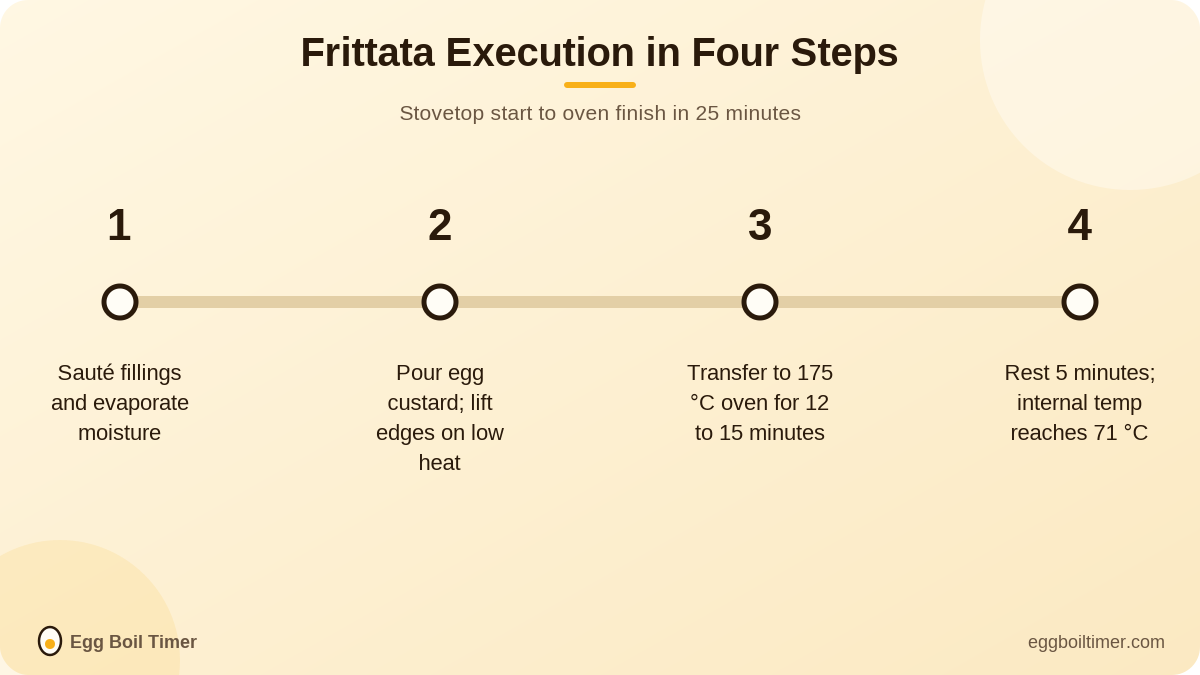
- Whisk 8 large eggs with 60 ml of whole milk or heavy cream, 1/2 teaspoon of fine salt, and 1/4 teaspoon of black pepper until uniform. Avoid beating excessive air into the bowl, which causes the bake to puff up and collapse.
- Warm 15 ml of olive oil or unsalted butter in a 25 cm oven-safe skillet over medium-low heat. Coat the pan floor and lower sidewalls thoroughly.
- Spread 300 to 400 grams of pre-cooked, warm fillings evenly across the skillet base.
- Pour the egg mixture over the fillings. Stir gently for 45 to 60 seconds with a heatproof silicone spatula to distribute ingredients evenly.
- Let the bottom cook undisturbed for 3 to 4 minutes on low burner heat until the outer rim turns opaque and pulls slightly away from the metal.
- Move the skillet to an oven preheated to 175 °C (350 °F). Bake for 12 to 15 minutes until the center shows only a slight tremble and registers 71 °C (160 °F).
- Rest the skillet on a wooden trivet for 5 minutes before slicing into wedges.
If you also prepare soft or hard eggs for meal prep, our Egg Boil Timer calculates precise boil times based on egg size, cold-storage temperature, and local altitude.
Moisture Control for Vegetables, Meats, and Cheeses
A watery frittata is almost always caused by raw vegetables. Plant cell walls break down under heat and dump cell water straight into the cooking eggs. Pre-cooking all vegetables in a skillet drives off excess moisture while caramelizing natural sugars for better flavor.
Different vegetable types demand specific pre-treatment before they meet the eggs.
- Leafy greens like baby spinach, chard, or kale release remarkable amounts of water. Sauté them until wilted, let them cool slightly, and squeeze them firmly inside a clean lint-free kitchen towel.
- High-moisture produce like zucchini, bell peppers, and sliced button mushrooms requires high burner heat. Sauté them until their pan liquid evaporates and their edges turn golden brown.
- Starchy roots such as potatoes, sweet potatoes, and butternut squash will not soften during a brief oven bake. Boil, steam, or roast them until completely tender before folding them into the skillet.
- Cured meats like pancetta, crumbled Italian sausage, or bacon should be browned beforehand. Drain off pooled grease so the frittata does not end up heavy or separated.
Cheese placement also alters the finished crumb. Whisking finely grated Parmigiano-Reggiano or Pecorino Romano into the raw eggs seasons the custard evenly. Soft cheeses like goat cheese, fresh mozzarella pearls, or crumbled feta melt unevenly. Scatter them across the top right before sliding the skillet into the oven to create pockets of melted cheese.
Tested Ingredient Pairings by Flavor Profile
Because eggs provide a neutral base, balance savory elements with acidity, salt, and aromatic herbs. The decision table below pairs ingredients that cook at comparable rates and complement each other naturally.
| Style Profile. | Primary Sautéed Vegetable. | Protein or Starch Add-In. | Recommended Cheese. | Fresh Finishing Herb. |
|---|---|---|---|---|
| Roman Market. | 200 g drained steamed artichoke hearts. | 60 g crisp pancetta cubes. | 40 g shaved Pecorino Romano. | Chopped flat-leaf parsley. |
| Rustic Garden. | 150 g squeezed wilted baby spinach. | 100 g boiled baby red potatoes. | 60 g crumbled aged feta. | Minced fresh dill. |
| Tuscan Mushroom. | 200 g brown mushrooms and shallots. | 75 g cooked Italian fennel sausage. | 50 g grated Fontina or Gruyère. | Fresh thyme leaves. |
| Summer Harvest. | 150 g browned zucchini slices. | 80 g halved blistered cherry tomatoes. | 60 g fresh goat cheese curd. | Torn fresh basil. |
Keep total cooked fillings between 300 and 400 grams for an eight-egg mixture. Exceeding that threshold crowds out the liquid egg. The mixture then struggles to bind the components into cohesive wedges that hold together when lifted.
Matching Pan Diameter to Egg Count
Skillet geometry governs heat penetration and final thickness. If the pan is too wide, the custard spreads thin and turns dry in minutes. If the pan is too narrow, the edges turn brown before heat penetrates the tall core.
| Skillet Diameter. | Egg Count. | Dairy Amount. | Cooked Fillings. | Oven Time (175 °C). | Servings. |
|---|---|---|---|---|---|
| 20 cm (8-inch). | 4 to 5 large eggs. | 30 ml (2 tbsp). | 180 to 220 g. | 10 to 12 minutes. | 2 to 3. |
| 25 cm (10-inch). | 6 to 8 large eggs. | 60 ml (1/4 cup). | 300 to 400 g. | 12 to 15 minutes. | 4 to 6. |
| 30 cm (12-inch). | 10 to 12 large eggs. | 90 ml (6 tbsp). | 450 to 550 g. | 16 to 20 minutes. | 8 to 10. |
A well-seasoned cast-iron skillet retains steady thermal mass and produces an attractive golden crust around the perimeter. Check that your pan seasoning is smooth and sound. Bare iron reacts with sulfur in egg whites, causing harmless but unappealing gray discoloration.
Heavy, oven-safe non-stick pans offer the cleanest release when sliding a whole frittata onto a serving board. Confirm that the pan handle contains no wooden or low-temp plastic parts. Inspect the manufacturer temperature rating to ensure it tolerates 175 °C safely.
Cooking a Frittata Entirely on the Stovetop
You can execute an excellent frittata without turning on your home oven. This alternative suits warm summer months or kitchens without reliable oven heating.
Sauté your fillings in the skillet over medium heat as normal. Pour in the beaten egg and dairy mixture, and stir for 60 seconds to spread the heat. When the perimeter begins to firm, turn the burner flame down to its absolute lowest setting.
Cover the skillet with a heavy, tight-fitting lid or invert a wide baking sheet over the rim. The trapped lid catches ascending steam and radiates heat back onto the exposed egg surface. Cook undisturbed for 12 to 16 minutes. Check the pan at the 10-minute mark to verify the bottom is not browning too quickly. The top is ready when it transitions from wet liquid to an opaque, touch-firm surface.
Symptom and Fix: Watery Bases, Rubber Whites, Burnt Crusts
Tender eggs depend on removing the skillet before albumen proteins over-coagulate. When egg proteins get too hot, they contract tightly into rigid bonds. That contraction squeezes out bound water, leaving dry curds floating in a pool of liquid.
Symptom: liquid pools under wedges after cutting.
Cause: raw watery vegetables like zucchini or spinach shed cellular water, or excessive oven heat forced the egg proteins to seize.
Fix: cook wet vegetables until dry before adding eggs. Squeeze greens dry in a kitchen cloth. Keep the baking temperature at 175 °C.
Symptom: tough, rubbery, or porous mouthfeel.
Cause: the skillet stayed in the oven too long. The center puffed up into a tall dome, pushing core heat past 77 °C.
Fix: remove the pan when the center still exhibits a slight wobble. Carryover heat stored in the heavy pan finishes cooking the middle during resting.
Symptom: scorched, bitter bottom crust with a liquid top.
Cause: burner heat was set too high before the pan went into the oven.
Fix: keep stovetop heat on low or medium-low. Let the bottom set for no more than 3 to 4 minutes before transferring the pan to the oven.
Symptom: eggs stick tightly to the skillet.
Cause: insufficient cooking fat, cold eggs poured into a cold pan, or degraded non-stick coating.
Fix: warm the pan first, coat the floor and sides with butter or olive oil, and bring eggs out of the refrigerator 10 minutes before whisking.
Cooling, Refrigerating, and Reheating Wedges
Delicate dishes like Authentic Carbonara: The Roman Egg Emulsion Recipe suffer when held off heat, but a frittata gains structural stability as it cools. Cooling allows the fats and proteins to settle, yielding clean, handsome cuts that hold their shape.
Allow the skillet to rest undisturbed at room temperature for 15 minutes before running a thin spatula around the edges. Cutting a piping-hot frittata tears the tender curds and vents steam, drying out the slice.
Store leftover slices in an airtight container with parchment paper layered between pieces. Kept at 4 °C in the refrigerator, wedges maintain fresh flavor and texture for 3 to 4 days.
To reheat refrigerated slices without turning the eggs rubbery, preheat your oven or toaster oven to 150 °C. Place the wedges on a parchment-lined baking sheet, cover loosely with foil to retain moisture, and heat for 8 to 10 minutes until warm through. Avoid high-power microwave bursts, which boil interior water and toughen the egg matrix.
Chilled wedges make convenient portable lunches. Serve cold slices between crusty bread with olive oil and arugula, or pack them alongside crisp picnic items like Classic Deviled Eggs Recipe: Creamy Filling and Easy Peeling.
Nutritional Balance and Meal Planning
A single wedge from an eight-egg vegetable frittata cut into six servings contains approximately 180 to 220 calories. It delivers 12 to 14 grams of complete protein, balanced fats from yolks and olive oil, and minimal carbohydrates.
Because the recipe skips flour pastry crusts, it naturally accommodates gluten-free meal planning. You can adapt the nutrient profile to your preferences. Swapping whole milk for skim reduces total fat slightly, while incorporating dark leafy greens and mushrooms boosts dietary iron, potassium, and vitamins A and C.
Round out the meal by pairing warm frittata wedges with an acidic, peppery arugula salad dressed in lemon juice and olive oil. That light acidity cuts through rich egg yolk fats. If you are serving a hearty brunch, set out a frittata alongside toasted sourdough, seasonal fruit, or cold sides like Twelve Eggs, Five Lunches: A Week of Egg Salad That Does Not Get Boring.


