Cooking consistent boiled eggs requires controlled water temperature and strict timing. Lower large, cold eggs straight from the refrigerator into rapidly boiling water. Maintain a gentle boil throughout cooking. Then, transfer the eggs immediately into an ice water bath when the timer rings. This hot-start method sets the outer whites instantly, preventing stubborn shell adhesion while keeping yolks exactly at your desired texture.
Boiling Times for Every Doneness
Egg size, starting temperature, and water volume dictate cooking speed. The baseline figures below apply to standard large eggs (55 grams) taken straight from a 4 °C refrigerator into boiling water at sea level. Use our Egg Boil Timer to calculate adjustments for other sizes or mountain elevations.
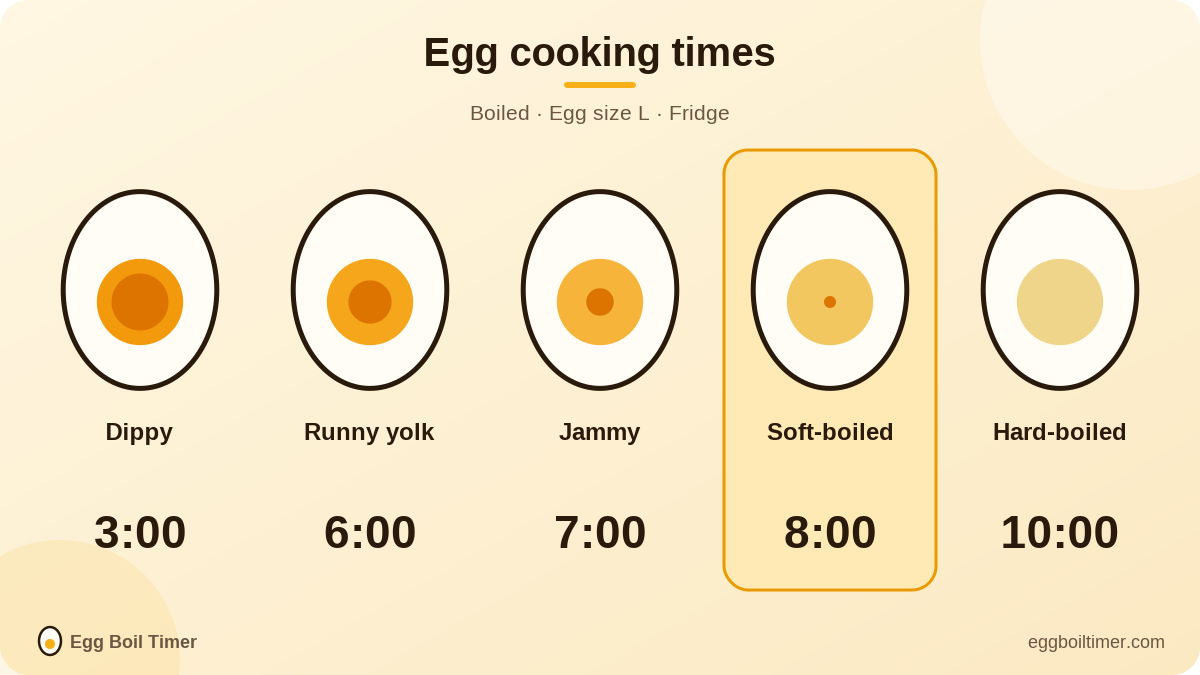
| Doneness | Time | Yolk Temperature | Texture Profile |
|---|---|---|---|
| Dippy | 3 minutes | 60 °C (140 °F) | Warm liquid yolk, barely set delicate white |
| Runny | 6 minutes | 63 °C (145 °F) | Fluid golden yolk with tender, fully opaque white |
| Jammy | 7 minutes | 66 °C (151 °F) | Fudge-like, spreadable yolk with firm white |
| Soft | 8 minutes | 70 °C (158 °F) | Custardy center with completely set white |
| Hard | 10 minutes | 77 °C (171 °F) | Solid pale yellow yolk without sulfur discoloration |
The Hot Start Method: Why Boiling Water Wins
Starting eggs in cold water is a common habit that ruins texture and peeling. When eggs warm slowly in cold water, albumen proteins fuse to the inner shell membrane. Once heat sets those bonds, peeling tears the white into ragged chunks.
Plunging cold eggs directly into boiling water causes sudden thermal shock. Outer white proteins coagulate rapidly between 62 °C and 65 °C. This immediate setting forms a clean boundary layer against the shell membrane. The steam and rapid contraction preserve a smooth surface when you peel later.

Step-by-Step Guide to Boiling Eggs
- Boil the water: Bring at least 1.5 liters of water to a rolling boil in a deep saucepan. Ensure the water depth covers the eggs by at least 2.5 centimeters.
- Lower the eggs gently: Reduce heat slightly to stop vigorous bubbling. Use a slotted spoon to lower cold eggs into the water one by one. Raise heat to sustain a steady simmer.
- Start your timer: Begin timing the moment all eggs rest on the bottom. Keep the pot uncovered or partially vented to prevent boil-overs.
- Prepare the ice bath: Combine equal weights of ice cubes and cold tap water in a wide bowl while the eggs cook.
- Shock and chill: Lift eggs out the instant your timer signals completion. Plunge them directly into the ice water for at least 10 minutes to stop cooking completely.
Peeling and Cooling: The Ice Bath Rule
Thermal shock does more than stop internal cooking. Cooling hot eggs in chilled water contracts the internal albumen faster than the rigid calcium carbonate shell. This differential shrinkage pulls the egg body away from the inner shell membrane.
Tap the cooled egg gently around its equator against a hard surface. Roll the egg lightly under your palm to create fine cracks across the entire shell. Begin peeling from the broad base where the natural air pocket sits. Peeling under cold running water or submerged in your ice bath lets water slip underneath the membrane, lifting large shell fragments cleanly.
Altitude and Freshness Variables
Two unseen factors alter your results: atmospheric pressure and egg age. Pure water boils at 100 °C (212 °F) only at sea level. At higher elevations, lower atmospheric pressure drops the boiling point by roughly 1 °C for every 300 meters of altitude. Boiled eggs cooked in Denver or mountain towns require extra cooking minutes to reach identical yolk firmness.
Fresh eggs straight from the farm have a lower internal pH around 7.6. This acidic environment causes egg white proteins to grip the keratin membrane stubbornly. As eggs age in the refrigerator over two weeks, carbon dioxide escapes through porous shells. Internal pH rises to around 9.2, weakening membrane adhesion naturally. If you must use farm-fresh eggs, steam them rather than boil them.
Complete Boiled Egg Guides and Timers
Explore our dedicated guides for every stage of boiled egg preparation:
- Soft Boiled Egg Timer: Dedicated timing parameters and yolk textures for runny breakfast eggs.
- Hard Boiled Egg Timer: Precise times for meal prep, deviled eggs, and firm yolks without gray rings.
- How to Peel a Boiled Egg in Ten Seconds (and Why the Spoon Trick Works): Step-by-step mechanical peeling techniques for stubborn eggs.
- Ice Bath or Cold Tap? What Cooling Really Does to a Boiled Egg: Science of thermal shock and cooling ratios to arrest cooking.
- You Have Probably Been Starting the Egg Timer at the Wrong Moment: Why timer accuracy depends on the hot-start method.
- Fresh Eggs Are the Worst Eggs to Boil. Here Is Why: Why fresh egg pH bonds to shells and how to overcome it.
- Boiling Eggs at High Altitude: Why the Same Egg Takes Longer in Denver: Elevation compensation charts for mountain boiling.