Boiling jammy eggs on a gas stove takes seven minutes (420 seconds) for a large 55-gram egg straight from the refrigerator. Lowering cold eggs into rapidly boiling water creates a clear boundary between firm whites and a thick, fudge-like yolk. Gas burners deliver instant heat output, bringing water back to a boil within 30 seconds and keeping temperatures stable.
Gas cooking gives home cooks total control over thermal output, but open flames require specific pot placement and heat management. Adding cold eggs drops pot temperatures instantly. A high gas flame compensates quickly, restoring boiling water faster than electric coils. Matching your specific egg weight, starting temperature, and elevation is simple with our interactive Egg Boil Timer.
What happens inside a 7-minute egg on gas heat
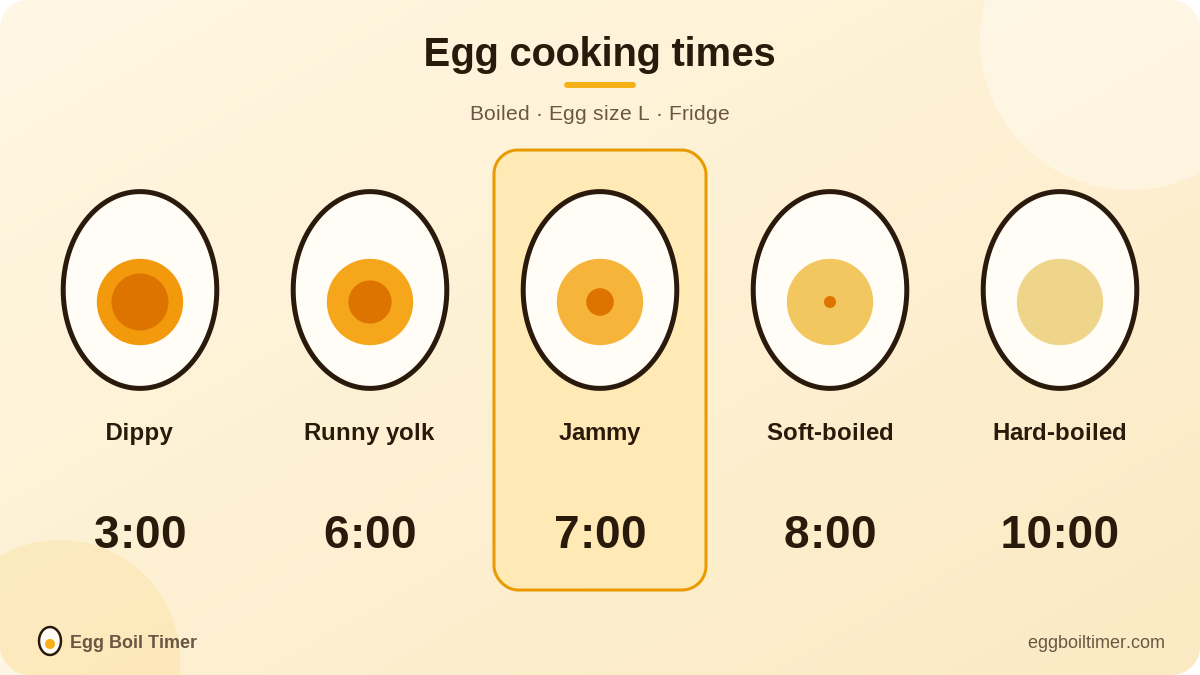
A jammy egg features a fully set, tender white surrounding a soft, sticky yolk that flows slowly rather than running like liquid sauce. The yolk warms to roughly 66 °C, gaining enough viscosity to hold its shape on a spoon while staying moist and glossy.
Gas hobs suit this cooking method because their open flame adjusts thermal transfer instantly. When four cold eggs enter a 2-liter pot, the water temperature drops from 100 °C to roughly 93 °C. Maintaining high flame output for 45 seconds restores the active boil, ensuring the total time remains accurate to the second. A steady rolling boil drives thermal energy through the shell at a predictable rate.
Why yolk and white set at different temperatures
Egg whites and yolks firm up at distinct thermal thresholds due to their different protein compositions. Egg white contains approximately 10% protein dissolved in water, dominated by ovotransferrin and ovalbumin. Ovotransferrin begins coagulating at 62 °C, forming a soft white gel structure, while ovalbumin requires 80 °C to set completely solid.
Yolk proteins, rich in lipovitellins and low-density lipoproteins, begin thickening at 63 °C and set firm by 70 °C. Holding the core temperature between 65 °C and 67 °C creates the signature jammy consistency. Heat moves from the exterior shell inward via thermal conduction during a 7-minute boil in 100 °C water. At 420 seconds, the outer white sets firm while the inner yolk core transforms into a dense, spreadable paste.
Four steps for a 7-minute boil over a gas flame
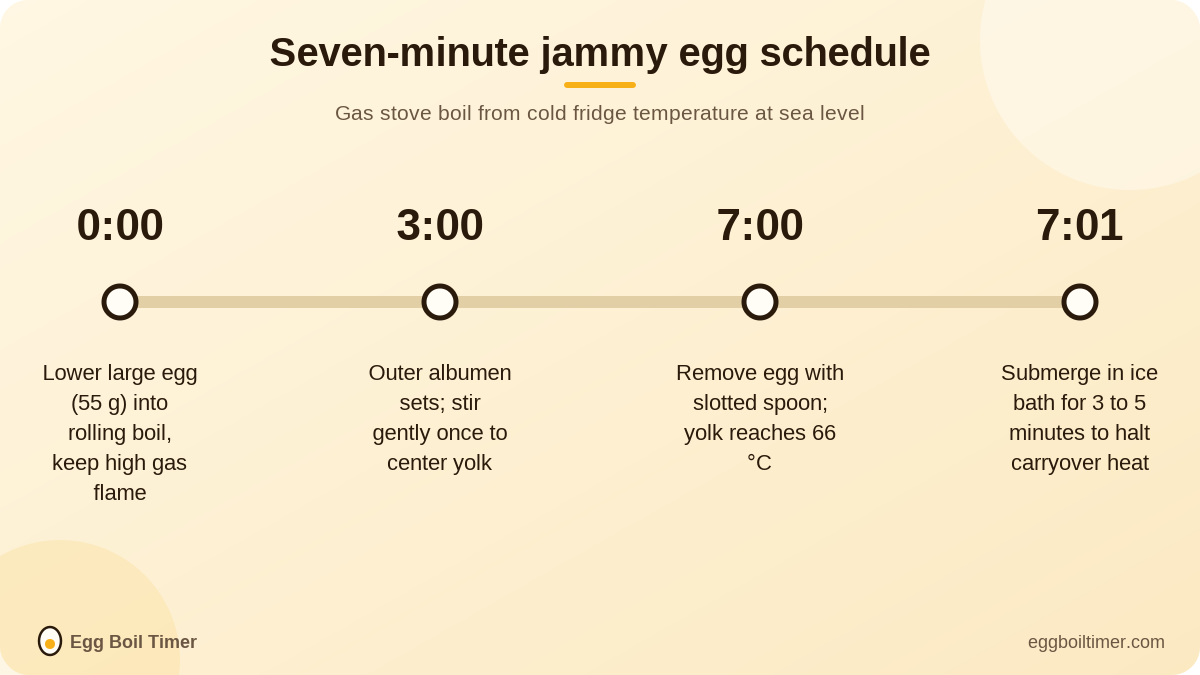
- Boil sufficient water: Select a medium saucepan and add at least 1.5 liters of water (about 5 to 7 centimeters deep). Place the pot over your main gas burner on high heat. Match the flame ring diameter to the saucepan base so heat flows directly upward without wrapping around the sides. Bring the water to a rolling boil where large bubbles break continuously across the surface at 100 °C.
- Lower the eggs gently: Take large 55-gram eggs directly from the refrigerator (4 °C). Place each egg on a slotted spoon and lower it into the bubbling water. Keep the gas flame on medium-high to sustain an active boil while preventing eggs from bouncing violently against the pot bottom.
- Time 7 minutes precisely: Start your digital timer the moment the last egg enters the water. Keep a consistent boil over medium-high heat for exactly 7 minutes (420 seconds). Stir the water gently in a circular motion twice during the first 2 minutes. This centers the yolk within the setting albumen.
- Cool in an ice bath: Prepare a large bowl filled with equal parts cold water and ice cubes while the pot boils. At the 7-minute mark, lift the eggs out with the slotted spoon and submerge them immediately in the ice water. Leave them submerged for 3 to 5 minutes to halt internal carryover cooking.

Why hot-water immersion prevents torn whites
Plunging cold eggs into boiling water is essential for clean shell removal. Sudden exposure to 100 °C water creates intense thermal shock. This rapid temperature surge causes the albumen to contract quickly away from the inner shell membrane before protein bonds can form between them. Starting eggs in cold water allows proteins to heat slowly and fuse to the membrane, leading to pitted whites during peeling.
Freshly laid eggs have a low internal pH of around 7.6, causing the inner membrane to adhere tightly to the egg white. As eggs store in the refrigerator over 1 to 2 weeks, carbon dioxide escapes through porous calcium carbonate shells. This raises the internal pH to approximately 9.2, naturally loosening the membrane grip.
After 3 minutes in the ice bath, tap the wider end of the egg against a hard surface to fracture the internal air cell. Peel under a thin stream of cool tap water. Water flows beneath the loosened membrane, lifting shell fragments away effortlessly without tearing the delicate white.
Adjusting boil times for egg size and elevation
Atmospheric pressure decreases as altitude increases, lowering the boiling point of water by approximately 1 °C for every 300 meters (or 1 °F per 500 feet). Because boiling water is cooler at higher elevations, heat penetrates the egg shell more slowly. Gas burner times must be extended to reach the target 66 °C yolk center.
| Egg Size | Weight (g) | Sea Level (100 °C) | 600 m / 2,000 ft (98 °C) | 1,500 m / 5,000 ft (95 °C) |
|---|---|---|---|---|
| Medium (M) | 50 g | 6:30 (390 s) | 6:45 (405 s) | 7:15 (435 s) |
| Large (L) | 55 g | 7:00 (420 s) | 7:20 (440 s) | 7:50 (470 s) |
| Extra Large (XL) | 60 g | 7:30 (450 s) | 7:50 (470 s) | 8:25 (505 s) |
| Jumbo (XXL) | 65 g | 8:00 (480 s) | 8:25 (505 s) | 9:05 (545 s) |
Room-temperature eggs (stored at 20 °C) require about 30 seconds less boiling time than fridge-cold eggs (4 °C). If your eggs rested on the counter before cooking, subtract 30 seconds from the table parameters above to avoid overcooking the yolk.
Fixing cracked shells and uneven gas heat
Gas flames concentrate high heat across the pot bottom, creating distinct cooking conditions. Addressing common gas hob scenarios keeps your results consistent:
- Shells cracking upon insertion: Thermal shock or aggressive boiling bubbles can cause fragile shells to fracture. Add 1 tablespoon of white vinegar or lemon juice to the boiling water. Acetic acid accelerates albumen coagulation, sealing minor hairline cracks instantly. Adjust gas flame control so bubbles remain steady without shaking the eggs against the cookware base.
- Rubbery whites with liquid yolks: This occurs when burner heat drops excessively after adding cold eggs, taking minutes to recover. Maintain maximum gas flame output for the first 45 seconds after immersion to rebuild 100 °C water temperatures before adjusting down to medium-high.
- Off-center yolk alignment: Yolk fats are less dense than albumen and float toward the shell top during initial heating. Stirring the boiling water gently in circular motions for the first 120 seconds keeps the yolk suspended in the center while outer proteins set.
- Greenish ring around the yolk: Overcooking causes hydrogen sulfide gas in the white to react with iron in the yolk, creating greenish ferrous sulfide. While safe to eat, this ring signals excessive thermal exposure. Stick strictly to 7 minutes of boiling followed by immediate ice bath shock.
- Reheating stored jammy eggs: Microwaving in-shell or peeled soft eggs can cause vapor pockets that burst dangerously. Reheat cold jammy eggs by submerging them unpeeled in a bowl of warm tap water (50 °C) for 10 minutes. This warms the center without altering the yolk texture.
Salmonella risks, digestion, and fridge storage
Jammy egg yolks remain partially soft and unpasteurized. The U.S. Food and Drug Administration (FDA) advises that vulnerable populations, including pregnant women, young children, older adults, and individuals with weakened immune systems, avoid unpasteurized soft yolks due to potential Salmonella enteritidis risks. Read our evidence-based safety guides on Eggs and Salmonella: Real Risks, Temperatures, and Raw Egg Safety, managing diets during Eggs in Pregnancy: Safety Rules, Choline, and Cooking, and serving soft eggs as Runny Eggs for Toddlers: Why the Answer Depends on Where You Live.
Heat denatures folded egg proteins, opening amino acid chains so human digestive enzymes break them down more efficiently. Clinical research indicates fully set egg whites achieve roughly 91% protein digestibility, compared to 51% for raw egg whites. Jammy eggs pair firm whites with a warm, viscous yolk, delivering high nutrient bioavailability while remaining gentle on the digestive system. This section provides general educational information, not medical advice.
Store unpeeled jammy eggs in an airtight container in the refrigerator at 4 °C for up to 4 days. Avoid freezing cooked eggs. Freezing damages the gelled protein lattice of the egg white, releasing water and leaving behind a tough, spongy texture upon thawing.


