Eggs Florentine pairs warm buttered spinach and soft poached eggs with silky hollandaise sauce over a split toasted English muffin. Swapping wilted greens for ham in Classic Eggs Benedict Recipe: Poached Eggs and Silky Hollandaise, this recipe relies on a poached egg cooked for 3 minutes. The yolk reaches 63 °C while the white sets completely.
What Sets Eggs Florentine Apart
In classical French cooking, the term à la Florentine refers to dishes served on a bed of spinach and rich sauce. Italian legend attributes this name to Catherine de' Medici bringing Florentine cooks to France in the sixteenth century.
Modern Eggs Florentine uses the framework of poached eggs on toasted bread, replacing ham with seasoned greens. Earthy garlic spinach cuts through the rich lemon-butter emulsion. This gives the plate a balanced acidity that meatier dishes lack.
The Four Core Elements of Eggs Florentine
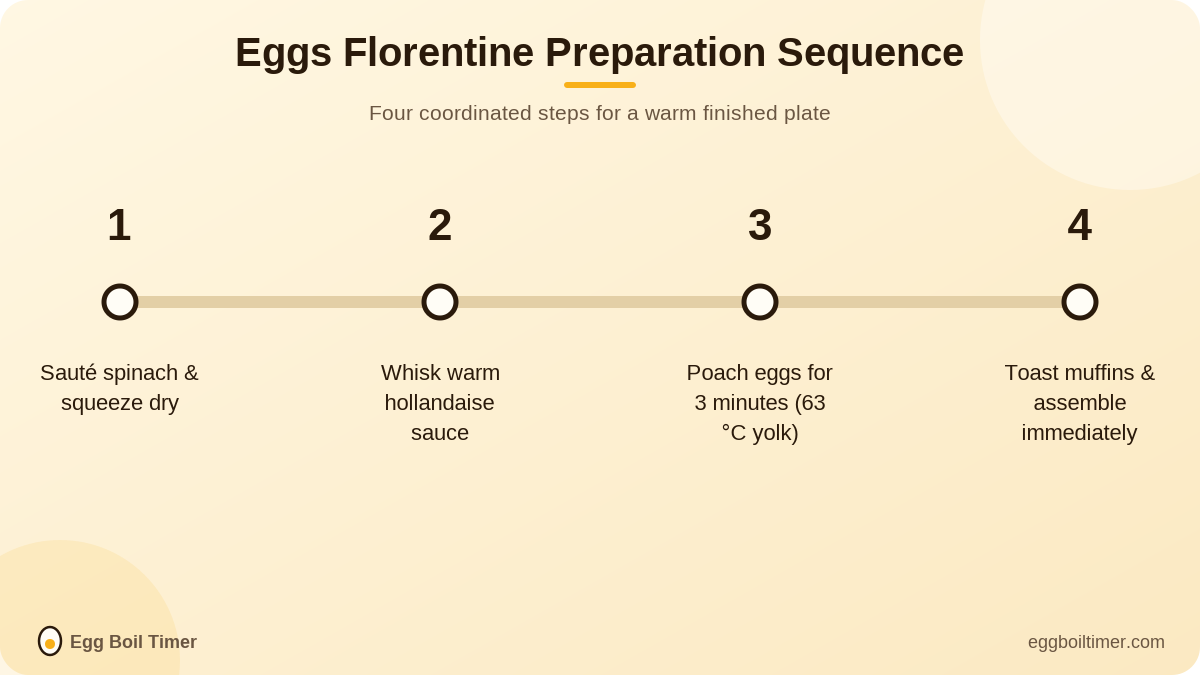
Constructing a balanced plate requires four distinct components working together.
- Poached eggs. Fresh large eggs hold tight whites around warm, runny yolks when cooked at 90 °C.
- Spinach base. Sautéed baby spinach with garlic, butter, and heavy cream creates a soft, savory bed.
- Hollandaise sauce. A warm emulsion of egg yolks, melted butter, fresh lemon juice, and cayenne pepper.
- Bread foundation. Split English muffins toasted deep golden brown provide nooks that capture running yolk and sauce. Thick slices of sourdough or brioche work equally well.
Spinach provides exceptional nutritional value to the dish, supplying vitamins A, C, K, and folate alongside iron and calcium. For more breakfast ideas and egg preparation techniques, see our main guide on Egg Recipes: Breakfast, Lunch, and Dinner Ideas.
Bread Options and Sauce Modifications
Selecting the right bread base alters the structural strength of the dish.
| Bread Option | Texture Profile | Best Application |
|---|---|---|
| English Muffin | Crisp edge with deep nooks | Classic presentation; holds heavy sauce without collapsing. |
| Artisan Sourdough | Chewy crumb with sturdy crust | Supports double portions of spinach and poached eggs. |
| Toasted Brioche | Rich, tender, slightly sweet | Decadent brunch style; pairs well with lemon acidity. |
| Gluten-Free Muffin | Dense texture; requires extra crisping | Needs thorough double-topping to prevent breakdown. |
A quick blender hollandaise offers a reliable shortcut for busy cooks. Whisking hot melted butter into egg yolks in a high-speed blender emulsifies the sauce in two minutes. Adding a pinch of grated nutmeg to the spinach enhances the classic flavor profile.
Poaching Eggs to a Liquid 63 °C Yolk
Precise egg poaching relies on controlling water temperature and timing. A violent rolling boil tears delicate egg whites apart. Water below 85 °C leaves albumens uncoagulated and slimy.
- Prepare the water bath. Fill a wide pot with 8 cm of water. Heat until small bubbles rise gently at 90 °C without boiling.
- Add acid. Stir in 15 ml of white vinegar per liter of water. Mild acidity accelerates white protein coagulation without altering flavor.
- Strain the egg. Crack a cold large egg into a fine-mesh sieve over a bowl to shed thin albumen. Transfer the strained egg into a small ramekin.
- Submerge gently. Stir the water gently to create a slow, shallow whirlpool. Lower the ramekin near the surface and let the egg slide smoothly into the center.
- Time the cook. Keep heat steady and cook for 3 minutes for a large egg. Use our Egg Boil Timer or target tool at Poached Egg Timer: Exact Water Times and Pro Technique to calculate exact timing for medium or extra-large eggs.
- Drain and transfer. Lift the egg with a slotted spoon when the white sets and the yolk reaches 63 °C. Rest it on paper towels so excess water does not soak the bread.
Egg size directly affects thermal transfer rates during poaching. Medium eggs require 2 minutes and 45 seconds, while extra-large eggs take 3 minutes and 15 seconds at sea level. If using room-temperature eggs, reduce cooking time by 15 seconds.
Sautéing Garlic Spinach Without Excess Water
Raw spinach consists of over 90 percent water. Heating breaks its cell walls, releasing trapped moisture into the pan quickly. Unmanaged liquid turns toasted bread into wet mush within seconds.
Melt 15 g of butter in a skillet over medium heat. Add one minced garlic clove and cook for 30 seconds until fragrant. Toss in 200 g of fresh baby spinach in batches. Turn with tongs until the leaves collapse completely.
Season with a pinch of salt and black pepper. Dump the cooked spinach into a fine strainer and press firmly with a spoon to squeeze out liquid. Return the squeezed greens to the warm pan off the heat and fold in 15 ml of heavy cream for a glossy finish.
Emulsifying a Stable Warm Hollandaise
Hollandaise suspends tiny droplets of melted butter inside an egg yolk and lemon juice base. Unpasteurized egg yolks carry a potential risk of Salmonella. Whisking the sauce over gentle steam heats the yolks safely to 63 °C while building a thick emulsion.
- Set up a double boiler. Place a heatproof bowl over a pot filled with 3 cm of simmering water. Ensure the bowl bottom does not touch the water.
- Whisk yolks and acid. Add 2 egg yolks and 10 ml of fresh lemon juice to the bowl. Whisk constantly until pale and thick enough to leave trailing lines.
- Drizzle butter slowly. Pour in 100 g of warm melted butter in a thin, steady stream while whisking vigorously. The sauce thickens as fat emulsifies into the yolk liquid.
- Season and hold. Remove the bowl from heat when the sauce coats the back of a spoon. Whisk in a pinch of salt and cayenne pepper. Keep warm near the stove until assembly.
Layering the Components Hot onto Toasted Muffins
Assembly requires quick, coordinated steps so every component arrives hot at the table.
- Toast the muffin base. Split an English muffin and toast both halves until golden brown and firm.
- Mound the greens. Divide the squeezed garlic spinach evenly across the toasted muffin halves.
- Position the eggs. Nest one warm, drained poached egg onto each bed of spinach.
- Spoon the sauce. Ladle warm hollandaise sauce over each egg, letting it coat the top smoothly. Serve immediately.
Fixing Broken Sauces and Watery Spinach
Managing four temperature-sensitive components simultaneously can create technical issues. Use these targeted adjustments to fix common problems quickly.
| Symptom | Root Cause | Immediate Solution |
|---|---|---|
| Hollandaise splits or looks oily | Butter added too fast or yolk overheated past 70 °C | Whisk 10 ml of warm water in a clean bowl. Slowly whisk the broken sauce into it droplet by droplet. |
| English muffin turns soggy | Spinach retained free water after sautéing | Press cooked spinach firmly through a fine strainer before layering it onto toasted bread. |
| Albumen spreads into wisps | Water boiling too hard or missing acid | Reduce heat to a gentle simmer at 90 °C. Add 15 ml white vinegar to speed white coagulation. |
| Yolk cooks hard in center | Poaching time exceeded 3.5 minutes for large egg | Pull egg at 3 minutes when yolk reaches 63 °C. Drain on paper towels to stop carryover heat. |


