Tamagoyaki is a Japanese rolled omelette made from thin, seasoned egg sheets. Cook each layer in a rectangular pan, rolling it forward while the top stays glossy. The finished golden log has a tender, layered core that slices into pillowy pieces without browning.
Atsuyaki and Dashimaki Tamago: Texture and Moisture Profiles
Two distinct styles dominate Japanese rolled eggs. Regional tastes and liquid volume set them apart. The roll can be a sweet, firm breakfast staple or a juicy, savory custard.
| Attribute. | Atsuyaki Tamago (Classic/Kanto). | Dashimaki Tamago (Kansai Style). |
|---|---|---|
| Liquid per 4 eggs. | 15 to 30 ml liquid. Light dashi or water works well. | 60 to 90 ml rich dashi broth. |
| Flavor profile. | Sweet roll with a mild soy finish. | Savory roll rich in umami. |
| Internal texture. | Dense, springy, and firm enough for lunchboxes. | Tender and soft. It weeps broth when sliced. |
| Rolling difficulty. | Moderate difficulty. It holds shape cleanly during turns. | High difficulty. The fragile sheet tears easily. |
| Best culinary setting. | Bento boxes and sushi nigiri toppings. | Izakaya plates and hot breakfasts with daikon. |
Beginners should master Atsuyaki first. Its lower moisture keeps the protein bonds cohesive. This prevents tearing as you nudge the roll with spatulas. Explore other global traditions in Egg Recipes: Breakfast, Lunch, and Dinner Ideas. For a single fold rather than layers, practice with our Omelette Timer: Exact Cooking Times and Fold Guide.
Skillet Dynamics: Rectangular Makiyakinabe and Round Pans
The rectangular pan for rolled eggs is called a makiyakinabe. Standard consumer models measure roughly 13 by 18 cm. Straight vertical walls form crisp right angles. This geometry gives the finished roll neat squared edges for slicing.
You can prepare tamagoyaki without specialized Japanese hardware. A standard 20 cm non-stick round skillet works when you adapt the geometric footprint.
- Pour a thin layer of egg batter into the warm, oiled round skillet.
- Fold the curved left and right sides inward by 2 cm. This turns the circle into a flat-sided rectangle.
- Roll the egg log from top to bottom, keeping the roll taut against the pan base.
- Slide the roll to the edge and wipe the pan with oil. Pour the next layer, lifting the log so fresh egg flows underneath.
Trim 1 cm off each end after the roll rests. Circular pans leave tapered tips, but the center yields neat, uniform slices.
Seasoning Chemistry and Heat Control
Sugar and mirin provide characteristic sweetness. Both caramelize quickly as temperature climbs. Heat above 160 °C scorches the sugar, leaving bitter brown blotches on the pale yellow sheet.
Maintain medium-low heat throughout cooking. A test drop of egg should sizzle gently without browning. Keep an oiled paper towel held in tongs beside the pan. Wiping the surface between pours ensures release without pooling excess grease.
Whisk the eggs with a side-to-side cutting motion using chopsticks. Avoid circular whipping, which beats in excess air. Trapped air expands over heat, creating holes in the finished slices. Strain the mixture through a fine sieve to catch stringy albumen for an even color.
Layer Timing and the Omelette Preset
Cooking tamagoyaki requires precise heat management across several rapid cycles rather than one long bake. In our timer system, the French omelette preset (omelette:0) is calibrated to 120 seconds of total active pan heat for two eggs. When dividing a four-egg tamagoyaki batter across four individual pours, each layer spends only 20 to 30 seconds over the heat.
| Pour Stage. | Batter Volume. | Pan Time. | Surface Visual Cue. | Action Required. |
|---|---|---|---|---|
| Layer 1 (Core). | 60 ml (1/4 total). | 20 to 25 seconds. | Bottom set, top wet and glossy. | Roll tightly into small starter cylinder. |
| Layer 2 (Body). | 60 ml (1/4 total). | 25 to 30 seconds. | Edges firm, center custardy. | Lift log, let batter flow under, roll back. |
| Layer 3 (Bulk). | 60 ml (1/4 total). | 25 to 30 seconds. | Micro-bubbles appear, pale sheen. | Prick bubbles, roll forward to build girth. |
| Layer 4 (Skin). | 60 ml (remaining). | 30 to 35 seconds. | Smooth, matte bottom, tacky top. | Final roll forward; seal seam against pan edge. |
Notice how the pan time lengthens slightly for later layers. As the central egg roll grows thicker, it absorbs heat from the fresh liquid, slowing coagulation slightly. Keeping the flame steady prevents thermal spikes that blister the delicate outer skin.
Rolling Method: The Sequence from Sheet to Log
Timing each layer demands constant focus. Each thin sheet cooks in roughly 20 to 30 seconds before it must be folded forward.
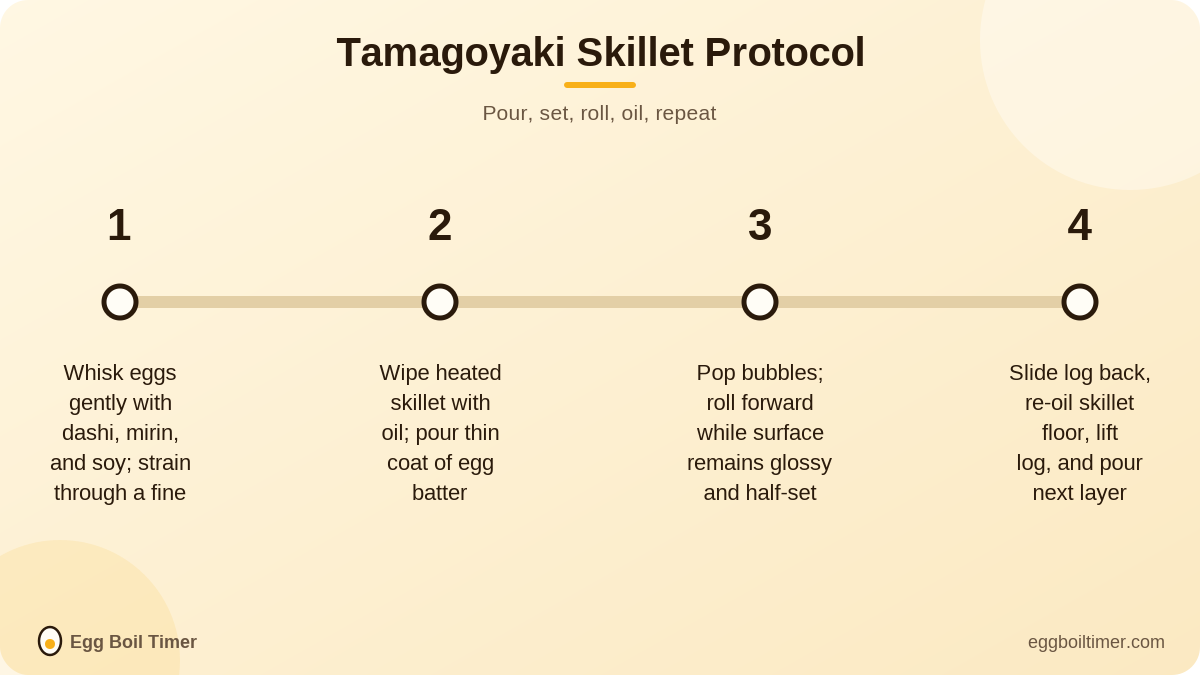
- Strain the seasoned egg mixture: Whisk 4 large eggs with 2 tbsp dashi, 1 tbsp sugar, 1 tsp mirin, 1 tsp light soy sauce, and a pinch of salt. Four large eggs supply about 25 g of protein. Pour through a fine-mesh sieve into a spouted measuring pitcher.
- Preheat and oil the skillet: Warm the pan over medium-low heat. Saturate a folded paper towel with vegetable oil and sweep it across the base and side walls.
- Pour the introductory sheet: Pour one-fourth of the egg mixture into the pan. Tilt immediately to spread an even coat across the heated metal.
- Prick surface bubbles: Pierce any expanding bubbles with chopsticks. Raw liquid fills the holes, preserving a smooth layer.
- Execute the initial roll: When the bottom sets and the top remains glossy, roll the sheet forward toward the far wall in 2 cm folds. Use chopsticks or a thin spatula.
- Re-oil the skillet floor: Push the rolled log back toward the handle. Wipe the exposed pan floor with your oiled towel.
- Underlay the subsequent layer: Pour another thin coat of batter. Lift the cooked log slightly so raw liquid flows underneath and seals the seam.
- Roll back and repeat: When the new layer turns glossy and tacky, roll the log back over it toward you. Repeat until all batter is used.
- Shape with a bamboo mat: Transfer the warm log onto a bamboo mat (makisu). Roll gently, apply light pressure to square the edges, and rest for 5 minutes. Slice into 2 cm pieces.
Diagnosing Structural and Visual Faults
Rolled omelettes present distinct mechanical hurdles. If your layers crack, separate, or scorch, check this diagnostic matrix to adjust your pan handling.
| Observable Problem. | Underlying Cause. | Immediate Correction. |
|---|---|---|
| Brown spots or scorched skin. | Pan temperature is too high. Sugar caramelizes before protein sets. | Lower stove heat. Pull the pan off the burner for 5 seconds between pours. |
| Layers separate when sliced. | The bottom sheet was dry before rolling. | Roll while the top stays tacky. Wet egg acts as culinary glue. |
| Batter sticks and tears. | Insufficient oil film on the pan surface. | Wipe the skillet with an oiled towel between every pour. |
| Large interior air gaps. | Steam blisters were left unpunctured. | Prick bubbles immediately. Compress the warm roll in a bamboo mat. |
| Log weeps watery broth. | Excess dashi weakened the egg protein matrix. | Reduce dashi to 1 tbsp per 2 eggs until rolling technique improves. |
Stable pan heat keeps rolled layers smooth, just as exact water temperature controls our Egg Boil Timer timing. Tamagoyaki pairs naturally with jammy Ramen Eggs at Home: The 30 Seconds That Decide Everything in bento lunches. For a different Japanese folding method, see the soft egg blanket in Omurice: Master Japanese Omelette Rice at Home.
Incorporating Fillings into the Layers
Once you master plain egg sheets, you can embed contrasting ingredients between turns. Adding fillings alters the moisture balance, so choose items that lie flat without puncturing the delicate albumen sheet.
A sheet of toasted nori seaweed laid over the second poured layer creates a crisp black spiral when sliced. Finely minced scallions or red pickled ginger (beni shoga) scattered across the third layer provide sharpness that balances sweet mirin. For modern izakaya variations, placing a thin stick of melting cheese or seasoned pollock roe (mentaiko) right at the core creates a molten center encased in firm egg folds.
Serving Temperatures and Storage Rules
Tamagoyaki stays tender even when cold. In lunchboxes, sugar and dashi lock moisture inside the cooked egg proteins. This keeps the slices juicy for hours without weeping.
Store leftover slices wrapped in cling film inside an airtight container for up to 3 days. Avoid freezing the roll. Freezing damages egg proteins and releases trapped moisture, leaving a spongy texture. Enjoy slices cold from the fridge, or warm them in a dry skillet for 1 minute per side.


