Cooking sous vide eggs gives exact control over protein coagulation by stabilizing water heat to a tenth of a degree. A chilled large egg submerged at 75 °C (167 °F) for 12 minutes produces an opaque, tender white around a warm runny yolk. Leaving the egg in the bath for 14 minutes sets the yolk into a rich, spreadable jam without toughening the albumen.
How Water Bath Heat Alters Albumen and Yolk Proteins
Egg whites and egg yolks consist of distinct proteins that denature at completely different thermal thresholds. Ovotransferrin begins setting around 62 °C (144 °F) and solidifies at 65 °C (149 °F). Ovalbumin, which makes up over half of the albumen protein mass, does not fully coagulate until heat reaches 80 °C (176 °F). Yolk proteins like lipovitellin and livetin begin thickening at 65 °C (149 °F) and transition into a tender gel near 70 °C (158 °F).
Boiling water exposes the shell to 100 °C turbulence, creating a steep temperature gradient between the shell and the yolk. The outer albumen turns rubbery before heat reaches the center. In our 15 Ways to Cook Eggs, From Boiled to Sous Vide (With Times for Each), sous vide stands out because water circulating below boiling point brings both white and yolk to equilibrium without thermal shock.
Fresh eggs carry a lower white pH, near 7.6 to 8.2, which binds albumen tightly together and keeps the inner membrane anchored to the shell. As eggs sit in storage, carbon dioxide escapes through porous calcium carbonate shells, raising the pH toward 9.2. This alkaline shift weakens the bond between the membrane and albumen, easing the peeling process after gentle thermal baths.
Comparing the 75 °C Method to Low-Heat Baths
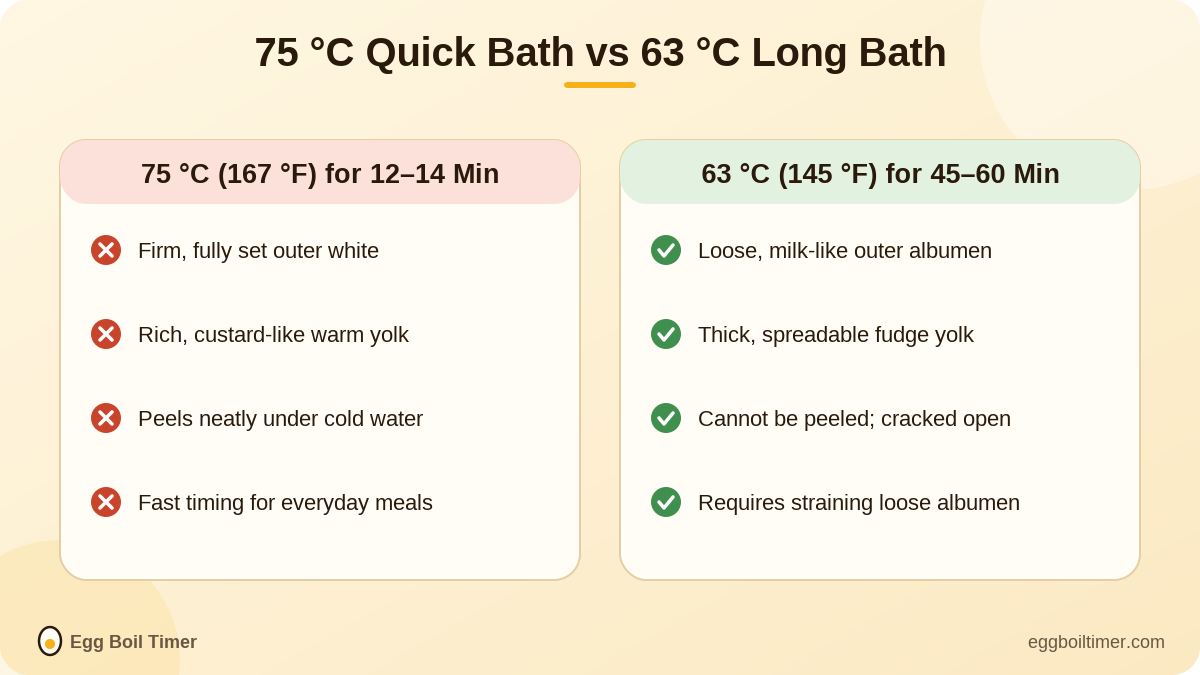
Cooks using an immersion circulator generally choose between two paths: a rapid 75 °C bath or an extended low-temperature soak. Our timer presets use 75 °C because higher heat resolves the main flaw of low-temperature cooking: loose, watery egg whites. At 63 °C, the white remains delicate and milky, yielding a soft consistency similar to a Japanese Onsen Eggs: The Japanese Egg That Never Meets Boiling Water.
| Bath Temperature | Cook Time | White Texture | Yolk Texture | Best Culinary Use |
|---|---|---|---|---|
| 75 °C (167 °F) | 12 minutes | Tender, cohesive, fully opaque | Liquid, warm, runny | Plated over grains, rice bowls, sourdough |
| 75 °C (167 °F) | 14 minutes | Firm, smooth, cleanly sliced | Jammy, rich, spreadable gel | Ramen topping, lunch salads |
| 65 °C (149 °F) | 45 minutes | Soft, pudding-like, delicate | Velvety, thickened cream | Eggs on English muffins, warm lentils |
| 64 °C (147 °F) | 45 minutes | Loose, delicate, partially milky | Warm custard, thick cream | Cracked directly into warm broths |
| 63 °C (145 °F) | 60 minutes | Very soft, needs slotted spoon | Thick paste, spreadable | Sauce base over charred greens |
Choose 75 °C when you want an egg that peels cleanly and holds its oval shape on a plate. Choose 63 °C when your recipe calls for a thick, spoonable yolk that blends directly into a sauce. Thermal conduction scales with mass: medium eggs (50 g) require about 30 seconds less at 75 °C, while extra-large eggs (60 g) benefit from an additional 45 seconds to reach equivalent core warmth.
Circulator Setup and Water Vessel Preparation
Preparing the water bath requires minimal gear because the eggshell functions as its own cooking capsule. You do not need plastic pouches or vacuum sealers.
- Fill a deep stockpot or heat-resistant container with warm tap water halfway between the circulator fill markers. Warm water cuts preheating time in half.
- Clamp the circulator upright against the container wall to allow unobstructed water flow around the base.
- Set the unit to 75 °C (167 °F). Allow the water to reach equilibrium, verifying the temperature with an instant-read probe if the circulator calibration feels uncertain.
- Place a silicone trivet beneath lightweight metal pots if your kitchen counter is sensitive to sustained thermal contact.
- Cover the container surface with aluminum foil or a notched silicone lid if running long low-temperature cooks, preventing water evaporation that could drop liquid below safety lines.
- Set a perforated slotted spoon on the counter next to the pot. Dropping raw eggs by hand onto the container floor will crack the shells.
Submerging and Timing Eggs in the Bath
Always cook eggs straight from the refrigerator. Starting with chilled shells keeps yolk core temperatures predictable and protects runny centers while the outer albumen solidifies.
- Lower cold eggs gently to the bottom of the preheated 75 °C bath using your slotted spoon.
- Start timing immediately. Hold the water at 75 °C for 12 minutes for a liquid yolk, or 14 minutes for a jammy texture. Track the countdown using the Egg Boil Timer preset.
- Leave space between shells so heated water flows around every egg. When cooking more than six eggs at once, add one minute to account for water temperature drop.
- Maintain steady circulation without violent agitation that rattles shells against the metal walls.
- Fill a mixing bowl with equal parts cold water and ice cubes while the timer runs.
- Lift the eggs from the vessel with your spoon the second the alarm sounds and transfer them straight into the ice bath.
Handling the Fragile Cooked Shell
Peeling sous vide eggs requires more patience than peeling boiled eggs. At 75 °C, the inner membrane clings tightly to the tender albumen, particularly when working with fresh eggs from local farms.
Leave the cooked eggs in the ice water for three minutes. This short cooling step contracts the albumen slightly away from the shell membrane without cooling the yolk center. Tap the blunt bottom of each egg against a flat board to break the air cell, then roll the shell softly across your palm to produce fine fractures over the surface.
Peel the shell under a thin stream of cool tap water or submerged inside the ice bath. Water runs beneath the cracked fragments and lifts the membrane away cleanly. For eggs cooked at 63 °C to 65 °C, skip peeling entirely. Crack the blunt end over a small bowl, tip the egg upright, and let the soft white and yolk slide onto a slotted spoon to drain thin liquid.
Resolving Watery Whites and Shell Ruptures
While an immersion circulator removes guesswork, small equipment and handling oversights can alter your results.
- A watery outer white happens when bath heat drops below 70 °C or total cooking time falls short of coagulating ovotransferrin. If you dislike loose albumen, stick to the 75 °C timing or compare this texture against Poached Egg Timer: Exact Water Times and Pro Technique results.
- Hairline cracks during submersion occur when cold air inside the blunt end expands abruptly in hot water. Piercing the wide base with a fine pushpin vents internal pressure before the shell enters the bath.
- Floating eggs indicate older stock with enlarged air chambers. Weight them down with a wire basket or slotted spoon so the shell remains submerged in circulating water.
- Flat spots on one side develop when an egg rests motionless on the container floor. Stir the bath water gently during the first two minutes to center the yolk inside the setting albumen.
- A rubbery yolk edge indicates the egg remained in hot water after the timer finished. Transfer shells directly into ice water to halt latent heat conduction.
- Yolks sticking to shell walls happen when eggs sit on their sides for weeks in storage before cooking. Store cartons upright to keep the chalazae cords centered.
Culinary Pairings for Controlled-Texture Eggs
The cohesive structure of a 75 °C egg makes it versatile across everyday savory dishes. Set a warm 12-minute egg onto toasted sourdough spread with smashed avocado and coarse sea salt. Piercing the surface releases a warm, silky yolk that acts as a natural sauce for the bread.
For noodle bowls, place 14-minute jammy eggs into a marinade of soy sauce, mirin, and sliced scallions for two hours. Slice them lengthwise across tonkotsu ramen or alongside roasted asparagus spears. You can also slip a warm 64 °C egg into a cup of hot dashi broth garnished with grated ginger and bonito flakes, letting the creamy yolk enrich the soup.
Cooks curious about other gentle thermal techniques can compare these results with Steamed Eggs: Easier to Peel, Just as Fast, and Hardly Any Water or Air Fryer Boiled Eggs: Do They Work, and How Long Do They Take? to see how dry air and steam differ from water circulation. Unlike vapor or forced hot air, continuous liquid flow guarantees identical heat transfer across every square millimeter of the shell.
Salmonella Safeguards and Storage Rules
Consuming raw or lightly cooked eggs carries a risk of Salmonella infection. While circulator baths can pasteurize intact eggs, pasteurization requires specific minimum time-temperature exposures. Holding whole eggs at a core temperature of 57 °C (135 °F) for at least 75 minutes reduces bacterial presence without solidifying egg proteins.
Quick baths like 75 °C for 12 minutes cook egg proteins but do not guarantee complete thermal destruction of foodborne pathogens throughout the egg. Vulnerable populations, including young children, pregnant women, older adults, and anyone with weakened immunity, should eat eggs cooked until both white and yolk are firm, or use commercially pasteurized eggs. This is general information, not medical advice.
Store unpeeled sous vide eggs in a sealed container in the refrigerator for up to three days. To reheat, submerge the cold eggs in a 60 °C (140 °F) water bath for 10 minutes. This restores serving warmth without cooking the yolk or toughening the white.


