Raw shell eggs stay fresh for 3 to 5 weeks when refrigerated immediately. To ensure safety, buy eggs graded USDA AA or A before the expiration date and store them in the main body of the fridge rather than the door. Our Egg Boil Timer helps you adjust for these fridge-cold temperatures to reach your preferred doneness every time. This guide covers label meanings, storage science, and shelf-life extension to ensure every egg you crack is high quality.
Selecting Quality Shells at the Market
Open the carton before you buy to ensure no eggs are stuck to the cardboard. This often indicates a hidden crack or a slow leak. Even a hairline fracture serves as an entry point for bacteria like Salmonella. Choose eggs with clean, uncracked shells to minimize food safety risks. While Small, Large or Jumbo: Egg Sizes Explained, and Why They Change Your Timer usually come in Medium, Large, or Extra-Large, the size does not indicate quality, only the weight per dozen.
Look for the USDA grade shield on the packaging. Grade AA eggs have thick, firm whites and high, round yolks, making them ideal for poaching or frying. Grade A eggs are the most common retail standard, with slightly less firm whites. Grade B eggs are rarely found in stores as they usually go into liquid egg products, but they are safe for baking. Always check the "Sell-By" or "EXP" date; while eggs often remain safe for weeks after this date, the interior quality declines as the air cell expands.
Decoding Common Production Labels
Egg cartons carry a vocabulary of farming methods that directly impact the price. These labels often dictate Buy Eggs Smarter: Labels, Prices, and Real Freshness, reflecting different animal welfare standards and diet. Understanding the specific requirements for each label helps you choose a product that aligns with your values. For instance, "Cage-Free" ensures hens are not in battery cages, but it does not guarantee they ever see the sun.
| Label | Living Conditions | Outdoor Access | Feed Focus |
|---|---|---|---|
| Cage-Free | Large open barns | None | Standard grains |
| Free-Range | Open barns | Required (size varies) | Standard grains |
| Pasture-Raised | Rotated pastures | 108 sq. ft. per hen | Natural forage |
| Organic | Varies (usually free-range) | Required | Non-GMO, no pesticides |
Pasture-raised is widely considered the gold standard for welfare, as birds spend the majority of their time outdoors. Some studies suggest that pasture-raised eggs contain higher levels of Vitamin D and Omega-3 fatty acids due to the hens' varied diet. You can read more about these distinctions in our guide to Egg Labels Explained: Free-Range, Organic, and Pasture-Raised.

The Science of the Bloom and Refrigeration
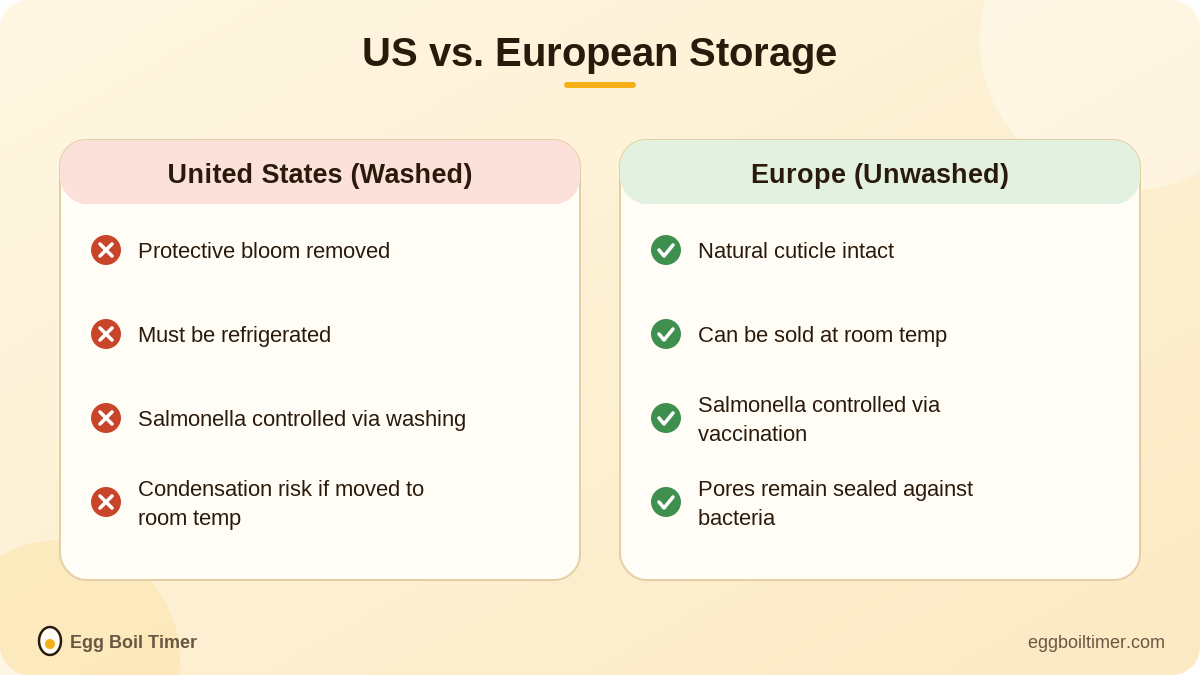
The difference between US and European storage comes down to the cuticle, or "bloom." This is a natural waxy coating that seals the thousands of pores on an eggshell. In the United States, commercial eggs are washed and sanitized to remove surface bacteria. This process strips away the bloom, making the egg vulnerable to moisture loss and bacterial penetration. Consequently, washed eggs must be kept at 40°F (4°C) or colder to prevent spoilage.
In most European countries, hens are vaccinated against Salmonella, and the eggs are not washed. This keeps the bloom intact, allowing for safe storage at cool room temperatures. However, once a washed egg is refrigerated, it must stay there. Moving a cold egg to room temperature causes condensation to form on the shell, which can pull surface bacteria through the pores. Regardless of the region, Storing Eggs in Fridge: Shelf Life, Placement, and Safety in the refrigerator is the most effective way to slow the aging process and maintain the thick white (albumen).

Best Practices for Fridge Placement
Keep your eggs in their original Egg Tray and Carton Guide: Materials, Reuse, and Rules to maximize shelf life. The cardboard or plastic prevents the eggs from absorbing strong odors from foods like onions or fish. Eggshells are porous; the carton acts as a secondary barrier against flavor contamination. Avoid using the built-in egg trays found in many refrigerator doors. The door is the warmest part of the appliance and is subject to constant temperature fluctuations.
Place the carton on a middle or bottom shelf toward the back of the refrigerator. This is where the temperature is most stable. If you find yourself with an abundance of eggs, A Dozen Eggs on Sunday: The Meal-Prep Habit That Feeds You All Week is an excellent way to use them before they age. Just remember that the shelf life changes once they are cooked; you should consult our data on How Long Do Hard-Boiled Eggs Last in the Fridge? to ensure you consume them within seven days.
Freezing and Traditional Preservation
If you cannot use your eggs before they expire, preservation is possible. Never freeze eggs in their shells, as the liquid inside expands and shatters the shell. Instead, crack the eggs into a bowl, whisk them gently, and freeze the liquid in airtight containers. For instructions on handling yolks and whites separately, see our guide on How to Freeze Eggs: Whole, Whites, and Yolks. Raw whites freeze perfectly, but yolks require a pinch of salt or sugar to prevent them from becoming gelatinous.
For those with unwashed farm-fresh eggs, traditional methods like "water glassing" involve submerging eggs in a solution of hydrated lime and water. This seals the pores and can preserve eggs for up to a year in a cool, dark place. However, this method is only safe for eggs that have never been washed or refrigerated, as the bloom must be entirely intact for the seal to work. Never attempt this with store-bought eggs.
How to Verify Freshness at Home
If you are unsure how long your eggs have been sitting, you can perform the Does the Egg Float? What the Water Test Really Tells You. Place the egg in a bowl of water; a fresh egg will sink and lay flat. As an egg ages, the air cell at the large end grows. An older egg will stand upright on the bottom, while a very old egg will float to the surface. A floating egg is not necessarily rotten, but it is old and should be cracked into a separate bowl for a smell test before use.
The ultimate judge of safety is your nose. A spoiled egg will produce a sharp sulfur odor the moment it is cracked. If the egg passes the smell test but the white looks watery or the yolk is flat, it is likely safe to eat but better suited for baking or hard-boiling than for poaching. Always refer to When Do Eggs Expire? True Shelf Life and Spoilage Signs for a clear timeline on safety vs. quality.


