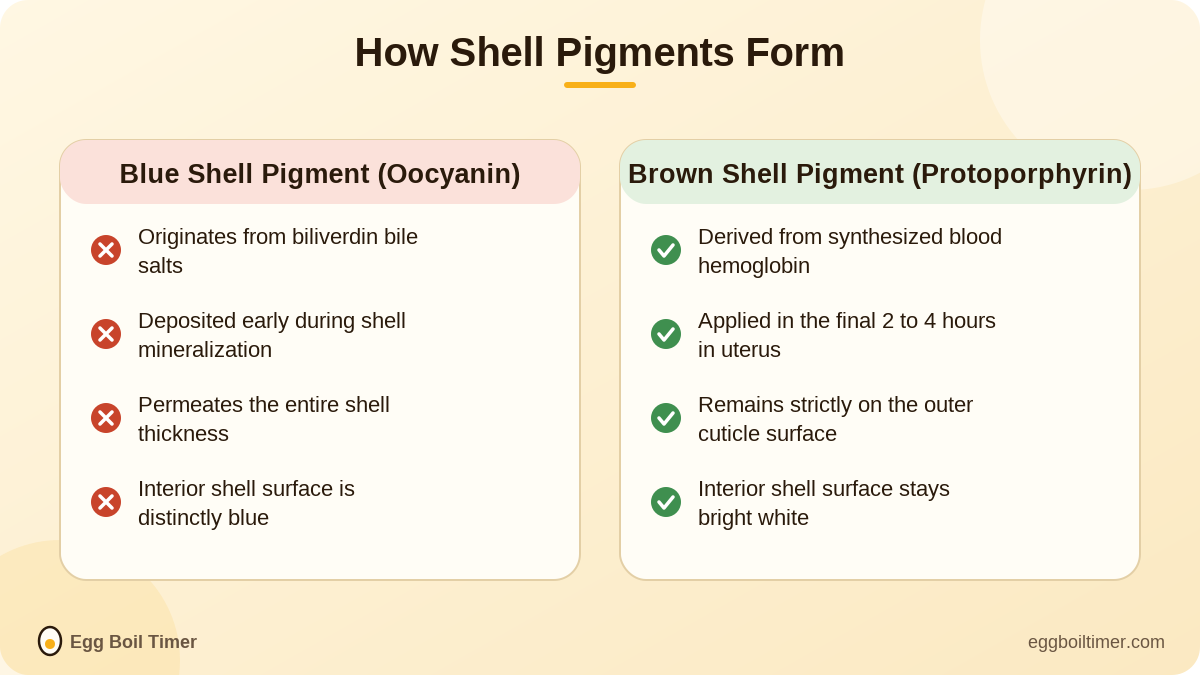
Naturally colored blue eggs come from domestic hens carrying an ancient genetic mutation that deposits a bile pigment called oocyanin throughout the calcium carbonate shell matrix. Unlike brown pigment painted solely onto the outer shell coating during the final hours of formation, blue pigment infuses the shell from the very start, coloring both the interior and exterior surfaces.
How Oocyanin Colors the Shell Matrix from Within
Eggshell development takes roughly 24 to 26 hours within the reproductive tract of a hen. The yolk drops from the ovary into the infundibulum, travels down the oviduct where albumen forms over several hours, and halts inside the uterus, also known as the shell gland pouch. Calcium carbonate crystals deposit onto the outer shell membrane for over twenty hours, constructing a rigid protective dome from calcite columns.
In standard layers producing white shells, no pigment touches this mineral layer. In hens that lay blue eggs, an ancient endogenous retrovirus insertion designated EAV-HP stimulates the expression of the SLCO1B3 gene in the shell gland. This gene codes for an organic anion transporter protein that shuttles biliverdin, a breakdown byproduct of bile and heme catabolism, straight into the calcifying uterine fluid.
The gland secretes biliverdin alongside liquid calcite throughout shell construction. That constant supply bonds the pigment directly into the mammillary cores and palisade layer of the mineral crystal lattice. The resulting turquoise hue penetrates the entire cross-section. When you crack open a blue egg, the interior wall facing the albumen remains light blue, proving the pigment is integral to the structure rather than a cosmetic surface wash.
Brown eggshells develop along an entirely different biological pathway. Brown layers synthesize protoporphyrin IX from red blood cell precursors in the mucosal epithelial cells of the shell gland. This brown pigment is released almost exclusively during the final two to four hours before oviposition. Because calcification is already complete when protoporphyrin discharges, the brown tint forms a surface glaze on the outer cuticle. The interior calcite wall of a brown egg stays chalk white.
Blue, Green, or Olive: How Shell Pigments Combine
Every non-white egg starts from either a white foundation or a blue foundation. Green eggs do not rely on an independent green pigment molecule. Instead, green, sage, and olive tones appear when a hen's shell gland deposits brown protoporphyrin pigment over an existing blue shell substrate.
The genetic trait for blue shell color, symbolized as O, is an autosomal dominant allele located on poultry chromosome 1. A hen inheriting a single copy of this allele will produce oocyanin and lay a blue-based shell. When breeders cross a bird carrying the blue gene with a breed selected for heavy brown pigmentation, the female offspring inherit the capacity to produce both pigments simultaneously.
During oviposition in these hybrid birds, the shell gland first constructs a solid blue calcite wall over twenty hours. Then, during the terminal three hours in the uterus, the shell gland sprays a concentrated wash of brown protoporphyrin over the outer surface. Just like blending yellow and blue tempera paint, the yellow-brown coating over the sky-blue core tricks the human eye into perceiving moss green, seafoam, or khaki.
The intensity of the green shade depends on the specific parent stock. A first-generation cross between an Ameraucana and a white-laying Leghorn produces daughters that lay pale sky-blue eggs because no brown pigment interferes. Crossing that same Ameraucana with a bird producing moderate brown shells, like a Rhode Island Red, produces standard Easter Eggers laying pastel mint or sage eggs.
Breeding a blue-egg layer to a Black Copper Marans, which deposits exceptionally dense dark chocolate brown protoporphyrin, yields an Olive Egger. The heavy brown layer over saturated blue produces deep military-green and avocado shells that stand out vividly beside ordinary Chicken Eggs: Anatomy, Formation, Nutrition, and Cooking.

Taste, Nutrition, and Commercial Scarcity
Colored shells frequently prompt claims of richer yolks, lower cholesterol, or superior vitamins. Shell color has no biochemical relationship to yolk flavor, albumen viscosity, or micronutrient density. Just like conventional brown and Brown or White: Does the Colour of the Shell Change the Boiling Time?, a large blue egg weighing 50 grams delivers approximately 6.3 grams of protein alongside identical baseline concentrations of lipids, iron, and choline.
The persistent myth that blue eggs possess unique dietary value traces back to Chile during the 1970s, where early marketing claimed Araucana eggs were entirely cholesterol-free. Controlled university feeding trials quickly refuted this claim, showing identical cholesterol content per gram of yolk across blue, brown, and white shells. The ratio of albumen to yolk remains consistent with bird body weight rather than shell coloration.
Flavor variations trace back to flock diet and husbandry, never the SLCO1B3 gene. A heritage hen foraging freely on pasture for insects, seeds, and clover deposits lutein, zeaxanthin, and omega-3 fatty acids into her yolk. That pasture diet yields deep golden yolks with a rich mouthfeel whether the shell outside is blue, cream, or terracotta. A caged bird fed basic industrial mash produces mild, pale yolks even inside vibrant pastel shells.
Commercial supermarkets rarely stock blue-shelled eggs because pure blue-laying breeds lay fewer eggs annually than industrial hybrids. Commercial white Leghorns and production red crosses yield over 300 eggs per year with minimal feed consumption. Most purebred blue layers produce between 180 and 220 eggs annually. For shoppers seeking them, farmers markets, local backyard flock keepers, and select organic specialty grocers remain the practical sources.

Comparing Blue and Green Egg Chicken Breeds
Not all birds producing blue or olive shells share the same temperament, size, or physical markers. Purebred birds adhere to strict breed standards, whereas utility hybrids balance novel egg colors with steady egg production.
| Breed | Shell Hue | Comb Type | Facial Features | Annual Output |
|---|---|---|---|---|
| Araucana | Robin's egg blue | Pea comb | Ear tufts, rumpless (no tail) | 170–200 eggs |
| Ameraucana | Clear sky blue | Pea comb | Full muffs and beard | 200–220 eggs |
| Cream Legbar | Light pastel blue | Single comb | Small feathered crest | 220–260 eggs |
| Easter Egger | Aqua, mint, or pink | Variable | Often muffs or beard | 240–280 eggs |
| Olive Egger | Sage to deep olive | Pea or modified | Mixed hybrid traits | 200–240 eggs |
The Araucana originated in Chile and represents the ancestral genetic source for blue shell pigmentation in modern domestic poultry. True exhibition Araucanas lack a tail bone (rumpless) and carry distinct feathered ear tufts protruding from the sides of the head. The gene responsible for these tufts is an autosomal dominant lethal allele; embryos inheriting two copies of the tuft gene die in the shell around day 17 to 19 of incubation, reducing average hatch rates.
Ameraucanas were developed in the United States during the late twentieth century to preserve blue egg laying without the lethal genetics. Breeders selected birds with tails, pea combs, full facial muffs, and slate-colored shanks, eliminating the rumpless gene entirely. Ameraucanas breed true for shell color, producing consistent sky-blue eggs throughout their productive years.
Cream Legbars were bred at Cambridge University in the 1930s by geneticists Reginald Punnett and Michael Pease. They combined the blue-laying traits of Chilean stock with Gold Campines and production Leghorns. Legbars are autosexing: male and female chicks display distinct down patterns at hatch, allowing keepers to separate pullets instantly without surgical or vent sexing.
Easter Eggers are popular backyard hybrids that carry one copy of the blue shell allele paired with an allele for white or brown eggs. Because they are not a standardized breed, their plumage and egg colors vary widely. Individual hens may lay aqua, olive, or beige eggs, but each individual bird lays the same base color throughout her adult life.
Why Blue Shells Fade or Shift Across the Season
Backyard flock owners often notice that a hen's shell color fluctuates across months of production. While genetics dictates whether a bird possesses the ability to produce oocyanin, environmental and physiological factors influence its visual depth.
Early spring eggs typically show the deepest pigment. As a hen lays continuously through the summer months, her body expends bile salts faster than her liver regenerates them, resulting in progressively paler turquoise shells toward autumn. A winter molt resets her pigment reserves.
High ambient temperatures suppress feed intake and compromise uterine muscle tone. When high heat causes chickens to pant, they exhale carbon dioxide rapidly. This leads to respiratory alkalosis, which lowers the concentration of bicarbonate ions in the blood and reduces the density of calcium carbonate deposited in the shell gland. The shell becomes thinner and the pigment distribution looks washed out.
The bloom, an organic protein cuticle applied seconds before oviposition, also alters perceived shade. A thick, chalky bloom refracts sunlight, making an intense sky-blue shell appear powdery lilac or sea green until gently washed with warm water.
A hen cannot switch her underlying genetics mid-season. If a nesting box suddenly contains brown eggs instead of blue, an Easter Egger pullet has begun laying, or a different flock member has taken over the nest.
Boiling and Culinary Handling of Pastel Eggs
In the kitchen, blue and olive eggs behave identically to standard farm eggs. Shell color has zero effect on heat transfer through the calcium barrier. The internal cooking times depend strictly on egg mass, starting water temperature, and initial egg temperature.
A medium blue egg weighing 50 grams requires less heat exposure than a heavy 70-gram shell from How to Boil Duck Eggs: Times for Runny, Jammy and Hard Yolks or an immense speckled shell from Turkey Eggs: Flavor, Nutrition, Cooking Times, and Scarcity. Because heritage blue layers often produce eggs with exceptionally thick, fresh cuticles, farm-fresh blue eggs can be difficult to peel when hard boiled immediately after collection. As an egg ages in refrigeration, moisture and carbon dioxide escape through microscopic shell pores, raising the albumen pH from roughly 7.6 to over 9.0. This natural chemical shift loosens the inner shell membrane from the white.
Whether preparing a soft-boiled egg with a liquid yolk or a jammy center for grain bowls, use our Egg Boil Timer to calculate exact cooking seconds for your egg's weight, starting temperature, and local elevation.


