To learn how to thai fried egg (khai dao), fry a room-temperature egg in 1 to 2 cm of neutral oil heated to 175 to 190 °C (350 to 375 °F). The white blisters into golden ruffles within seconds. Continuous basting sets the inner albumen in 60 to 90 seconds, keeping the yolk fluid and warm.
The Contrast That Defines Khai Dao
Contrast rules this dish. A Western fried egg relies on gentle skillet heat to set albumen without browning. In contrast, Thai street vendors drop the egg directly into a shimmering wok. The outcome is dramatic: shatteringly crisp edges paired with a liquid yolk to coat hot jasmine rice.
Unlike standard skillet techniques in our Fried Egg Timer: How to Fry an Egg to Any Doneness guide, khai dao relies on shallow immersion. Rapid convection forces moisture in the raw white to vaporize in milliseconds. Steam expands the protein network into porous ruffles while the raised yolk stays sheltered above the fat.
Wok Curvature and High-Heat Neutral Oils
Smoke points matter. Crisp edges without oily sogginess require fat that tolerates heat above 200 °C (400 °F). Refined peanut oil, soybean oil, and rice bran oil perform best. Butter and unrefined oils scorch quickly at these temperatures. Avoid them completely.
A carbon steel wok gathers 120 ml of oil into a deep pool without wasting excess fat. A small 20 cm skillet or curved cast-iron pan also works on flat induction burners. Avoid wide skillets that spread shallow oil too thin. The egg needs depth to float freely.

Targeting 180 °C for Golden Frills and Liquid Centers
Heat dictates the result. Oil temperature decides whether the egg turns crisp or greasy. Match your target yolk consistency to the heat ranges below.
| Target Yolk State | Oil Temperature | Cooking Duration | Visual Indicators |
|---|---|---|---|
| Runny (Liquid center) | 180–190 °C (356–374 °F) | 60–75 seconds | Energetic bubbling, dark golden frills, and untouched yolk dome. |
| Jammy (Custardy yolk) | 170–175 °C (338–347 °F) | 80–95 seconds | Moderate foam, lacy border, and lightly basted yolk surface. |
| Firm (Set throughout) | 160–165 °C (320–329 °F) | 110–130 seconds | Steady sizzle, light golden base, and continuous surface basting. |

Dropping, Basting, and Lifting: The 90-Second Routine
- Warm the egg at room temperature for 15 minutes before cooking. Chilled eggs cool the oil quickly and cause violent splattering. Crack the egg into a small ramekin rather than straight over hot oil. Do not skip this step.
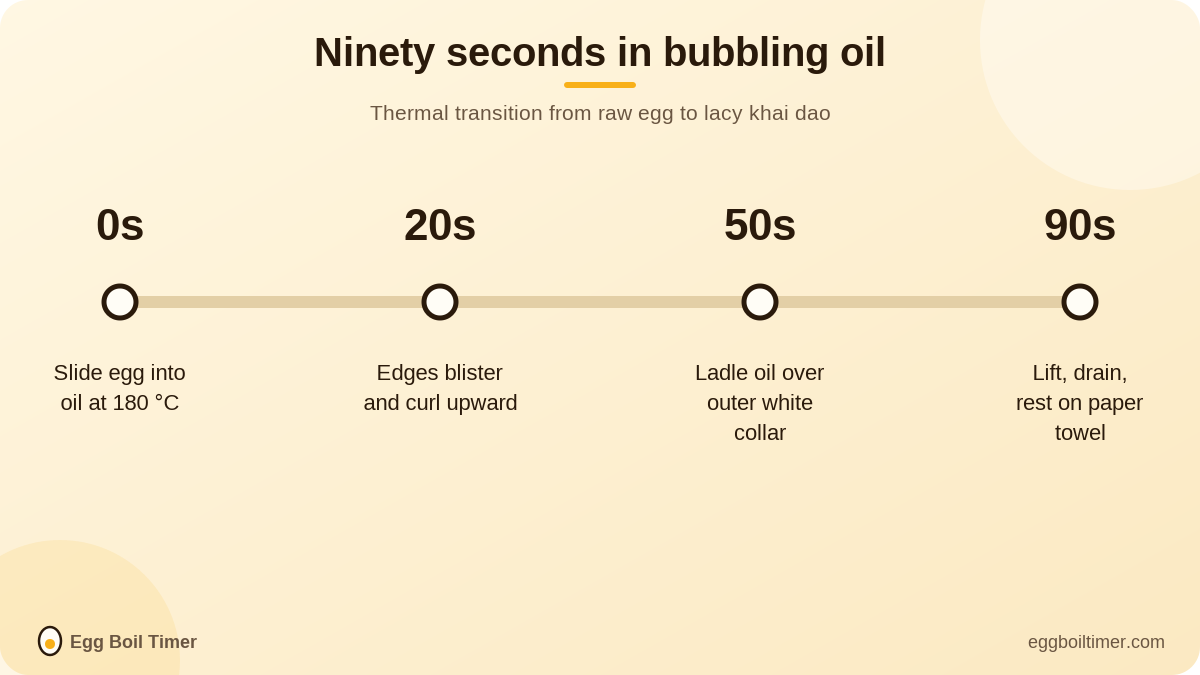
- Add oil to the wok to a depth of 1.5 cm and heat over medium-high. Test the heat with a dry wooden chopstick. Steady streams of tight bubbles confirm the oil has reached 175 to 190 °C.
- Hold the ramekin right at the oil surface and slide the egg in smoothly. The outer ring froths into tall waves within three seconds. Leave the egg undisturbed for 20 seconds so the bottom sets into a rigid crust.
- Tilt the wok slightly toward your dominant hand. Ladle hot oil over the thick white collar surrounding the yolk. Keep spooning oil until this inner ring turns opaque. Avoid basting the yolk dome directly to keep it bright orange and runny. Work quickly.
- Lift the finished egg with a wire skimmer once the edges turn bronze. Hold it above the wok for five seconds to drain, then rest on paper towels. Season with ground white pepper and serve immediately. Crisp edges soften fast.
Steam Pressure and Maillard Reactions in Hot Fat
Physics shapes every bite. An egg white consists of roughly 88% water and 10% structural protein. When raw albumen hits oil past 180 °C, that water flashes into vapor instantly. Expanding steam punches microscopic vents through setting proteins. This physical reaction locks the albumen into an airy, porous lattice instead of a dense rubber mat.
High heat also triggers fast Maillard reactions between glucose and protein along the edges. This rapid caramelization creates a savory crust unique to wok frying. Gentle water poaching or soft boiling on our Egg Boil Timer timer never produces these flavors. Older eggs work well here because thin albumen spreads fast across the oil surface, creating delicate lacy frills. Fresh eggs stay compact.
Diagnosing Greasy Whites, Broken Yolks, and Pan Sticking
Small errors ruin texture quickly. When a fried egg turns out greasy or leathery, a few mechanical missteps are usually responsible.
- Tough, oily whites with zero crunch point to oil temperature below 165 °C. The albumen soaked up grease instead of vaporizing its moisture. Check heat with a probe thermometer before cooking. Heat is key.
- A broken yolk in the pan happens when dropping the egg from too high. Dropping it more than 2 cm above the fat ruptures the delicate vitelline membrane. Slide the egg gently from a small bowl held level with the oil.
- A burnt bottom with raw white on top means pan heat was too high or basting was skipped entirely. Ladle hot oil over the inner collar so thick albumen cooks before the base scorches. Basting transfers heat upward.
- Sticking occurs when pans are insufficiently heated before adding cooking fat. Our guide on Egg Sticking to Pan: The Science and Fix for Any Skillet explains how proper preheating forms a nonstick thermal barrier. Never add eggs to a cold pan.
Street Food Combinations and Crispy Salads
Khai dao rarely sits alone. In Thai food culture, it crowns fiery stir-fries like Pad Kra Pao, rich curries, and fried rice. The runny yolk acts as an emulsified sauce, balancing pungent fish sauce and fiery bird's eye chilies. It softens fierce heat immediately.
The classic accompaniment is Prik Nam Pla. Stir together two tablespoons of fish sauce, sliced bird's eye chilies, lime juice, and minced garlic. A spoonful over the crispy edges cuts through the richness before you break the yolk. For gentler textures, compare this wok method to Sunny-Side Up Eggs: Set Whites and Liquid Yolks Without Flipping or steam-cooked Basted Eggs: How to Get Velvety Whites and Liquid Yolks.
Leftover fried eggs transform into Yam Khai Dao, a famous Thai fried egg salad. Cut crispy fried eggs into wedges, then toss them with sliced shallots, Chinese celery, cilantro, and lime dressing. The porous ruffles soak up dressing while retaining their crunch. In southern Thailand, cooks often choose duck eggs (khai dao khai pet). Duck eggs contain larger, richer yolks and denser albumen, creating darker amber frills and an intensely custardy center.
Splatter Prevention and Safe Serving Temperatures
Safety demands focus. Shallow frying requires careful moisture control. Keep all utensils completely dry. Water droplets on spoons or skimmers flash into steam instantly and throw scalding grease across the counter. Keep a splatter guard or wok lid nearby during the first 20 seconds. Stand back slightly.
A large egg delivers approximately 72 calories and over 6 grams of protein. Health agencies advise vulnerable groups to cook eggs thoroughly to 71 °C (160 °F) to reduce bacterial risks. This applies to young children, pregnant women, older adults, and anyone with weakened immunity. For a fully cooked yolk, baste hot oil over the center until an opaque veil covers the dome. This is general culinary information, not medical advice.


