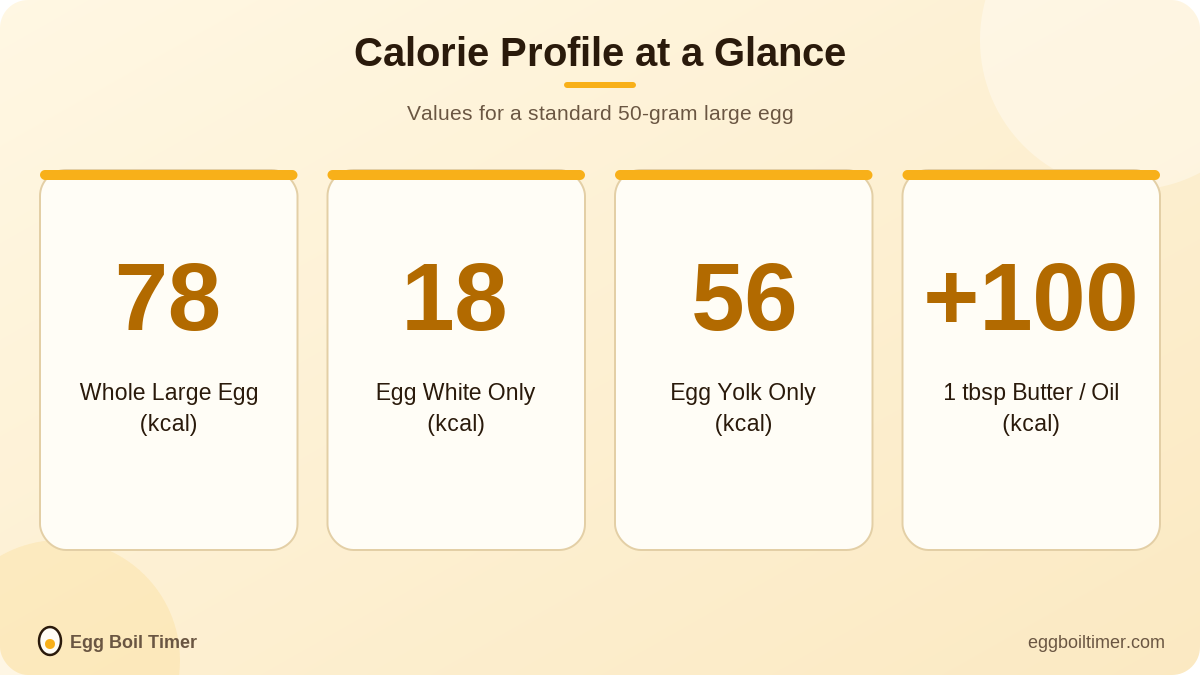
A single large hard-boiled chicken egg provides approximately 78 calories, 6.29 grams of protein, 5.3 grams of fat, and trace carbohydrates. The caloric density stays lean when boiled or poached in water. Pan frying in butter or vegetable oil can easily double the total caloric intake per meal.
Egg Calories Across Commercial Sizes
Egg cartons group eggs by total weight per dozen rather than by the weight of each individual egg. This packaging method creates subtle variations in caloric density across different carton sizes. In standard commercial grading, a small egg weighs roughly 38 grams, while an extra-large or jumbo egg reaches 56 to 63 grams.
| Carton Size. | Average Weight. | Energy. | Protein. | Total Fat. |
|---|---|---|---|---|
| Small (S). | 38 grams. | 54 calories. | 4.8 grams. | 3.9 grams. |
| Medium (M). | 44 grams. | 63 calories. | 5.5 grams. | 4.4 grams. |
| Large (L). | 50 grams. | 78 calories. | 6.3 grams. | 5.3 grams. |
| Extra-Large (XL). | 56 grams. | 85 calories. | 7.0 grams. | 5.8 grams. |
| Jumbo. | 63 grams. | 95 calories. | 7.9 grams. | 6.5 grams. |
Regional labeling also introduces clear differences. United States grading assigns large status to eggs averaging 50 grams without shell, which equals about 57 grams in shell. In the United Kingdom and the European Union, a medium egg spans 53 to 63 grams in shell. European large eggs span 63 to 73 grams. Our digital timer tool at Egg Boil Timer uses a 55-gram in-shell egg as its baseline to balance these international variations.
The Calorie Divide Between White and Yolk
Separating the egg reveals where the caloric energy actually resides. The egg white constitutes roughly two-thirds of total liquid mass but holds less than a quarter of the energy. The yolk contains almost all the lipid content, fat-soluble vitamins, and essential fatty acids.
A standard 34-gram large egg white contains approximately 18 calories, 3.6 grams of protein, and negligible fat. In contrast, a 17-gram yolk provides roughly 56 calories, 2.7 grams of protein, and 4.75 grams of lipids. Cooking with whites alone minimizes energy density. However, discarding the yolk removes vital micronutrients like choline, lutein, and vitamin D.
| Egg Component. | Portion Weight. | Energy. | Protein. | Total Fat. | Cholesterol. |
|---|---|---|---|---|---|
| Egg White (Albumen). | 34 grams. | 18 calories. | 3.6 grams. | 0.06 grams. | 0 milligrams. |
| Egg Yolk. | 17 grams. | 56 calories. | 2.7 grams. | 4.75 grams. | 186 milligrams. |
| Whole Edible Portion. | 50 grams. | 78 calories. | 6.3 grams. | 5.3 grams. | 186 milligrams. |

How Preparation Methods Alter Total Energy
Water-based cooking methods never alter the intrinsic energy value of an egg. Hard-boiling, soft-boiling, and poaching transfer heat through water without introducing external lipids. A poached or boiled large egg retains its baseline 78 calories.
Caloric inflation occurs when eggs absorb cooking fats in a hot pan. Butter, olive oil, and bacon grease contribute roughly 100 to 120 calories per tablespoon. Beaten eggs possess a porous coagulating matrix that absorbs melted fat rapidly during cooking. When scrambling eggs, adding two tablespoons of whole cow milk adds roughly 19 calories and 1 gram of fat. Swapping that milk for heavy whipping cream adds roughly 101 calories and 11 grams of fat. A diner-style scramble cooked in butter can quickly exceed 350 calories for a two-egg portion.
| Preparation Style. | Added Ingredients. | Total Calories. | Added Fat. |
|---|---|---|---|
| Boiled or Poached. | Water and salt only. | 156 calories. | 0 grams added fat. |
| Fried Sunny-Side Up. | 1 teaspoon olive oil (5 ml). | 196 calories. | 4.5 grams added fat. |
| Skillet Fried in Butter. | 1 tablespoon salted butter (14 g). | 258 calories. | 11.5 grams added fat. |
| Scrambled with Whole Milk. | 1 tablespoon butter plus 2 tablespoons whole milk. | 277 calories. | 12.5 grams added fat. |
| Scrambled with Heavy Cream. | 1 tablespoon butter plus 2 tablespoons heavy cream. | 358 calories. | 21.5 grams added fat. |
| Non-Stick Pan with Spray. | Light mist olive oil cooking spray. | 160 calories. | Under 1 gram added fat. |
Popular additions to morning scrambles also shift energy counts substantially. Even small garnishes of cheese or cured meat contribute meaningful calories to an otherwise lean dish.
| Ingredient. | Standard Measure. | Added Calories. | Primary Macronutrient. |
|---|---|---|---|
| Salted butter. | 1 tablespoon (14 g). | 102 calories. | Fat (11.5 g). |
| Extra virgin olive oil. | 1 tablespoon (15 ml). | 119 calories. | Fat (13.5 g). |
| Whole cow milk (3.25%). | 2 tablespoons (30 ml). | 19 calories. | Carbohydrate and fat. |
| Heavy whipping cream. | 2 tablespoons (30 ml). | 101 calories. | Fat (10.8 g). |
| Cheddar cheese (shredded). | 28 grams (1 oz). | 113 calories. | Fat and protein. |
| Fresh baby spinach. | 1 cup raw (30 g). | 7 calories. | Fiber and micronutrients. |

Net Calorie Availability: Cooked Versus Raw Eggs
The number of calories stated on a food label does not always equal the net calories your body absorbs. Biochemical research shows that heat alters the molecular structure of egg proteins. In a landmark human digestion study, scientists measured protein breakdown in both raw and cooked eggs.
The results demonstrated that cooked egg protein achieves roughly 91 percent digestibility. Raw egg protein reached only 51 percent digestibility in the small intestine. Digestive proteases like pepsin and trypsin struggle to cleave tightly folded raw albumen chains. Heat denatures these protein structures, unfolding them so digestive enzymes can break them down efficiently. While raw eggs yield fewer net calories, unabsorbed protein travels directly into the large intestine. Cooking eggs ensures full amino acid assimilation and eliminates food safety risks.
Satiety and Nutrient Density Beyond Calorie Counts
Evaluating eggs strictly by caloric counts overlooks their impressive nutrient density. Daily energy intake connects directly to satiety hormones and gut signaling. Egg protein provides a complete amino acid profile with exceptional bioavailability.
Consuming eggs triggers the release of peptide YY and glucagon-like peptide-1 in the digestive tract. These two gut hormones signal fullness directly to appetite centers in the brain. Two large eggs deliver 156 calories alongside 12.6 grams of quality protein. Clinical feeding trials show that egg-based breakfasts curb voluntary calorie intake over the following 24 hours. Participants who ate eggs felt fuller than those consuming equal-calorie carbohydrate meals like bagels.
Beyond protein, a single large egg supplies roughly 147 milligrams of dietary choline. This quantity covers more than 25 percent of the daily requirement for an adult. Choline supports brain development, nerve signaling, and cellular membrane integrity. Eggs also provide bioavailable lutein, zeaxanthin, selenium, riboflavin, and natural vitamin D.
Dietary Cholesterol and Cardiovascular Evidence
For decades, dietary advice restricted whole eggs because a large yolk contains roughly 186 milligrams of cholesterol. Modern cardiovascular research draws a sharp distinction between dietary cholesterol and circulating blood cholesterol.
Saturated and trans fats stimulate hepatic low-density lipoprotein production far more aggressively than ingested dietary cholesterol. In about 70 percent of individuals, dietary cholesterol produces negligible changes in plasma cholesterol. The remaining 30 percent experience modest increases in both LDL and HDL levels, maintaining a steady ratio. Major health organizations have dropped strict numerical daily limits on dietary cholesterol. Current medical guidelines permit an egg daily as part of a varied, nutrient-dense diet. Individuals managing specific cardiovascular conditions or type 2 diabetes should consult their physician.
This is general nutritional information, not individualized medical advice.
Practical Adjustments for Calorie-Conscious Cooking
Simple kitchen adjustments allow you to enjoy eggs while controlling total meal calories:
- Steam or soft-boil your eggs instead of frying them in open fat. Steaming tenderizes the whites, leaves yolks jammy, and requires no added butter or oil.
- Mix one whole egg with two separated whites for a satisfying scramble. This combination delivers 114 calories and nearly 14 grams of protein with yolk flavor.
- Use durable ceramic non-stick skillets to cook eggs with an oil mist rather than pooling fat.
- Fold in spinach, mushrooms, tomatoes, and herbs to expand portion volume with minimal calories.


