An egg cooker is a compact countertop appliance that cooks eggs in their shells using concentrated steam generated over an electrically heated metal plate. Rather than submerging eggs into several liters of turbulent boiling water, an electric cooker suspends them above a measured volume of water inside an enclosed dome. The water evaporates completely, triggering a thermal cutoff switch or audible chime when the heating plate reaches approximately 105 °C (221 °F). This steam mechanism produces consistent yolk textures, reduces fuel energy consumption, and makes shells easier to remove.
Steam Thermodynamics: How Water Volume Controls Egg Doneness
Countertop egg cookers operate on a dry-out cycle rather than an integrated countdown clock. The user controls the internal doneness by pouring a specific volume of cold water onto the stainless steel heating plate using the graduated measuring beaker included with the unit. Because pure water cannot exceed 100 °C (212 °F) at sea level while liquid remains, the temperature inside the covered cooking chamber stays locked at steaming equilibrium throughout the cycle.
When the measured liquid finishes boiling away into vapor, the temperature of the bare metal plate immediately spikes above 100 °C. A bimetallic thermostat attached directly beneath the heating plate detects this sudden thermal jump and trips the circuit. That trip activates an audible buzzer or cuts electrical power to the element. More water creates a longer vaporization duration, transferring thermal energy deep into the yolk core to produce firm whites and chalky centers. Less water evaporates quickly, leaving the white set while the yolk core remains liquid at 63 °C.
Cooking more eggs simultaneously requires less water in the reservoir. Multiple cold eggs provide greater surface area for steam to condense against inside the plastic lid. Condensed water droplets roll down the interior walls and drip back onto the heated plate to vaporize a second time. A single egg allows steam to escape through the dome exhaust vent without recycling, demanding more initial water to sustain the steaming duration.
Appliance Formats Compared: Electric Bases, Microwave Shells, and Stovetop Racks
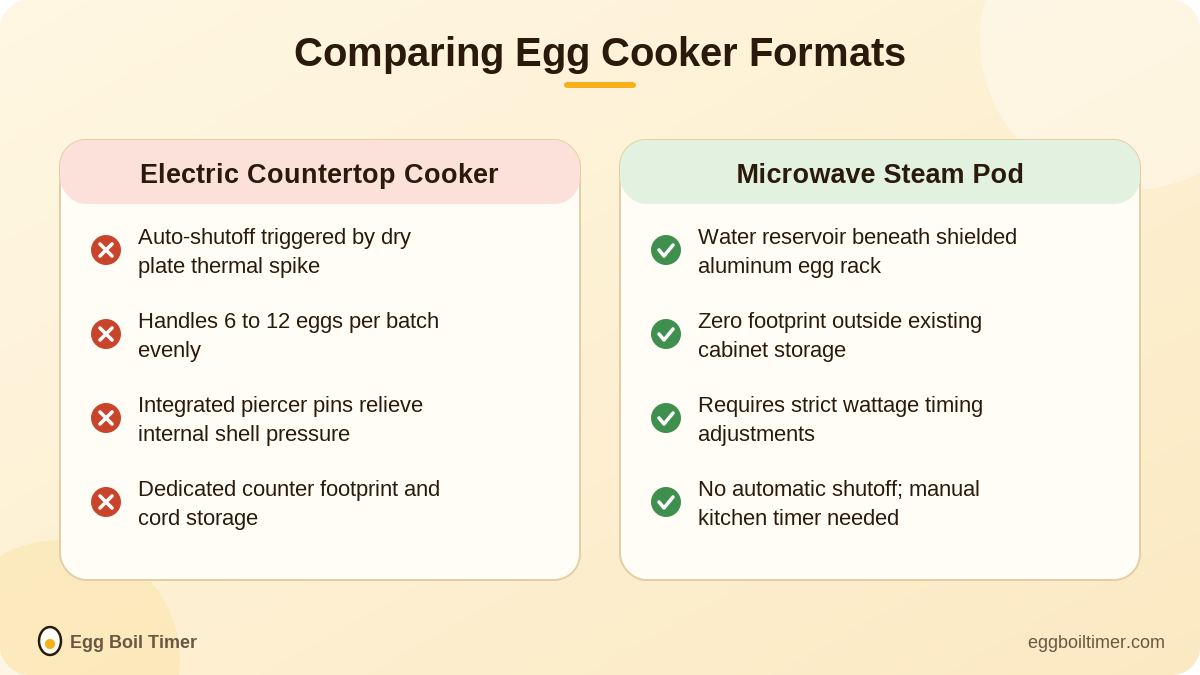
Home cooks choose between dedicated electric steam domes, microwave pressure containers, and stainless inserts designed for conventional saucepans. Each tool manages heat transfer through distinct physical principles, which directly dictates batch capacity, cleanup requirements, and operational consistency across repeated breakfast batches.
| Cooker Format | Heat Source | Capacity | Primary Strength | Main Operational Trade-Off |
|---|---|---|---|---|
| Electric Countertop | Built-in resistive plate | 6 to 12 eggs | Automatic thermal shut-off eliminates guess-timing | Mineral scale accumulates rapidly on base plate |
| Microwave Enclosure | Microwave water bath | 1 to 4 eggs | Zero electrical cords and dishwasher-safe plastic | Requires calibration for microwave wattage variations |
| Stovetop Steam Insert | Burner under saucepan | 4 to 8 eggs | Indestructible metal with no electrical components | Demands external kitchen timer and manual flame control |
Electric cookers excel at batch uniformity because the internal enclosure remains insulated from external kitchen drafts. Microwave units rely on an aluminum or steel interior shield that reflects microwaves away from raw egg albumen while allowing microwaves to boil water in a bottom sump. If the metal shield in a microwave egg pod is misaligned or scratched, arcing occurs or the egg absorbs raw radiation directly, generating interior steam pressure that detonates the shell.

Beyond Boiling: Steaming Omelets and Moulded Poached Eggs
Most commercial electric egg cookers bundle supplementary plastic or silicone inserts for preparing poached eggs and miniature omelets without shells. While manufacturers advertise these features prominently, the physics of steam alters the texture of bare egg proteins significantly compared to hot water baths or buttered skillet surfaces.
Moulded poaching trays suspend whisked or cracked eggs inside concave cups resting directly over the boiling water. The resulting egg is technically a steamed egg custard rather than a traditional poached egg. Without contact with moving water, the albumen sets uniformly against the plastic wall at 80 °C (176 °F), creating an elliptical disc with a firmer exterior skin than an egg simmered in a vortex. To prevent sticking, these polymer cups require a light coating of neutral oil or butter spray before loading raw eggs.
Omelet trays function identically by holding up to two thoroughly beaten eggs seasoned with salt and herbs. Because the dome traps 100 percent humidity, moisture cannot evaporate from the top surface. The finished omelet rises with a souffled, spongy crumb similar to Japanese chawanmushi, lacking the golden browning or buttery crust produced in a frying pan. For cooks requiring soft breakfasts without added dairy fats, the steamed format is efficient and hands-free.

Calibrating Water Volumes for Shell Count and Egg Size
The pre-printed graduations on factory measuring beakers serve as rough baseline estimates rather than universal rules. Differences in egg refrigeration temperature, shell size classifications, and regional electrical line voltages alter the evaporation rate of the heating base. Reaching an exact yolk state requires adjusting water measurements systematically.
- Check your starting temperature: beaker lines assume eggs come straight from a 4 °C (39 °F) refrigerator. Using room-temperature eggs resting at 20 °C (68 °F) requires cutting the water volume by roughly 15 percent to avoid overcooking the center.
- Compensate for shell weight: lines reflect standard Large eggs weighing 55 grams. When cooking Extra Large (60 grams) or Jumbo (65 grams) eggs, add 3 to 5 milliliters of water beyond the marking to extend steam production.
- Vent the wide end: pierce the blunt pole of each shell using the integrated steel pin in the beaker base. This punctures the inner pocket, releasing air that would otherwise expand rapidly and crack the shell.
- Position the puncture facing upward: seat eggs in the rack cradles with the hole pointing straight toward the dome exhaust vent, letting expanding air escape without forcing liquid albumen out through the shell.
- Mark calibrated adjustments: if your first run yields a loose center when aiming for a jammy yolk, add 2 milliliters on the subsequent batch and note the adjusted line directly on the plastic cup.
Diagnosing Texture Defects, Blown Shells, and Stubborn Peels
Cracked shells, rubbery whites, and stubborn membranes usually point to water calibration errors or trapped residual heat rather than appliance failure. Five recurring mechanical and thermal issues explain almost every disappointing batch.
| Observed Defect | Underlying Cause | Corrective Adjustment |
|---|---|---|
| White leaks through cracked shell | Internal air cell expanded faster than shell porosity allowed | Pierce the blunt pole with the base pin; load eggs gently into rack |
| Shell clings to cooked albumen | Egg cooled slowly without contraction shock | Transfer eggs to a 50/50 ice water bath for 3 minutes immediately at buzzer |
| Green-gray ring around yolk | Oversteaming drove iron and sulfur binding at yolk perimeter | Reduce water measure by 3 to 5 mL; remove lid promptly when chime sounds |
| Yolk is firm on one side, runny on other | Uneven steam flow due to clogged dome exhaust vent | Clear mineral debris from exhaust hole using a toothpick or pin |
| Buzzer sounds prematurely | Thick mineral scale on heating element triggers thermal sensor early | Descale the metal base plate using warm distilled white vinegar |
Shell peeling performance in an egg cooker generally surpasses stovetop boiling started in cold water. High-density 100 °C steam immediately denatures outer albumen proteins before they can adhere to the inner shell membrane. If peeling remains difficult, the cause is almost universally post-cook heat retention: leaving eggs inside the hot steamer after the alarm sounds allows residual plate heat to dry out the shell membrane.
Kitchen Trade-Offs: Dedicated Steamers Versus Stovetop Boiling Pots
Storage space and batch volume decide whether an electric cooker earns a spot on your kitchen counter. A dedicated electric cooker consumes between 350 and 500 watts of electrical power over a ten-minute cycle. In contrast, bringing two liters of water to a rolling boil on an electric range burner demands 1,500 to 2,000 watts sustained over fifteen to twenty minutes.
For individuals cooking two to four eggs every morning, the appliance pays for its small footprint through speed and automated safety. You pour water, press a switch, and walk away without monitoring a flame or boiling-water spillover. The cooker requires no pot scrubbing, and the eggs never crack against each other because the rack holds them stationary.
For cooks preparing large batches for holiday entertaining, deviled egg platters, or commercial meal prep, standard kitchen cookware remains superior. A large 6-liter stockpot accommodates two dozen eggs simultaneously, whereas most electric cookers cap at six or seven eggs per tier. If you prefer precision control using a digital timer and stovetop heat, use the Egg Boil Timer interactive tools to calculate exact boil seconds adjusted for your elevation and egg dimensions.
Descaling Heating Plates and Preserving Polymer Domes
Tap water contains dissolved calcium carbonate and magnesium salts that do not vaporize with steam. As liquid boils away during every cooking cycle, these minerals concentrate and precipitate onto the hot metal plate as a chalky white or brown crust. Left uncleaned, this limescale acts as an insulating barrier between the metal element and the water pool.
Scale buildup causes the plate temperature to rise prematurely, tripping the internal thermal cutoff before the eggs absorb sufficient steam. To restore factory heating efficiency, descale the unit every ten to twelve uses. Pour equal parts distilled white vinegar and warm tap water directly onto the cold base plate until the heating recess is submerged. Allow the acidic solution to dissolve the carbonate crust for twenty minutes without turning on the power.
Wipe the dissolved residue clean with a non-abrasive sponge, rinse the plate using a damp cloth, and dry thoroughly. Never submerge the electrical housing in a sink or place the powered base into a dishwasher. The plastic dome cover, egg cradle rack, and poaching cups should be washed in warm soapy water. Avoid high-heat drying cycles in residential dishwashers, which warp thin polymer lids and create steam leaks along the rim seal.


