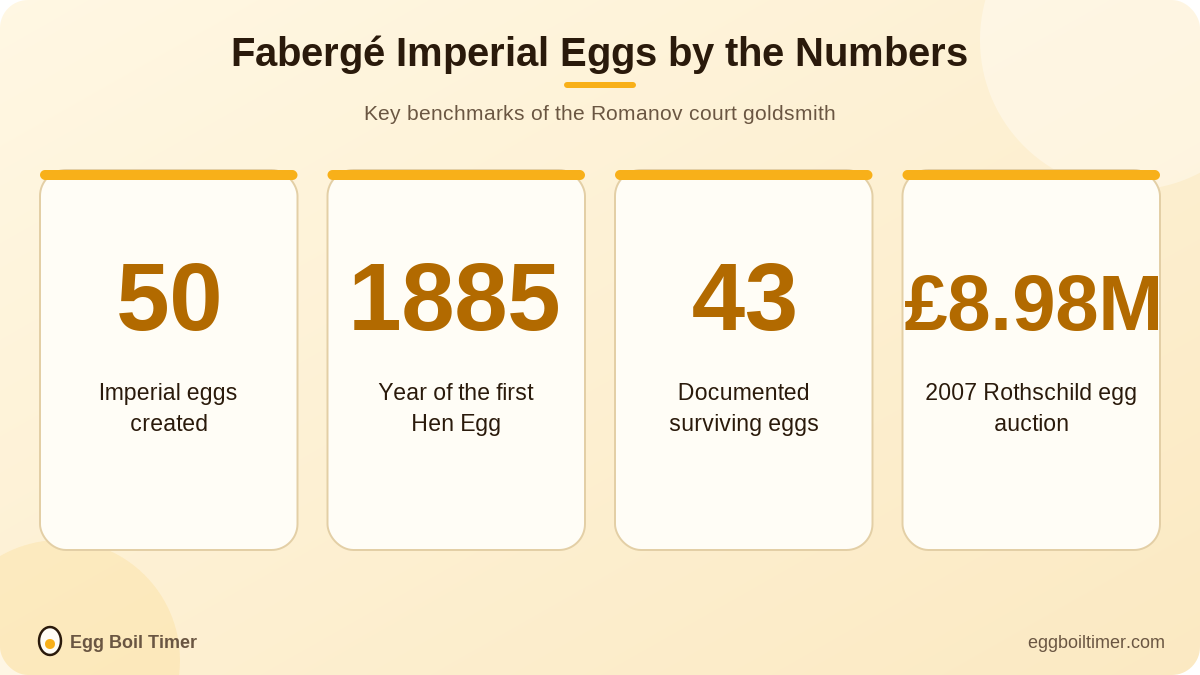
A faberge egg is a jeweled metal sculpture produced by the House of Fabergé between 1885 and 1917. Most famous for fifty Easter gifts delivered to Russian Tsars, these pieces bear no connection to organic eggs or folk crafts like traditional Easter Eggs: History, Meaning, Dyeing Methods, and Food Safety. Each hollow artifact enclosed an intricate mechanical surprise beneath layers of kiln-fired vitreous enamel.
Precious Metals Versus Organic Shells
Folklore occasionally confuses Fabergé eggs with hollowed bird shells. Peter Carl Fabergé built these objects entirely out of forged metals, hardstones, and vitreous glass. While goose and ostrich eggs featured in earlier European cabinet curiosities, the Russian workshop relied on platinum bands, variegated golds, rock crystal, and carved minerals like Siberian nephrite and jasper.
Vitreous enamel gave each piece its luminous exterior. Craftsmen first scored repetitive geometric patterns into the gold or silver core using a hand-operated rose engine lathe. Master enamellers then spread wet pastes of pulverized quartz and metallic oxides over the engraved lines, firing the metal in a kiln between 700 and 800 °C. Repeating this process up to six times created a glass-like shell that allowed light to reflect off the engraved metal beneath.
Tsar Alexander III commissioned the inaugural piece for Empress Maria Feodorovna in 1885. This First Hen Egg looked plain on the outside, finished in opaque white enamel resembling a normal poultry shell. Twisting it open revealed a matte gold yolk holding a chased gold hen with ruby eyes. Inside the hen rested a tiny diamond crown and a ruby pendant. The Empress loved the present so much that Alexander made the commission an annual royal decree.
The Romanov Imperial Easter Tradition
Easter was the primary religious holiday in Imperial Russia, marked across the empire with three ritual kisses and gifts of dyed hen eggs. Alexander III converted this folk custom into a personal state tradition. Workshops operated under strict secrecy for eleven months to prepare each spring unveiling.
When Nicholas II took the throne in 1894, he expanded the order to two eggs each spring: one for his widowed mother and one for his wife, Empress Alexandra Feodorovna. The royal court granted Fabergé complete creative freedom under two strict conditions. Every piece required an egg shape, and each had to conceal a unique surprise honoring imperial milestones, ships, or palaces.
Fabergé directed his Saint Petersburg workshop on Bolshaya Morskaya Street as a design manager rather than a solitary bench jeweler. He assigned projects to master goldsmiths Michael Perchin and Henrik Wigström, who led specialized teams of stone cutters, diamond setters, clockmakers, and miniature painters. The workshop produced 50 Imperial Easter eggs for the Romanovs, alongside roughly fifteen private commissions for patrons like the Duchess of Marlborough and the Russian industrialist Alexander Kelch.

Automatons, Miniatures, and Guilloché Enamel
The interior surprise served as the engineering core of every egg. Where the exterior displayed goldsmithing symmetry, the inside demanded clockwork precision. Fabricators developed tiny leaf springs, friction catches, and counterweights that could move smoothly without chipping the brittle enamel edges.
The 1897 Imperial Coronation Egg, commemorating the crowning of Nicholas II, contains an exact 10-centimeter model of Catherine the Great's 1793 carriage. The coach has platinum wheel rims, engraved gold door latches that open, functional suspension leaf springs, and window panes carved from thin rock crystal. Opening either carriage door triggers a folding gold footstep that drops down automatically.
Several imperial commissions relied on functioning automatons driven by internal clockwork springs:
- The 1900 Trans-Siberian Railway Egg opens to reveal a 39-centimeter folding clockwork train made of gold and platinum. When wound with a gold key, the tiny locomotive pulls five passenger coaches along a tabletop track.
- The 1908 Peacock Egg houses an enameled gold peacock resting among carved rock crystal branches. Once wound, the mechanical bird walks across the table and fans out its tail plumage.
- The 1911 Bay Tree Egg resembles a potted shrub with carved nephrite leaves. Pressing a tiny lever raises a feathered mechanical songbird that flaps its wings, turns its head, and sings.

Eight Milestone Imperial Eggs Compared
The surviving Imperial pieces trace thirty-two years of shifting decorative taste, moving from historicist French styles to delicate Art Nouveau botanical motifs and austere wartime steel casings.
| Year | Egg Name | Recipient | Internal Surprise | Current Location |
|---|---|---|---|---|
| 1885 | Hen Egg | Empress Maria Feodorovna | Gold hen with ruby eyes | Fabergé Museum, Saint Petersburg |
| 1897 | Imperial Coronation | Empress Alexandra Feodorovna | Miniature 1793 royal coach | Fabergé Museum, Saint Petersburg |
| 1898 | Lilies of the Valley | Empress Alexandra Feodorovna | Pop-up portraits of Tsar and daughters | Fabergé Museum, Saint Petersburg |
| 1900 | Trans-Siberian Railway | Empress Alexandra Feodorovna | Clockwork steam engine and carriages | Kremlin Armoury, Moscow |
| 1901 | Gatchina Palace | Empress Maria Feodorovna | Gold model of Gatchina residence | Walters Art Museum, Baltimore |
| 1906 | Moscow Kremlin | Empress Alexandra Feodorovna | Music box chiming Easter hymns | Kremlin Armoury, Moscow |
| 1913 | Winter Egg | Empress Maria Feodorovna | Platinum basket of quartz wood anemones | Private collection, Qatar |
| 1916 | Order of St. George | Empress Maria Feodorovna | Miniature watercolor portraits | Fabergé Museum, Saint Petersburg |
Bolshevik Confiscation and Global Dispersal
The Russian Revolution of 1917 abruptly stopped production at the Fabergé workshops. Following the abdication and execution of the Romanov family, Bolshevik forces seized the imperial palaces, nationalized Fabergé stock, and moved crown assets to Moscow. Peter Carl Fabergé escaped Russia on a diplomatic train to Riga, eventually settling in Switzerland, where he died in 1920.
Between 1928 and the mid-1930s, the Soviet state agency Gokhran sold off imperial treasures to foreign antique dealers to raise hard currency for industrial factories. Armand Hammer and Emanuel Snowman purchased several Imperial eggs for modest prices, bringing them to London and New York galleries.
Of the original fifty Imperial eggs, exactly 43 are accounted for today in museums and private collections. Seven disappeared during the revolutionary chaos. In 2012, an American scrap metal dealer discovered an unidentified golden egg at a flea market, having bought it for $13,302 with the goal of melting it for gold value. Research revealed it to be the lost 1887 Third Imperial Easter Egg, later sold to a private buyer for an estimated $33 million.
Hallmarks, Workmaster Marks, and Forgery Risks
Astronomical market values make antique Fabergé items frequent targets for forgery. Genuine pieces carry Russian Imperial assay stamps alongside individual workshop punch marks.
Pre-1899 Saint Petersburg items display a numeric purity stamp, such as "56" for 14-karat gold or "84" for silver. This number was punched alongside the crossed anchors and scepter of the imperial city crest. After 1899, official assayers stamped the kokoshnik profile mark: a woman's head facing left (1899 to 1908) or right (1908 to 1917), accompanied by initials of the district assay master.
Legitimate pieces bear the maker marks of Fabergé's primary workmasters:
- "М.П" indicates Mikhail Perchin, head workmaster from 1886 until his death in 1903.
- "H.W" designates Henrik Wigström, who directed the workshop from 1903 through 1917.
- "К. Фаберже" with the Imperial double-headed eagle appears on presentation boxes and larger imperial silver objects.
Counterfeiters regularly give themselves away with mixed historical stamps, placing pre-1899 city hallmarks next to post-1908 kokoshnik profiles. Authentic guilloché enamel is razor-thin, flat, and free of air bubbles or soft polymer resins. The mechanical tolerance on genuine Fabergé hinges allows seams to snap shut flush without gaps or wobble.
Auction records reflect the extreme rarity of verified pieces. In 2007, Christie's sold the non-imperial Rothschild Fabergé Egg for £8.98 million. The largest public collections remain on display at the Kremlin Armoury in Moscow, the Fabergé Museum in Saint Petersburg, the Virginia Museum of Fine Arts, and the British Royal Collection. When working with farm-fresh eggs on the stove rather than jeweled palace artifacts, use our Egg Boil Timer to track your boil down to the second.


