Kuku Sabzi is a traditional Persian herb frittata made with a high ratio of greens to eggs. Whisked eggs act primarily as a binder for chopped parsley, cilantro, dill, and chives. Essential for Nowruz tables, its green hue symbolizes spring renewal. Walnuts provide crisp crunch while dried barberries add tart balance. Gentle heat yields a dense, fragrant cake with a dark golden crust. Discover more global dishes in our collection of Egg Recipes: Breakfast, Lunch, and Dinner Ideas.
Kuku Sabzi and Its Place on the Nowruz Table
In Iranian home cooking, kuku refers to a class of egg-bound dishes pan-fried or baked into thick, savory cakes. While potato or eggplant kuku rely on cooked vegetables, Kuku Sabzi highlights fresh green herbs (sabzi). It holds a central spot during spring New Year celebrations (Nowruz). Bright green herbs represent rebirth, while eggs symbolize fertility and creation.
The distinction between Kuku Sabzi and a Western frittata lies in the egg ratio. A standard frittata contains roughly 70 percent egg custard and 30 percent fillings. Kuku Sabzi completely reverses that ratio. Fresh chopped herbs make up nearly 80 percent of the volume. Just enough egg protein binds the greens so the cake sets during cooking. Slice into a cooked piece to reveal a dense green mosaic inside a golden crust.
Herbs, Fenugreek Limits, and Moisture Control
Fresh herbs form the core of Kuku Sabzi. A classic blend combines equal parts parsley, cilantro, dill, and garlic chives or scallions. A small pinch of dried fenugreek (shanbalileh) adds deep herbal aroma. Keep dried fenugreek to a maximum of half a teaspoon per four cups of fresh herbs. Excess fenugreek creates severe bitterness that overpowers the dish.
Moisture control determines whether the herb cake sets firmly or becomes watery. Residual moisture on herb leaves turns into steam during cooking, forcing egg protein chains apart and preventing a solid bind. Prepare greens with this precise sequence:
- Wash thoroughly: Submerge herbs in cold water to remove soil, then drain in a colander.
- Spin dry: Run herbs through a salad spinner in small batches to remove surface droplets.
- Air dry completely: Spread leaves across clean cloth towels for one to two hours until bone dry to the touch.
- Hand chop finely: Chop dry herbs with a sharp knife. Avoid food processors, which bruise plant tissue and release cell sap.

Ratio of Herbs to Eggs, Walnuts, and Barberries
To prepare a standard six-egg Kuku Sabzi serving four to six people, assemble the following ingredients:
- 6 large eggs: Yields 37.8 grams of egg protein (6.3 g per egg) for structural binding.
- 4 cups chopped herbs: Equal parts parsley, cilantro, dill, and chives or green onion tops.
- 1/2 cup walnuts: Finely chopped to provide rich fat and pleasant crunch.
- 1/3 cup dried barberries: Rinsed zereshk for tart balance; chopped unsweetened cranberries work as a swap.
- 1 teaspoon ground turmeric: Delivers warm color and subtle earthy note.
- 1/2 teaspoon baking powder: Provides gentle aeration so the dense herbs stay tender.
- 1 tablespoon flour: Absorbs leftover cell moisture while heating.
- 1 teaspoon salt and 1/2 teaspoon black pepper: Essential seasoning.
- 3 tablespoons oil or ghee: For pan-frying or lubricating the baking pan.
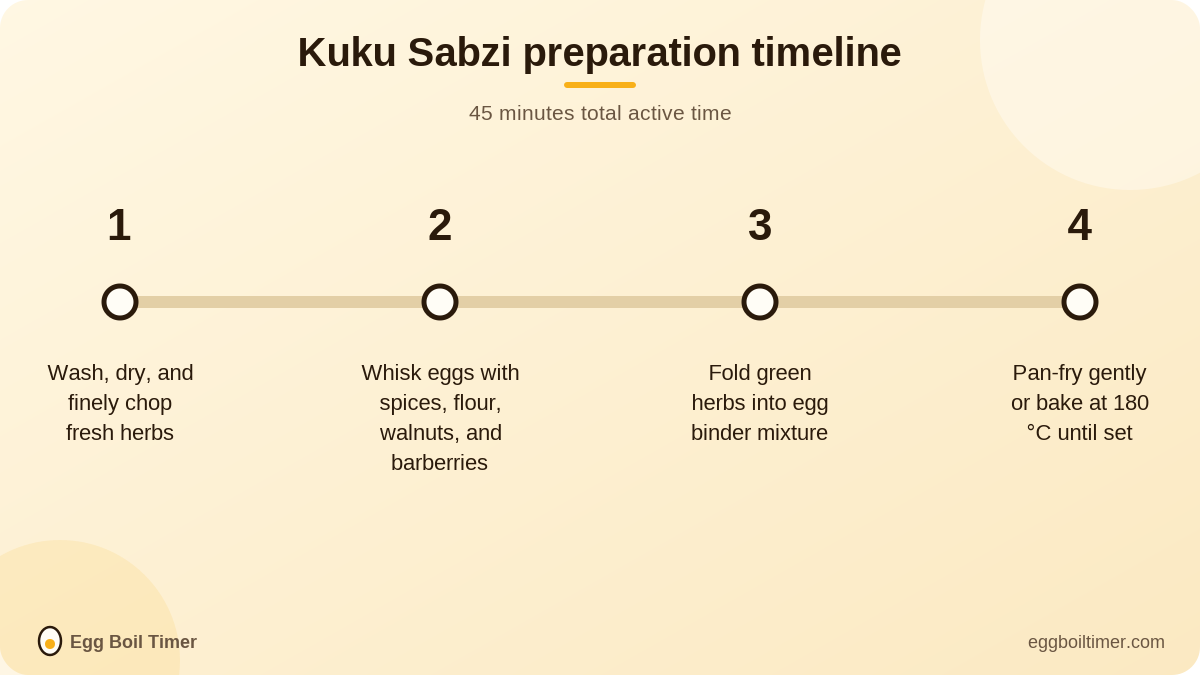
Crack six large eggs into a wide bowl and whisk until smooth. Whisk in salt, black pepper, ground turmeric, baking powder, and flour until no lumps remain. Stir in chopped walnuts and barberries. Fold in the dry chopped herbs using a large spatula until every leaf is lightly coated in raw egg binder. The mixture should look like a heavily dressed green salad rather than a liquid batter.

Skillet Frying Versus Oven Baking
Cooks prepare Kuku Sabzi either on the stovetop in a heavy skillet or in the oven. Both methods produce great results, but they differ in active effort and texture.
| Factor. | Stovetop Pan-Frying. | Oven Baking. |
|---|---|---|
| Crust Quality. | Thick, crisp dark crust on top and bottom. | Uniform, tender lighter crust around edges. |
| Oil Required. | 3 to 4 tablespoons in skillet. | 1 to 2 tablespoons for dish greasing. |
| Total Time. | 25 minutes active stove monitoring. | 35 minutes hands-off oven baking. |
| Attention Needed. | Requires slicing into wedges and flipping mid-cook. | Set oven timer and bake uncovered. |
| Best Used For. | Traditional crisp-crusted execution. | Large dinner gatherings and clean square cuts. |
A non-stick or well-seasoned 25 cm skillet yields the best stovetop crust. Baking in a greased 20x20 cm ceramic baking dish produces clean square portions. Much like a classic Frittata Recipe: The Italian Skillet Method and Fillings, vessel selection controls heat distribution. If serving boiled eggs alongside your meal, use our Egg Boil Timer to calculate exact cooking times for your egg size and altitude.
Heat Calibration for a Golden Crust and Set Center
For stovetop cooking, heat 3 tablespoons of ghee or oil in a 25 cm skillet over medium heat. Pour in the herb mixture and press the surface smooth with a spatula. Cover the skillet with a tight-fitting lid, reduce heat to low, and cook undisturbed for 12 to 15 minutes.
During this stage, egg proteins coagulate between 62 °C and 70 °C, setting the herb matrix. When the top looks mostly set, cut the cake into four triangular wedges right in the skillet using a silicone spatula. Carefully flip each wedge over. Drizzle 1 tablespoon of extra oil along the pan edges if dry. Cook uncovered over medium-low heat for 8 to 10 minutes to brown the second side.
For oven baking, preheat your oven to 180 °C (350 °F). Grease a 20x20 cm baking dish with 2 tablespoons of oil, transfer the mixture inside, and level the surface. Bake uncovered on the middle rack for 30 to 35 minutes. The center should feel firm, and a skewer inserted into the middle must come out clean. Allow the dish to rest for 10 minutes before slicing into squares.
Diagnosing Sogginess, Bitterness, and Crumbling
Herb cakes depend on proper moisture removal and balanced heat. Use this troubleshooting guide to identify and fix common preparation issues.
| Observed Symptom. | Root Cause. | Corrective Fix. |
|---|---|---|
| Soggy or watery interior. | Herbs chopped while damp or wet. | Air-dry herbs on cloth towels for 2 hours before chopping. Bake 5 minutes longer. |
| Wedges break during flip. | Flipping before bottom sets or under-binding. | Wait until bottom forms a set crust. Add 1 extra egg or 1 tsp flour next time. |
| Harsh or bitter taste. | Too much fenugreek or burnt pan bottom. | Limit dried fenugreek to 1/2 tsp max. Keep stovetop burner on low heat. |
| Dense, heavy texture. | Overwhisked eggs or omitted baking powder. | Whisk eggs gently by hand. Include 1/2 tsp baking powder for light structure. |
| Burnt bottom with wet top. | Skillet burner heat calibrated too high. | Lower flame and keep lid covered during the first 12 minutes of stovetop cooking. |
Resist the temptation to add extra eggs if the mixture looks dry in the bowl before cooking. Too many eggs transform this traditional herb cake into a soft green scramble rather than a firm, sliceable slice. For comparison with another iconic thick skillet dish, view our guide on Spanish Omelette: Classic Tortilla Española Step by Step.
Serving Options, Storage, and Reheating
Kuku Sabzi is versatile: serve it hot from the pan, warm, at room temperature, or cold from the refrigerator. Traditional Iranian accompaniments balance the herbs and spices:
- Yogurt: Plain whole-milk Greek yogurt or garlic-shallot yogurt (mast-o-musir) softens herbal astringency.
- Flatbreads: Warm sangak, lavash, or barbari bread wrap naturally around sliced wedges.
- Pickles and radishes: Persian cucumber pickles (torshi) and crisp sliced radishes add pleasant crunch.
To store leftovers, let the cooked kuku cool completely at room temperature, then slice into wedges. Place slices in an airtight glass container and refrigerate for up to 4 days. Cold slices make great sandwich fillings in pita bread with sliced fresh tomatoes. To reheat, warm wedges in a 175 °C oven for 8 minutes to restore crust crispness. Cooked slices can also be frozen for up to 1 month; thaw overnight in the refrigerator before reheating.


