A bad egg yolk color rarely signals food spoilage. Natural yolk shades range from pale yellow to deep golden orange based entirely on pigments in hen feed. Only pink, green, or black yolks accompanied by foul odors indicate bacterial contamination. Most unexpected colors are completely safe to eat.
How Hen Feed Shapes Yolk Tone From Straw to Amber
The shade of an egg yolk traces directly to fat-soluble plant pigments called carotenoids. Laying hens cannot synthesize these organic compounds internally. Every milligram of yolk pigment originates in the feed the bird consumes during egg assembly inside the ovary and oviduct. The underlying chemistry remains consistent across commercial and backyard flocks.
Feeds based on white wheat, barley, or grain sorghum yield pale straw-colored yolks because these plants contain minimal yellow pigment. Conversely, layer rations rich in yellow corn, dehydrated alfalfa meal, or dried marigold flower petals shift the yolk to deep yellow or golden amber. United States Department of Agriculture regulations ban artificial color additives in shell egg production. Every natural shade from butter yellow to burnt orange complies with federal safety standards.
Visual tone does not alter basic protein or lipid structures. A pale yolk provides roughly 6 grams of protein and 5 grams of total fat, matching dark orange yolks from identical bird breeds. Calorie counts stay steady at about 70 calories for a standard large egg. Consumer preferences for dark yolks reflect cultural market expectations rather than differences in microbiological safety or primary protein density.
Lutein, Zeaxanthin, and the Chemistry of Yolk Pigment
Specific yellow-orange compounds known as xanthophylls dominate yolk lipid chemistry. Lutein and zeaxanthin account for more than 70 percent of all carotenoids deposited inside the yolk core. These lipophilic molecules travel from the hen's intestinal tract into blood plasma, accumulating inside growing yolk follicles over a 10-to-14-day development cycle.
Lutein and zeaxanthin gather in the human macula, where they absorb high-energy light rays and act as internal antioxidants. Peer-reviewed research from the USDA Agricultural Research Service demonstrates that egg yolks deliver these carotenoids with higher bioavailability than most plant sources. Yolk lipids form a natural emulsion that helps human digestive enzymes absorb xanthophylls more effectively than raw leaf matrixes like spinach or kale.
Dark orange yolks carry higher microgram counts of lutein and zeaxanthin than pale yellow yolks. That variance influences micronutrient concentration without affecting structural safety. A pale yolk remains completely wholesome. Altering feed rations adjusts pigment density while maintaining basic food safety.

Safe, Odd, and Unsafe Yolk Colors: A Direct Diagnostic Matrix
Distinguishing safe diet variations from true spoilage requires checking physical color, white transparency, and odor upon cracking. The diagnostic table below outlines common visual conditions, underlying chemical mechanisms, and clear handling steps.
| Yolk Appearance | Primary Chemical Cause | Safety Status | Recommended Action |
|---|---|---|---|
| Pale straw yellow | Wheat, barley, or sorghum feed base | Safe | Cook normally. |
| Deep golden orange | Corn, alfalfa, or marigold extracts | Safe | Cook normally. |
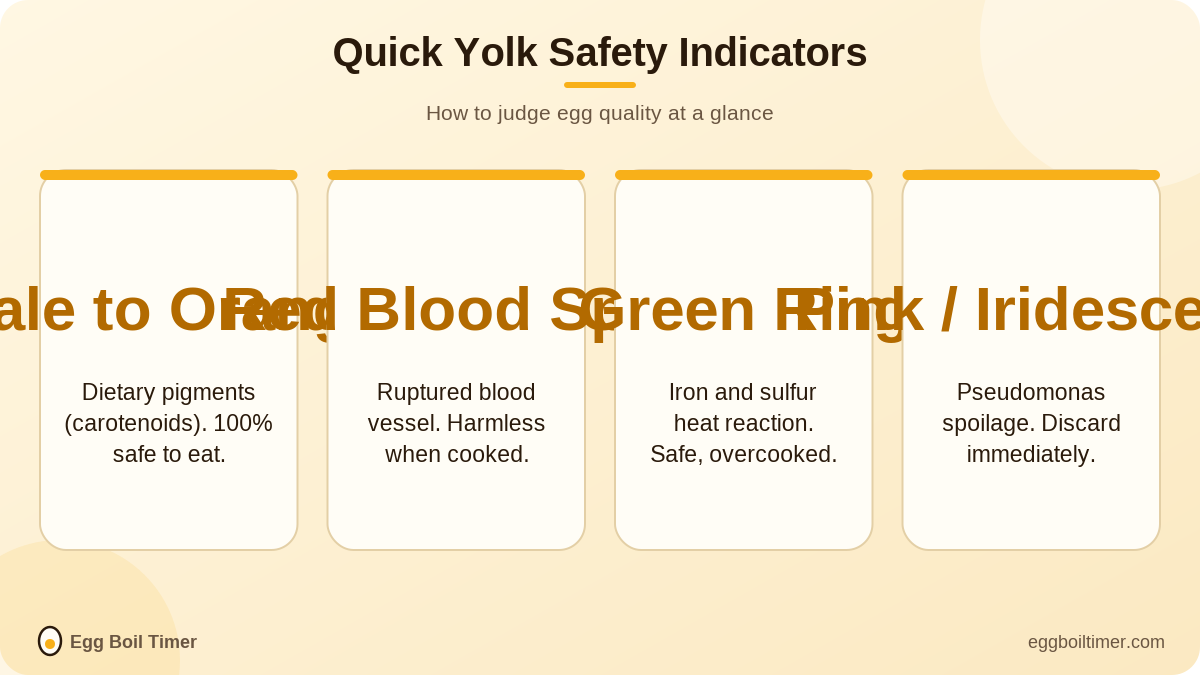
| Red spot on yolk surface | Ruptured blood vessel during ovulation | Safe | Remove spot with spoon tip; cook. |
| Brown meat spot fragment | Oviduct tissue shed during shell casing | Safe | Scrape off or cook thoroughly. |
| Greenish-gray outer layer | Ferrous sulfide heat reaction | Safe | Eat as is; reduce boiling duration. |
| Pink or iridescent white | Pseudomonas fluorescens bacterial growth | Spoiled | Discard egg immediately. |
| Black yolk or green raw white | Advanced bacterial decomposition | Spoiled | Discard egg without tasting. |
Pathogenic spoilage causes noticeable structural breakdowns. Pseudomonas bacteria synthesize pyoverdine, a fluorescent pigment that makes raw egg whites shimmer with a pink, green, or pearlescent sheen under direct light. Discard affected eggs without hesitation. Anaerobic bacteria also break down proteins into volatile hydrogen sulfide gas. If an egg emits a sharp rotten smell, throw it away regardless of shell appearance.

Evaluating Spoilage: What Watery Yolks and Odors Mean
Color provides only one indicator of egg quality. Physical yolk height and albumen viscosity indicate storage age and internal structural integrity.
Freshly laid eggs feature tall, domed yolks anchored securely by thick inner white and twisted protein strands called chalazae. You can review internal membrane structures in our guide to the What Is the Chalaza? Egg Anatomy, Freshness, and Cooking. As an egg sits in cold storage, carbon dioxide gas escapes through thousands of microscopic pores in the calcium carbonate shell. Internal pH rises from roughly 7.6 to over 9.2 across several weeks of refrigeration.
This alkaline environment weakens protein chains in the vitelline membrane enclosing the yolk. Water shifts from the albumen into the yolk core through osmosis, causing the yolk to flatten, spread out, and break easily when cracked. A flat yolk indicates an older egg, not a spoiled one. Conversely, a cloudy or milky egg white signals high residual carbon dioxide, proving the egg was laid recently. Check precise doneness charts on our Egg Boil Timer page to match cooking times with egg age.
Ferrous Sulfide Formation: The Chemistry of Green-Ringed Yolks
Hard-boiled eggs frequently exhibit a dark greenish-gray border where the yolk meets the firm white. This discoloration startles home cooks, but it stems from simple heat chemistry rather than spoilage.
Extended heating triggers the reaction. When cooking temperatures exceed 70 °C (158 °F), sulfur-containing amino acids such as cysteine in the egg white break down and release hydrogen sulfide gas. This gas migrates inward toward the cooler yolk core. There, hydrogen sulfide meets iron molecules bound to yolk phosvitin proteins, generating ferrous sulfide (FeS) along the outer yolk surface.
High cooking temperatures, prolonged boiling, and alkaline water accelerate ferrous sulfide formation. The resulting gray-green coat is harmless and safe to eat. Plunging cooked eggs into an ice water bath immediately after boiling lowers internal pressure, stops gas migration, and preserves clear golden yolk surfaces. To prevent dark borders entirely, follow our detailed timing guide for The Green Ring on Your Hard-Boiled Eggs Is Telling You Something. You can also explore underlying protein shifts in our breakdown of Egg Science: Biology, Chemistry, and Physics of Culinary Eggs.
How Poultry Diet Formulations Shift Pigment Intensity
Commercial egg producers adjust hen diets to align with regional consumer preferences. European shoppers typically select dark amber yolks, whereas North American markets accept pale to medium yellow tones. Farmer feed choices respond directly to these market demands.
Egg processors evaluate yolk shade using standardized color fan scales numbered from 1 to 15. Adding 10 to 20 grams of marigold petal meal per ton of feed increases yolk color scores by several points within 7 to 10 days of feeding. Small additions of paprika extract introduce redder tones for specialized culinary markets.
Free-range hens foraging outdoors consume wild grass, clover, and insects rich in natural xanthophylls. Their yolk shades fluctuate with seasonal vegetation growth. Spring pastures yield dark golden yolks, while winter forage results in lighter tones. Regardless of farming style, yolk color reflects feed choices rather than bacterial safety. Reading our guide on How Are Eggs Made? Inside the Hen's 25-Hour Cycle details how laying hens convert feed nutrients into complete shell eggs.


