Specialty producers and local farms sell double-yolk eggs in dedicated cartons, but finding them in stores requires knowing how commercial graders handle oversized shells. If you want to buy double yolk egg cartons, specialty poultry brands sell hand-sorted dozens, while commercial packing plants route most double-yolk specimens into jumbo or super jumbo packaging. Double-yolk eggs are completely safe to eat, offering rich yolk volume and extra emulsifying power for fried, scrambled, or poached dishes.
Hormonal Surges and Shell Formation in Young Hens
A double-yolk egg forms when a hen's ovary releases two yolks into the oviduct within 30 minutes of each other. The reproductive tract encapsulates both yolks inside a single shell membrane, surrounding them with albumen before depositing calcium carbonate. This synchronized double ovulation happens mainly in young pullets entering their initial laying cycle, as their hormonal rhythms take several weeks to stabilize.
In commercial egg production, double yolks occur in approximately 1 out of every 1,000 eggs. Because young hens in commercial flocks reach laying age in synchronized batches, farms experience localized, temporary spikes where twin yolks appear frequently. Other poultry species show similar reproductive patterns, such as waterfowl laying oversized How to Boil Duck Eggs: Precise Times, Peeling, and Safety">duck eggs or game birds laying double-yolk How to Boil Quail Eggs for Runny, Jammy, or Firm Yolks">quail eggs. Inside the shell gland, both yolks receive identical protein layers and protective bloom coatings.
Backyard chicken owners routinely find twin yolks in nesting boxes during spring, but commercial packing plants separate them using automated sorting equipment. High-speed cameras and precision weigh scales detect physical shell dimensions, steering abnormally large eggs away from standard medium and large cartons toward specialized processing lines.
Older hens near the end of their laying lifecycle also produce occasional double yolks due to erratic hormonal signals. However, pullet eggs remain the primary commercial source because young flocks produce dense shells capable of holding the increased internal pressure without cracking during transport.
Commercial Sorting, Weight Categories, and Buying Options
Finding double-yolk eggs intentionally relies on understanding how commercial grading operates. Automated light sensors pass strong beams through passing shells during a process known as candling, projecting dark dual shadows when two yolks float in the albumen. Dedicated producers like Sauder's Eggs package these candled eggs into specifically labeled double-yolk cartons for regional grocery stores.
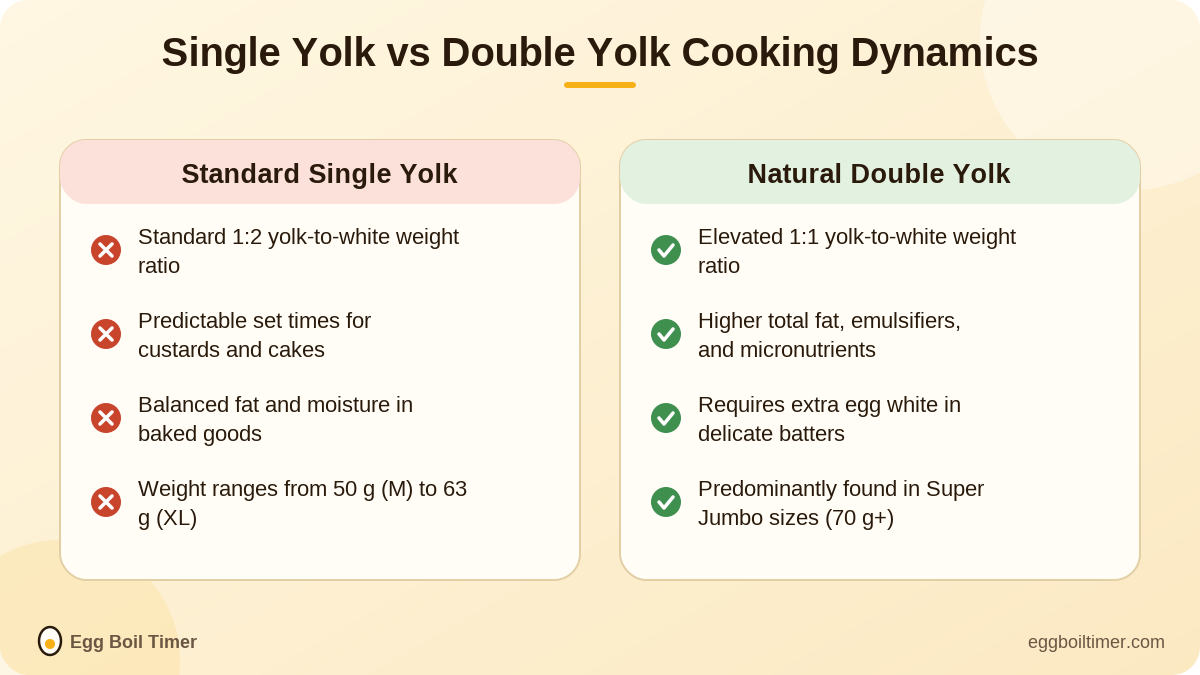
When labeled cartons are unavailable, purchasing the heaviest weight class in the dairy aisle offers the highest probability of finding twin yolks. Super Jumbo eggs weigh at least 70 grams per shell. A single yolk rarely generates enough body to fill a shell of that scale, meaning super jumbo cartons frequently contain multiple double-yolk specimens.
| Shopping Objective | Primary Source | Selection Strategy | Yolk Probability |
|---|---|---|---|
| Guaranteed Twin Yolks | Specialty Poultry Brands | Purchase cartons explicitly labeled "Double Yolk" | 95% to 100% |
| High Probable Odds | Supermarket Dairy Case | Select Super Jumbo or Jumbo brown/white cartons | 50% to 75% |
| Seasonal Surges | Local Farm Stands | Buy un-graded eggs from new pullet flocks in spring | 20% to 40% |
| Casual Discovery | Standard Retail Cartons | Choose Extra Large Brown or White: Does the Colour of the Shell Change the Boiling Time?">white eggs or brown eggs | Less than 1% |
At local farm stands lacking automated optical sorters, shell shape serves as a reliable visual indicator. Double-yolk shells are visibly elongated rather than oval, often featuring a pronounced cylindrical midpoint or asymmetrical point. Physical weight also provides an immediate sign: an egg that feels distinctly heavy relative to its neighbors in a dozen almost certainly contains twin yolks.
Buying directly from pasture-raised farms during early spring increases your odds even further. As young pullets begin laying outdoor forage diets, whole farm batches produce twin yolks across several consecutive weeks before settling into standard single-yolk cycles.

Culinary Ratios: Adjusting Yolks and Whites in Precision Cooking
For basic pan cooking like frying, scrambling, or French omelettes, double-yolk eggs require no special handling. The extra yolk adds emulsifying fats, deep yellow pigmentation, and rich mouthfeel. Structural baking is far less forgiving: angel food cakes, soufflés, and meringues require precise volumetric balance between fluid albumen protein and yolk fat. Dropping a double-yolk egg directly into a structured cake batter disturbs that liquid balance.
A standard large egg yields roughly 33 grams of liquid white and 17 grams of yolk, establishing a 2:1 white-to-yolk ratio. A double-yolk egg weighing 70 grams total contains two 15-gram yolks but only 38 to 40 grams of white. This shifts the ratio closer to 1.3:1, doubling the lipid content while leaving insufficient albumin to build a stable protein matrix.
To prevent baked goods from turning out dense, greasy, or flat, apply these kitchen adjustments:
- Measure by scale weight: Crack double-yolk eggs into a bowl on a digital kitchen scale. Use 50 grams of mixed liquid egg for every large egg specified in your recipe formula.
- Supplement pure albumen: Add 1 tablespoon (15 ml) of liquid egg white for every double-yolk egg used in delicate batters like sponge cakes or chiffons.
- Reserve for fat-heavy preparations: Direct twin yolks into homemade pasta dough, brioche dough, custard bases, or mayonnaise, where extra yolk fat directly improves texture.
In sauce making, twin yolks double the concentration of natural lecithin. Hollandaise and béarnaise sauces emulsify faster and hold higher butter ratios without breaking when constructed with double-yolk bases.

Boiling Times, Heat Transfer, and Yolk Coagulation
Boiling double-yolk eggs requires modifying standard cook timers because the increased total mass retards heat transfer to the innermost yolk core. Thermal conduction through an extra-large shell takes longer, meaning standard medium-boiled timing leaves the center yolk cold while the outer whites overcook.
When cooking double-yolk eggs in boiling water, calculate time based on total shell weight rather than yolk count alone. A 70-gram double-yolk egg requires approximately 7 minutes for runny yolks and 11 minutes for hard-boiled firmness when lowered into rolling water straight from the refrigerator. Using our Egg Boil Timer">egg boil timer with the weight set to XL or XXL gives precise timing adjustments for larger shell volumes.
Steaming offers a more forgiving medium for double yolks than boiling water. Steam transfers heat evenly across elongated shells, reducing thermal shock and preventing shell fracture near the enlarged air cell. Shocking double-yolk eggs in ice water for 5 full minutes after cooking halts internal carryover heat, keeping the double yolk cores uniformly jammy.
Peeling boiled double-yolk eggs reveals an oval, indented interior geometry where the two yolks sit side-by-side. Slicing them lengthwise across the wide axis produces distinct twin circles, making them popular for decorative deviled egg platters and ramen bowls.
Nutritional Density, Food Safety Standards, and Folklore
Double-yolk eggs present no distinct food safety risks. The internal environment of an intact double shell remains completely sterile prior to cracking. Food safety authorities recommend standard handling practices: cook until yolks and whites solidify, or use Pasteurized Eggs: Safety, Pasteurization Temp, and Cooking Uses">pasteurized eggs when preparing soft custards or unheated emulsions.
Nutritiously, twin yolks condense high micronutrient density into a single shell. One average egg yolk delivers roughly 40 IU of vitamin D, while whole cooked Chicken Eggs: Anatomy, Formation, Nutrition, and Cooking">chicken eggs supply 10 mcg of biotin alongside essential choline. A single large egg white contains 3.6 grams of pure protein. Consuming a double yolk doubles the intake of fat-soluble vitamins A, D, E, and lutein while adding zero dietary carbohydrates.
Historical folklore across Europe and Asia associated double-yolk eggs with good fortune and family fertility. Traditional English superstition held that opening a twin yolk foretold an upcoming wedding or twin pregnancy in the household. In agricultural regions, discovering multiple double yolks in a single basket signaled an abundant spring harvest and healthy livestock.
From an avian biology perspective, double-yolk eggs rarely result in live twin chicks. The fixed volume of oxygen inside the shell's air cell cannot support two developing embryos through incubation. In almost all natural cases, space constraints prevent both chicks from maneuvering into position for hatching, making twin births among chickens an exceptional anomaly.


