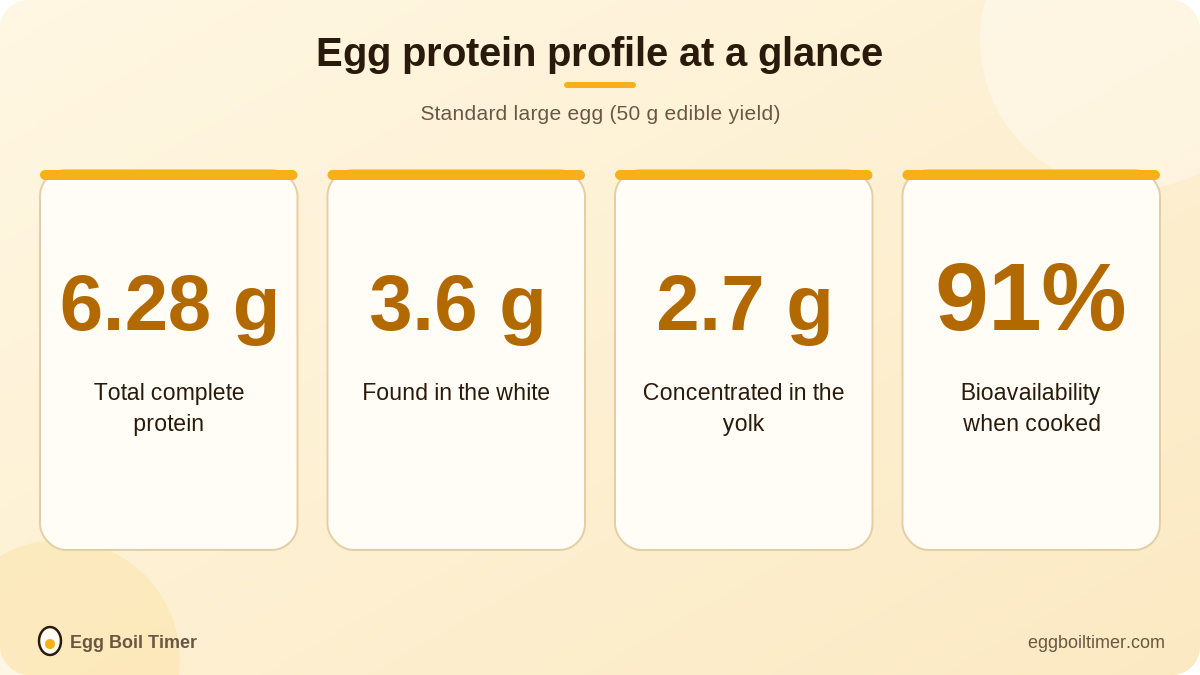
A standard large egg delivers 6.28 grams of protein containing every essential amino acid required for human tissue repair. Roughly 3.6 grams sit in the albumen while the yolk supplies 2.7 grams. Cooking transforms this protein network, raising digestive absorption from barely half in raw form to more than 90 percent.
Protein Distribution Across Commercial Egg Sizes
Egg protein scales directly with total weight, but the split between albumen and yolk remains remarkably steady. The white provides volume and clean protein dissolved in water. The yolk packs denser protein bound tightly alongside essential fatty acids, vitamins, and minerals. Skipping the yolk discards over 40 percent of the total amino acid package.
| Size Class | Edible Weight | White Protein | Yolk Protein | Total Protein. |
|---|---|---|---|---|
| Small (S) | 38 g | 2.7 g | 2.1 g | 4.8 g. |
| Medium (M) | 44 g | 3.2 g | 2.4 g | 5.5 g. |
| Large (L) | 50 g | 3.6 g | 2.7 g | 6.3 g. |
| Extra Large (XL) | 56 g | 4.0 g | 3.0 g | 7.0 g. |
| Jumbo (XXL) | 63 g | 4.5 g | 3.4 g | 7.9 g. |
Purchasing cartons labeled medium or large means adjusting kitchen counts when tracking strict macronutrients. Three medium eggs yield 16.5 grams of protein, whereas three jumbo eggs deliver nearly 24 grams. Check the net weight on the carton if your fitness tracking demands precise intake numbers.
Commercial egg sizing grades whole unshelled eggs. The shell accounts for roughly 10 to 12 percent of total egg weight. A large egg weighing 57 grams in the carton yields roughly 50 grams of liquid white and yolk. Keep this shell deduction in mind when weighing cracked whole eggs directly into your mixing bowl.
The Molecular Architecture of Albumen and Yolk
The protein inside an egg consists of dozens of distinct functional globulins and phosphoproteins designed to protect and nourish an embryo. Understanding these fractions explains why egg whites whip into foam and set firm when heated.
Ovalbumin forms roughly 54 percent of total albumen protein. It provides peptide sequences that coagulate into a firm gel above 80 °C. Ovotransferrin contributes another 12 percent, binding metallic iron to starve potential microbial invaders in the shell. Lysozyme acts as an enzymatic barrier against bacteria, while ovomucin provides the thick, viscous cushion surrounding the yolk.
Ovomucoid represents about 11 percent of egg white protein. Unlike ovalbumin, ovomucoid resists heat coagulation and peptic digestion. It serves as the primary allergen in egg allergies affecting young children. Most pediatric egg sensitivities fade as digestive tracts mature, with the majority of children outgrowing the allergy by adolescence.
Yolk proteins exist mostly as lipovitellins and phosvitin. Phosvitin holds a dense concentration of phosphoserine, giving the yolk exceptional mineral-binding capacity. Because yolk proteins link intimately with neutral lipids and lecithin, they digest at a slower pace than liquid white proteins. This slower gastric emptying promotes extended satiety between meals.

Cooked Versus Raw: Heat and Digestive Availability
Swallowing raw eggs remains a persistent athletic trope, yet human intestines absorb only about 51 percent of raw egg protein. When exposed to heat, tightly coiled polypeptide chains unfold and denature. This structural opening allows digestive proteases like pepsin and trypsin to cleave peptide bonds rapidly, boosting true intestinal absorption to 91 percent.
Heat also neutralizes avidin, an albumen glycoprotein that binds dietary biotin firmly. Human digestive enzymes cannot break that bond apart in raw form. Consuming raw whites regularly risks secondary biotin deficiency over time. Denaturing avidin through boiling, steaming, or pan-frying takes less than two minutes at temperatures above 70 °C.
Raw eggs also introduce food safety risks from Salmonella enteritidis, an organism capable of infecting internal egg contents before shell formation. Cooking eggs until both whites and yolks reach food-safe internal temperatures destroys bacterial cells completely. Vulnerable populations, including young children, pregnant women, and older adults, should consume eggs cooked thoroughly.
Gentle heat preserves protein structure without oxidizing delicate yolk fats. Boiling eggs using our Egg Boil Timer interactive tools provides complete thermal denaturation without scorching surface curds or drying the yolk. Severe prolonged overcooking forms cross-linked lysinoalanine complexes and pushes sulfur into the yolk. Standard boiling times, however, leave amino acid integrity completely intact.

Quality Benchmarks: PDCAAS, Leucine, and Whole Food Value
Nutritionists evaluate protein quality using metrics that measure amino acid patterns against human physiological requirements. Eggs consistently score near the ceiling of standardized international nutritional benchmarks.
- Biological Value: Set at 100 as the reference standard, indicating that human tissue retains nearly all nitrogen absorbed from whole eggs.
- PDCAAS: The Protein Digestibility-Corrected Amino Acid Score awards whole eggs a perfect 1.0, reflecting full essential amino acid adequacy.
- DIAAS: Under the Digestible Indispensable Amino Acid Score system, whole cooked eggs score above 1.15, surpassing plant isolates and matching dairy proteins.
- Leucine Content: A single large egg delivers approximately 0.55 grams of leucine, the primary branched-chain amino acid triggering muscle protein synthesis.
A standard threshold of 2.5 to 3.0 grams of leucine per meal initiates muscle protein synthesis in active adults. Reaching that trigger solely through whole eggs requires eating four to five large eggs. Combining fewer eggs with leucine-rich dairy or lean poultry achieves that anabolic threshold with fewer total calories.
Eggs require roughly 72 calories per six grams of protein, making them less protein-dense per calorie than skinless chicken breast or whey isolate. You can explore these caloric trade-offs directly in our guide to Egg Calories: Exact Counts by Size, Component, and Cooking Style. While pure isolates deliver higher protein-to-calorie ratios, whole eggs provide dense micronutrients alongside their amino acids.
Comparing Eggs to Other Protein Staples
Assessing protein value requires looking beyond crude grams per serving. Satiety, preparation speed, micronutrient density, and cost per gram of bioavailable protein distinguish kitchen staples from one another.
| Protein Source | Protein | Energy | Protein / 100 kcal | Key Micronutrient Advantage. |
|---|---|---|---|---|
| Whole Cooked Egg | 12.6 g | 143 kcal | 8.8 g | Choline, Lutein, Vitamin B12. |
| Cooked Egg White | 10.9 g | 52 kcal | 21.0 g | Zero fat, Potassium, Riboflavin. |
| Chicken Breast (Roasted) | 31.0 g | 165 kcal | 18.8 g | Niacin, Phosphorus, Vitamin B6. |
| Low-Fat Greek Yogurt (2%) | 10.0 g | 73 kcal | 13.7 g | Calcium, Iodine, Probiotics. |
| Firm Tofu (Steamed) | 9.5 g | 83 kcal | 11.4 g | Iron, Calcium, Isoflavones. |
| Canned Tuna (in Water) | 26.0 g | 116 kcal | 22.4 g | Selenium, Omega-3, Niacin. |
| Brown Lentils (Boiled) | 9.0 g | 116 kcal | 7.8 g | Dietary Fiber, Folate, Iron. |
Canned tuna and skinless chicken breast offer higher protein concentration per 100 calories. However, whole eggs supply essential fat-soluble compounds absent from lean meats. Egg whites provide an ultra-lean protein vehicle with virtually zero fat and carbohydrates, matching the caloric efficiency of commercial protein isolates.
The culinary versatility of eggs also sets them apart. Scrambling two eggs takes barely three minutes in a warm pan. Preparing lentils requires pre-soaking and simmering, while raw meats demand careful food safety sanitation. For rapid recovery meals, eggs bridge convenience and biological completeness better than most alternatives.
Matching Egg Portions to Daily Protein Targets
The standard baseline Recommended Dietary Allowance sits at 0.8 grams of protein per kilogram of body weight for sedentary adults. A 70 kg individual requires approximately 56 grams of protein daily simply to prevent deficiency. Active adults, strength athletes, and older populations aiming to preserve lean mass need between 1.2 and 2.0 grams per kilogram.
Hitting specific per-meal targets works best by treating eggs as a protein anchor and adding complementary whole foods:
- If your target is 20 grams: Cook two large eggs (12.6 g) and serve them with one slice of whole grain toast (4 g) and 30 grams of sharp cheddar (7 g).
- If your target is 30 grams: Scramble three large eggs (18.9 g) alongside 100 grams of simmered black beans (9 g) and 30 grams of crumbled feta cheese (4.2 g).
- If your target is 40 grams: Whisk two whole eggs with 100 grams of liquid whites (23 g) and plate them with 100 grams of smoked salmon (18 g).
- If your target is 50 grams: Combine three large eggs (18.9 g) with 150 grams of low-fat cottage cheese (18 g) and two slices of dense rye toast (8 g).
Relying exclusively on whole eggs to reach 150 grams of protein would require consuming roughly 24 eggs each day. That volume delivers over 1,700 calories and substantial dietary fat. A balanced kitchen routine pairs two or three whole eggs with legumes, fermented dairy, or lean animal proteins.
A proven tactic for athletes seeking high protein without excessive fat involves the hybrid scramble. Whisk two whole eggs with 100 milliliters of carton egg whites. This combination delivers 23 grams of protein for only 190 calories, keeping the rich flavor of yolks while trimming saturated fat.
The Whole Egg Advantage in Muscle Recovery
Exercise science researchers have examined whether consuming whole eggs or separated whites produces superior muscle recovery following resistance training. Clinical trials measuring post-workout myofibrillar protein synthesis show that whole eggs stimulate muscle repair more effectively than equivalent protein consumed solely from egg whites.
This enhanced response occurs despite both test meals delivering identical amounts of essential amino acids and leucine. Researchers attribute this anabolic advantage to the nutrient-dense matrix of the yolk. Lipids, phosphatidic acid, vitamins, and minerals in the yolk appear to improve the efficiency with which muscle tissue uses circulating amino acids.
Rather than discarding the yolk during training phases, active individuals benefit from keeping at least one or two yolks on the plate. The lipid matrix supports cellular repair, hormone synthesis, and sustained nutrient delivery following strenuous physical exertion.
Micronutrients Packaged Inside the Yolk
Discarding the yolk to save calories forfeits nutrients that actively assist protein metabolism. One large yolk delivers 147 mg of choline, fulfilling a quarter of adult daily requirements. Choline supports structural cell membrane integrity, lipid transport, and neurotransmitter synthesis.
The yolk carries virtually all the fat-soluble vitamins. It delivers vitamin A for tissue repair, vitamin D for calcium balance, vitamin E for antioxidant defense, and vitamin K2 for arterial health. It also provides bioavailable lutein and zeaxanthin, carotenoids that concentrate in the retinal macula to protect against oxidative damage.
Public health dietary guidelines no longer set an arbitrary ceiling on dietary cholesterol for healthy individuals. Clinical trials indicate that saturated fat intake exerts a significantly greater impact on serum LDL cholesterol than dietary cholesterol from eggs. For healthy adults, eating one to two whole eggs daily fits comfortably within a balanced diet. Individuals diagnosed with familial hypercholesterolemia or type 2 diabetes should discuss personal limits with their physician. This is general information, not medical advice.
Formats and Farming: Protein Myths Dissected
Shoppers often pay premiums expecting superior protein from specialty cartons, but the underlying biology tells a simpler story.
Shell color indicates nothing about nutrient density. A white Leghorn hen deposits calcium carbonate without pigment. In contrast, a Rhode Island Red hen coats the shell in protoporphyrin during the final hours in the oviduct. Shell color does not change protein concentration or amino acid balance.
Pasture-raised, organic, and caged hens produce eggs with almost identical total protein. Foraging hens lay yolks richer in omega-3 fatty acids, vitamin E, and carotenoids due to insect and green forage intake. However, the amino acid structure of the albumen and vitelline remains constant across production methods.
Pasteurized liquid whites in cartons offer identical protein quantity to cracked shell whites. Pasteurization heats the liquid sufficiently to kill pathogens and deactivate avidin without setting the albumen into a solid. Pouring 100 ml of carton whites into a pan with two whole eggs boosts protein by 10 grams. This adjustment adds substantial volume without contributing extra fat.
Powdered whole eggs and dried egg albumen provide concentrated shelf-stable alternatives. When rehydrated properly with water, their amino acid profile matches fresh eggs gram for gram. They serve exceptionally well in baking and outdoor camping, though culinary texture differs from freshly cooked eggs.


