Egg yolks form the nutrient-dense central core of avian eggs, consisting of roughly 50% water, 30% fat, and 16% protein. In culinary applications, egg yolks supply rich flavor, bright yellow pigment, and natural lecithin. This lipid acts as an emulsifier that binds oil and liquid into stable sauces like mayonnaise and hollandaise.
Anatomy of the Yolk: Water, Lipids, and Lecithin
Two twisted protein strands called chalazae suspend the yolk in the center of the albumen. Enclosed by a thin vitelline membrane, the yolk functions as a natural fluid emulsion. Microscopic droplets of neutral fats, cholesterol, and fat-soluble vitamins float inside a water-based protein liquid.
Lecithin represents about 8% to 10% of total yolk lipids. A lecithin molecule features a hydrophilic water-seeking head and a lipophilic fat-seeking tail. This dual structure allows it to anchor at the boundary between oil and water droplets. Consequently, fat remains dispersed throughout a sauce instead of separating into an oily layer.
Proteins in the yolk consist mostly of lipovitellins and livetin complexes suspended in plasma. Low-density lipoproteins make up roughly 68% of the yolk solids. These structures give cooked yolks their dense, creamy texture when heated to moderate temperatures.
Yolk color depends on carotenoids present in poultry feed, primarily lutein and zeaxanthin. Hens fed yellow corn, alfalfa, or marigold petals lay eggs with deep golden or orange yolks. Feed ingredients determine pigment depth rather than protein count. Darker yolks carry slightly higher concentrations of dietary antioxidants.
Nutritional Density: Fats, Vitamins, and Micronutrients
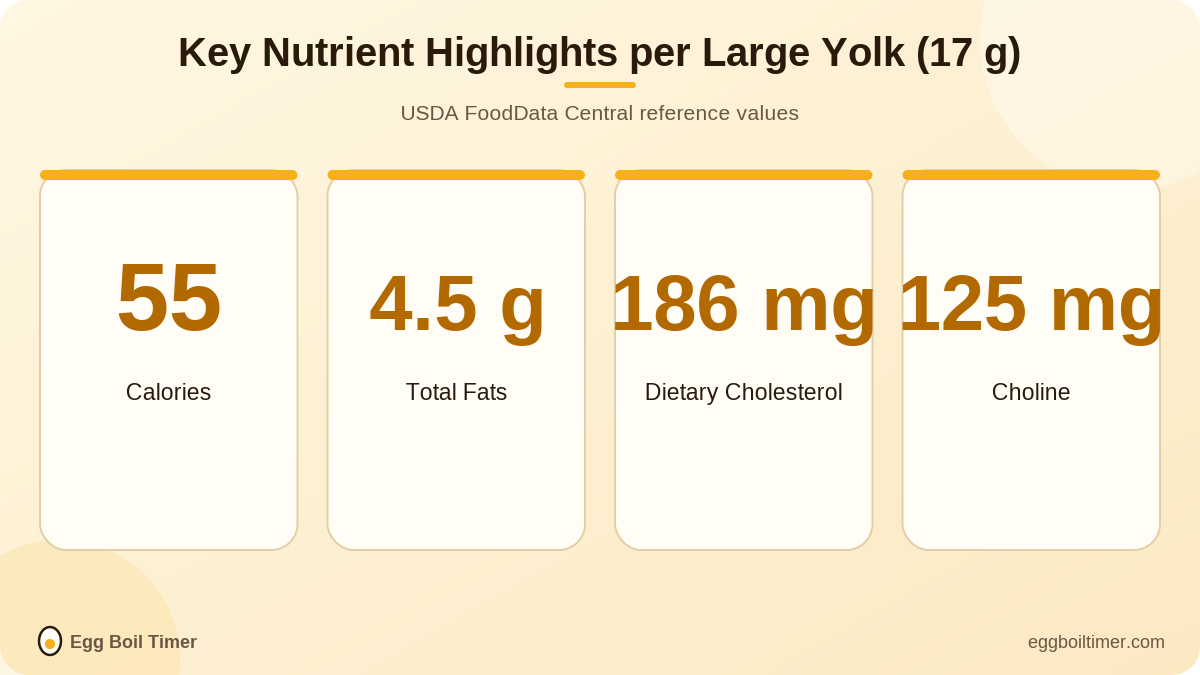
A single large egg yolk weighing 17 grams provides 55 calories, 4.5 grams of fat, and 2.7 grams of protein. While the egg white consists almost entirely of water and protein, the yolk stores virtually all of the egg's fatty acids, fat-soluble vitamins, and trace minerals.
- Fatty Acid Profile: The 4.5 grams of total fat include 1.6 grams of saturated fat, 2.0 grams of monounsaturated fat, and 0.7 grams of polyunsaturated fat.
- Dietary Cholesterol: One large yolk contains about 186 milligrams of cholesterol. Official research shows that dietary cholesterol has a minor impact on blood cholesterol for most healthy adults.
- Essential Choline: Delivering roughly 125 milligrams per large yolk, yolks rank among the concentrated food sources of choline. This essential nutrient supports brain development, liver function, and cellular membrane integrity.
- Fat-Soluble Vitamins: Yolks contain the egg's entire supply of vitamins A, D, E, and K. Consuming one yolk provides between 5% and 10% of the daily recommended intake for vitamins A and D.
- Enhanced Absorption: Healthy fats in the yolk improve the body's absorption of fat-soluble antioxidants like lutein. Phosphorus, iron, zinc, and selenium are bound to yolk proteins, making them easy for the digestive tract to process.

Yolk Versus White: Structural and Chemical Differences
Comparing the yolk to the egg white helps home cooks manage structure, richness, and moisture in recipes. Albumen whips into light, voluminous foams. Yolks add weight, tenderness, and moisture retention to batters.
| Nutritional Property. | Egg Yolk (17 g). | Egg White (33 g). |
|---|---|---|
| Energy Content. | 55 calories. | 17 calories. |
| Fat and Lipids. | 4.5 g. | 0.0 g. |
| Protein Density. | 2.7 g. | 3.6 g. |
| Primary Role in Cooking. | Tenderizing, emulsifying, coloring. | Structural aeration, leavening foam. |
| Thickening Temperature. | 65 °C to 70 °C (149 °F–158 °F). | 60 °C to 80 °C (140 °F–176 °F). |
Yolk proteins begin thickening at 65 °C (149 °F) and set firm at 70 °C (158 °F). By contrast, egg white proteins set in stages between 60 °C and 80 °C. When boiling whole eggs, setting the yolk to a jammy texture takes 7 minutes for a large cold egg in boiling water. Precision timing using our Egg Boil Timer calculator ensures consistent results across different egg sizes.
Yolk fats coat structural proteins and hinder them from binding into rigid networks. Even a tiny trace of yolk in a bowl of albumen ruins its ability to whip into stable peaks. When a recipe calls for pure aeration without added fats, separate the eggs cleanly following the techniques in our guide to Flax Egg White Guide: Ratios, Baking Uses, and Whipping Limits.

Emulsification, Heat Sensitivity, and Richness in Sauces and Bakes
Two functional behaviors make egg yolks indispensable in cooking: emulsification and heat-driven coagulation. In cold emulsified sauces like mayonnaise, yolks hold vegetable oil suspended within an acid base. Drizzling oil slowly into raw or pasteurized yolks divides the fat into tiny droplets. Lecithin coats these droplets, preventing them from coalescing into a greasy layer. One large yolk can emulsify up to 180 ml of oil when added gradually.
Warm emulsion sauces like hollandaise demand precise heat control alongside steady whisking. As the sauce reaches 65 °C (149 °F), yolk proteins unfold into a delicate mesh that traps butter fat and liquid. Pushing the pan past 85 °C (185 °F) forces those proteins to contract tightly. This squeezes out liquid and transforms a silky sauce into scrambled curds.
In sweet recipes like pastry cream and rich baked Custard Recipe and Science: Perfecting Egg-Thickened Creams, sugar and starch insulate yolk proteins from rapid heat spikes. This raises their curdling threshold above 85 °C. Rich doughs like brioche rely on yolk fats to coat flour proteins, which restricts gluten development so the crumb turns out soft and tender. Conversely, crisp baked items like French Mastering Meringue: French, Swiss, and Italian Techniques omit yolks entirely to build crisp, airy protein structures.
Freezing raw yolks requires special preparation due to gelation. Without added ingredients, freezing causes yolk lipoproteins to aggregate into a thick, rubbery gel that cannot mix smoothly into batters. Whisking 1.5 grams of salt or 5 grams of sugar into four raw yolks before freezing prevents protein aggregation and preserves liquid texture after thawing.
Freshness Indicators and Handling Risks
During extended storage, the vitelline membrane surrounding the yolk absorbs water from the albumen. This process stretches the membrane wall and weakens its structural strength. As a result, older yolks flatten and break easily when cracked.
- Fresh Yolk: Stands tall and round in the center of thick egg white. The vitelline membrane feels taut and resists rupturing under light pressure.
- Older Stale Yolk: Sits flat and spreads quickly across the pan. The vitelline membrane tears easily against sharp shell edges during separation.
- Spoiled Yolk: Displays a mottled or off-color surface, emits a distinct sulfur odor, or leaks fluid into watery albumen. Discard these eggs immediately.
Raw eggs carry a risk of Salmonella enteritidis contamination. Cooking yolks until firm or purchasing commercially pasteurized eggs protects vulnerable individuals. This includes young children, pregnant women, older adults, and anyone with a compromised immune system. This article provides culinary information and does not substitute for medical advice.
Kitchen Troubleshooting Matrix
Cooking with egg yolks requires moderate heat control, controlled whisking speeds, and balanced fat ratios. Refer to this decision table to diagnose and correct common culinary problems.
| Symptom or Problem. | Primary Cause. | Corrective Technique. |
|---|---|---|
| Yolk breaks during shell separation. | Warm egg temperature or sharp shell contact. | Separate eggs cold straight from the refrigerator. Use clean hands rather than sharp shell edges. |
| Hollandaise or mayonnaise splits into oil. | Oil added too quickly or pan temperature exceeded 80 °C. | Whisk 1 teaspoon of warm water into a fresh raw yolk. Slowly trickle the broken sauce into it while whisking. |
| Custard turns grainy and curdled. | Yolk proteins overcooked and tightened past 82 °C. | Remove pan from heat immediately. Pour the mixture through a fine-mesh sieve and whisk over an ice bath. |
| Boiled egg yolk has a green-gray ring. | Iron in yolk reacted with sulfur in white from heat. | Transfer cooked eggs immediately to an ice water bath after boiling. Time your boiling precisely using our Egg Boil Timer timing calculator. |


