A classic pavlova uses 4 large egg whites (120 grams) and 220 grams of superfine sugar. Bake the base with vinegar and cornstarch at 120 °C (250 °F) for 90 minutes, then let it cool inside the closed oven for two hours. Unlike a standard dry Mastering Meringue: French, Swiss, and Italian Techniques, pavlova retains internal moisture to form a plush marshmallow core beneath a crisp shell.
Understanding the Dual Texture of Classic Pavlova
Named after Russian ballerina Anna Pavlova, this dessert balances a brittle exterior with a soft, pillowy center. Dry meringues bake slowly at low heat until all liquid evaporates, yielding a uniform crunch throughout. In contrast, pavlova traps bound water inside its matrix. The outer crust dries under gentle oven heat, creating a thin protective shield while the interior gelatinizes.
Whipping raw Flax Egg White Guide: Ratios, Baking Uses, and Whipping Limits uncoils their native proteins, allowing ovalbumin and globulins to trap air bubbles. As beaters move through the liquid, albumens form a continuous foam network. Dissolved sugar coats the bubble walls, increasing viscosity and preventing air pockets from popping before heat sets the protein structure. Controlling this balance keeps the foam intact throughout baking.
How Sugar, Acid, and Cornstarch Control Moisture
Every added ingredient alters the foam chemistry and dictates final texture. Deviating from precise ratios alters how proteins set under heat.
- Superfine (caster) sugar: Granules measuring under 0.3 mm dissolve quickly in liquid whites. Granulated table sugar dissolves too slowly, leaving undissolved crystals that melt in the oven and bleed syrup through the crust.
- Room-temperature egg whites: Whites kept at 20 °C have lower surface tension than fridge-cold whites at 4 °C. Room-temperature proteins stretch easily during whisking, expanding into a stable foam with higher final volume.
- White vinegar or lemon juice: Introducing 5 ml of mild acid lowers the pH of the mixture to roughly 4.8. This acidity prevents ovalbumin from bonding too tightly and squeezing out water, keeping the interior soft. Alternatively, 0.5 tsp of cream of tartar achieves the same stabilization.
- Cornstarch: Starch granules swell at 65 °C, absorbing free water within the foam. This starch gel stabilizes the core and prevents liquid from pooling on the parchment during cooling.
- Vanilla extract: Pure vanilla adds aroma without introducing fats. Even a fraction of a gram of oil from unwashed beaters or stray yolk breaks the protein matrix and prevents stiff peaks.

Precision Recipe and Step-by-Step Baking Method
Cleanliness is critical for meringue success. Wipe your glass or stainless steel mixing bowl and whisk attachments with a paper towel dampened with lemon juice or vinegar to remove residual fat before cracking eggs.
Ingredients
- 4 large egg whites (120 g total, from 60 g whole eggs), cleanly separated at room temperature.
- 220 g (1 cup) superfine caster sugar.
- 1 tsp (5 ml) white distilled vinegar (or 0.5 tsp cream of tartar).
- 1 tsp (3 g) cornstarch.
- 1 tsp (5 ml) pure vanilla extract.
- 300 ml heavy whipping cream (35% to 40% milk fat), chilled.
- 200 g fresh passionfruit pulp, sliced kiwi, and fresh raspberries.
Step-by-Step Process
- Prepare oven and tray: Set an oven rack in the lower third position. Preheat to 120 °C (250 °F). Line a rimless baking sheet with parchment paper. Trace a 20 cm circle on the underside with a pencil as an outline guide.
- Whip whites to soft peaks: Add room-temperature whites to the cleaned bowl. Whisk on medium speed for 2 to 3 minutes until white foam forms and soft peaks bend over when the beaters lift.
- Incorporate sugar slowly: Increase speed to medium-high. Add superfine sugar one tablespoon (15 g) at a time, beating for 20 seconds between additions. Continue until the meringue becomes glossy, stiff, and completely smooth without gritty sugar feel when rubbed between thumb and forefinger.
- Fold in starch and acid: Sprinkle cornstarch, white vinegar, and vanilla extract across the top. Using a flexible silicone spatula, fold four to five times from the bottom up until evenly incorporated without deflating the structure.
- Shape the disc: Spoon the meringue onto the parchment paper circle. Use an offset spatula to smooth the sides upward, creating vertical walls and a slight indent in the top center. Tall walls help hold the soft marshmallow core intact during expansion.
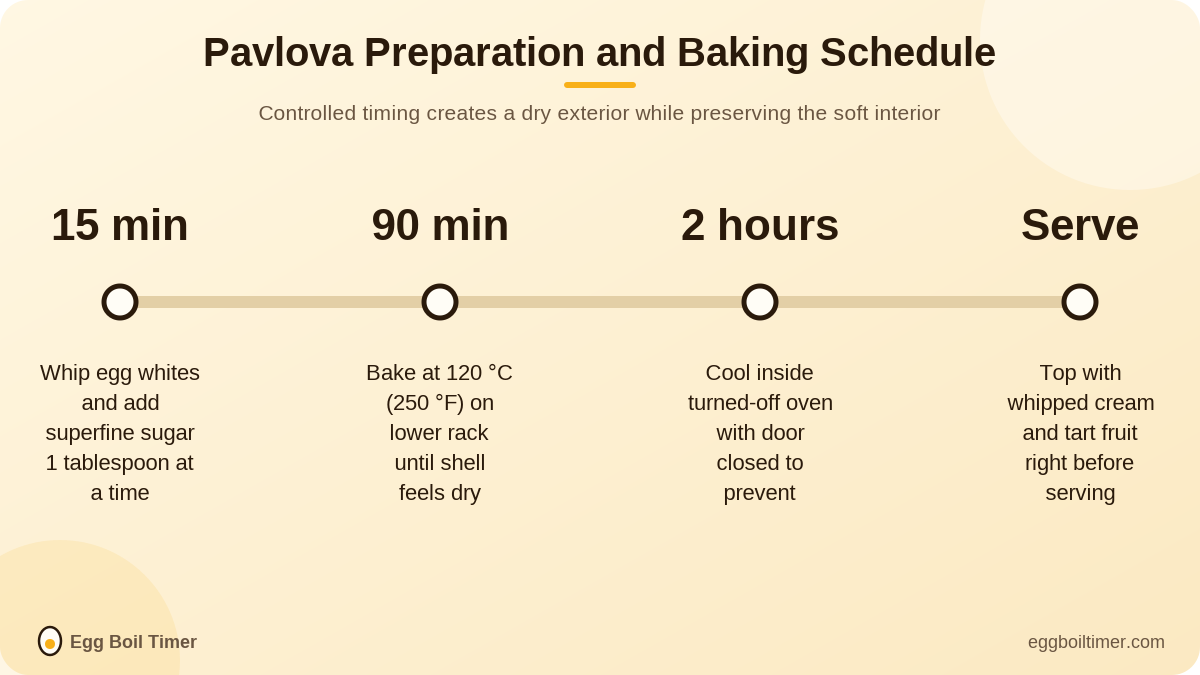
- Bake at low heat: Place the tray in the preheated oven immediately. Bake undisturbed at 120 °C (250 °F) for 90 minutes. Keep the oven door closed to maintain steady air temperature.
- Cool gradually inside oven: Turn off the heat after 90 minutes. Leave the door fully closed for at least 2 hours, or overnight. Slow cooling allows the air inside trapped pockets to adjust pressure gradually, preventing shell collapse.

Troubleshooting Table: Solutions for Cracks and Weeping
Baking meringue demands precise control over oven temperature and moisture levels. The diagnostic matrix below breaks down structural defects, their physical causes, and corrective actions.
| Symptom | Main Cause | What Happens | Action |
|---|---|---|---|
| Syrup Leaking (Weeping) | Undissolved sugar granules | Unmelted sugar draws moisture out of the foam during baking, forming liquid beads. | Add sugar 1 tbsp at a time, whisking until fully dissolved and smooth. |
| Deep Center Collapse | Thermal shock or early door opening | Hot air pockets shrink faster than the set protein walls can support. | Keep oven door completely closed during the 2-hour cooling phase. |
| Shell Cracking | Oven running too hot | Outer shell sets firmly before the wet interior finishes expanding. | Verify oven temp with an internal thermometer; maintain strictly 120 °C. |
| Sticky or Soft Crust | High room humidity after cooling | Sugar absorbs environmental water vapor directly from ambient air. | Transfer cooled base immediately into an airtight container. |
| Rubbery Core | Omission of acid or cornstarch | Egg proteins over-coagulate without acid, squeezing out interior water. | Always include exact quantities of vinegar and cornstarch. |
| Browned Exterior | Hot spots or excessive oven heat | Sugar undergoes caramelization above 130 °C. | Bake on lower oven rack and reduce setting to 110 °C if using convection. |
When you have leftover egg yolks after separating your whites, turn them into a rich, silky Custard Recipe and Science: Perfecting Egg-Thickened Creams, an authentic baked Classic Flan: Caramel, Custard Ratios, and Water Bath Baking, or a classic burnt-sugar Classic Crème Brûlée: The Science of Silky Custard. For precise kitchen timing on all stove and oven tasks, use the timer models available on our Egg Boil Timer page.
Choosing Fruit and Cream to Balance Sugar
Meringue contains substantial sugar to build its structural walls. To balance this inherent sweetness, select toppings high in fat and natural acid. Unsweetened heavy cream whipped to soft peaks provides a rich cushion that softens the top crust slightly right before serving.
Tart, acidic fruits complement the sugary base best. Passionfruit pulp offers sharp acidity and pleasant crunch. Fresh raspberries, blackberries, sliced kiwi, and sour cherries cut through sweet marshmallow notes. Avoid canned fruits packed in syrup or frozen berries that drop excess water as they thaw. Running juice dissolves the delicate outer crust.
Assemble the dessert within 30 minutes of serving. Heavy cream gradually transfers moisture into the dry meringue shell. If allowed to sit topped for several hours, the crisp outer walls absorb liquid and lose their crunch.
Managing Humidity and Preparing Meringue Bases Ahead
High atmospheric humidity presents a major challenge for meringue. Sugar is naturally hygroscopic, drawing moisture straight from humid air. When relative humidity exceeds 65%, a cooling pavlova shell pulls moisture into its crust, converting a crisp exterior into a sticky surface within hours.
If baking in a humid climate, keep the pavlova inside the closed, turned-off oven overnight. Once cold, transfer the plain shell into an airtight plastic container at room temperature. Never refrigerate an un-topped meringue base. Cold refrigerator air holds high humidity that softens the crust instantly.
You can bake the plain pavlova shell up to two days before your event. Store it sealed in a cool, dry pantry until ready to assemble. If the exterior absorbs moisture and softens slightly during storage, warm the plain base in a 100 °C (210 °F) oven for 15 minutes, then cool completely before adding cream and fruit.


